On this page
- Part 1: Legal Authority and Reasons for the Order
- Part 2: Definitions
- Part 3: Summary of Events Leading to the Issuance of the Order
- Part 4: Work Ordered
- Part 5: General Requirements
- Part 6: Hearing Before the Environmental Review Tribunal
- Appendix A: Technical Memorandum Re: Surface Water/Sediment Results in 2016 Annual Report
- Appendix B: Technical Memorandum Re: Groundwater Monitoring Results in 2016 Annual Report
- Appendix C: Technical Memorandum Re: 2016 Soil Vapour Monitoring Report
- Appendix D: Technical Memorandum Re: the Groundwater Extraction and Treatment Annual Report, Monitoring Program Summary Document, including Groundwater Extraction and Treatment System Operation
- Appendix E: Monitoring Program Summary (20181207)
- Appendix F: Certificate of Requirement
- Appendix G: Certificate of Requirement
- Appendix H: Certificate of Requirement
- Appendix I: Certificate of Requirement
- Licence
Source: AECOM_2024_PCB-Monitoring-Report-for-Storm-and-Groundwater_20250228, pp. 78-138.
Director’s Order
Environmental Protection Act, R.S.O. 1990, c.E 19 (EPA)
Ontario Water Resources Act, R.S.O. 1990, c. O. 40 (OWRA)
Pesticides Act, R.S.O. 1990, c. P11 (PA)
Safe Drinking Water Act, $.O. 2002, c.32 (SDWA)
Nutrient Management Act, 2002, S.O. 2002, c.4 (NMA)
Order Number: GE-PTBO-DO001FA
To: General Electric Canada Company, Suite 900, 1959 Upper Water St, Halifax, Nova Scotia, B3J 3N2, Canada
Attn: Heather Chalmers, Chairman of the Board, President and CEO
And
General Electric Canada Property Inc., 2300 Meadowvale Blvd, Mississauga, Ontario LSN 5P9
Attn: Manjit Sharma, Director
Site: 107 Park Street, Peterborough, ON
And
1063 Monaghan Road, Peterborough, ON
And
297 Rink Street, Peterborough, ON
And
107 Rubidge Street, Peterborough, ON
Part 1: Legal Authority and Reasons for the Order
1.1 Legislative Authority
- 1.1.1 Pursuant to subsection | (1) of the Environmental Protection Act, R.S.O. 1990, c. E.19, as amended (“EPA”), “contaminant” means any solid, liquid, gas, odour, heat, sound, vibration, radiation or combination of any of them resulting directly or indirectly from human activities that causes or may cause an adverse effect.
- 1.1.2 Pursuant to subsection | (1) of the EPA the meaning of “discharge”, when used as a verb, includes add, deposit, leak or emit and, when used as a noun, includes addition, deposit, emission or leak.
- 1.1.3 Pursuant to subsection 1(1) of the EPA “adverse effect” means one or more of,
- impairment of the quality of the natural environment for any use that can be made of it,
- injury or damage to property or to plant or animal life,
- harm or material discomfort to any person,
- an adverse effect on the health of any person,
- impairment of the safety of any person,
- rendering any property or plant or animal life unfit for human use,
- loss of enjoyment of normal use of property, and
- interference with the normal conduct of business.
- 1.1.4 Pursuant to subsection 1(1) of the EPA “natural environment” means the air, land and water, or any combination or part thereof, of the Province of Ontario.
- Subsection 18(1) of the EPA reads as follows:
The Director, in the circumstances mentioned in subsection (2), by a written order may require a person who owns or owned or who has or had management or control of an undertaking or property to do any one of more of the following:
-
- To have available at all times, or during such periods of time as are specified in the order, the equipment, material and personnel specified in the order at the locations specified in the order.
- To obtain, construct and install or modify the devices, equipment and facilities specified in the order at the locations and in the manner specified in the order.
- To implement procedures specified in the order.
- To take all steps necessary so that procedures specified in the order will be implemented in the event that a contaminant is discharged into the natural environment from the undertaking or property.
- To monitor and record the presence or discharge of a contaminant specified in the order and to report thereon to the Director.
- To study and to report to the Director on,
- the presence or discharge of a contaminant specified in the order,
- the effects of the presence or discharge of a contaminant specified in the order,
- measures to control the presence or discharge of a contaminant into the natural environment,
- the natural environment into which a contaminant specified in the order may be discharged.
- To develop and implement plans to,
- reduce the amount of a contaminant that is discharged into the natural environment,
- prevent or reduce the risk of a spill of a pollutant within the meaning of Part X, or
- prevent, decrease or eliminate any adverse effects that result or may result from a spill of a pollutant within the meaning of Part X or from any other discharge of a contaminant into the natural environment, including,
- plans to notify the Ministry, other public authorities and members of the public who may be affected by a discharge, and
- plans to ensure that appropriate equipment, material and personnel are available to respond to a discharge.
- To amend a plan developed under paragraph 7 or section 91.1 in the manner specified in the order. R.S.O. 1990, c. E.19, s. 18 (1); 2005, ¢. 12, 5. 1 (8, 9).
- 1.1.6 Subsection 18(2) of the EPA provides that the Director may make an order under section 18(1) if the Director is of the opinion, on reasonable and probable grounds, that the requirements specified in the order are necessary or advisable so as,
- To prevent or reduce the risk of a discharge of a contaminant into the natural environment from the undertaking or property; or
- To prevent, decrease or eliminate an adverse effect that may result from, (i) the discharge of a contaminant from the undertaking, or
- the presence or discharge of a contaminant in, on or under the property.
- 1.1.7 Section 131 of the EPA defines “works” for the purposes of Part XII of the EPA as an activity, facility, thing, undertaking or site in respect of which an approval or order is issued or a registration under Part II.2 is in effect.
- Subsection 132(1) of the EPA reads as follows:
The Director may include in an approval or order in respect of a works a requirement that the person to whom the approval is issued or the order is directed provide financial assurance to the Crown in right of Ontario for any one or more of,
-
- the performance of any action specified in the approval or order;
- the provision of temporary or permanent alternate water supplies to replace those that the Director has reasonable and probable grounds to believe are or are likely to be contaminated or otherwise interfered with by the works to which the approval or order is related; and
- measures appropriate to prevent adverse effects upon and following the cessation or closing of the works.
- 1.1.9 Subsection 196(1) of the EPA reads as follows:
The authority to make an order under this Act includes the authority to require the person or body to whom the order is directed to take such intermediate action or such procedural steps or both as are related to the action required or prohibited by the order and as are specified in the order.
- 1.1.10 Subsection 197(1) of the EPA provides that a person who has authority under this Act to make an order or decision affecting real property also has authority to make an order requiring any person with an interest in the property, before dealing with the property in any way, to give a copy of the order or decision affecting the property to every person who will acquire an interest in the property as a result of the dealing.
- 1.1.11 Subsection 197(2) of the EPA provides that a certificate setting out a requirement imposed under subsection (1) may be registered in the proper land registry office on the title of the real property to which the requirement relates, if the certificate is ina form approved by the Minister, is signed or authorized by a person who has authority to make orders imposing requirements under subsection (1) and is accompanied by a registerable description of the property.
1.2 Details of the Orderees and the Site
- 1.2.1 The current registered owner of the four (4) properties located at:
- 107 Park Street,
- 1063 Monaghan Road,
- 297 Rink Street, and
- 107 Rubidge Street
in the City of Peterborough (the City), Ontario (herein referred to as Site 1, Site 2, Site 3 and Site 4 , respectively, or collectively as “the Site”) is General Electric Canada Property Inc. It has been the registered owner of the Site since 2004.
- 1.2.2 Canadian General Electric Corporation Limited (Ontario Corporation Number 000001701), General Electric Canada Inc. (Ontario Corporation Numbers 000576365 and 000875925) are all predecessor corporations of General Electric Canada Company (Ontario Corporation Number 001796028), the previous owner of the Site.
- 1.2.3 A portion of what is now Site | (107 Park Street) was purchased by Canadian General Electric Canada Limited (CGECL) in 1893. Subsequent portions of Site | were purchased by CGECL between 1905 and 1941. In 2004, CGECL changed its name to General Electric Canada Inc. In 2004, Site 1 was transferred to General Electric Canada Property Inc. (GECPI). GECPI is the current registered owner of Site 1. The Property Identification Number (PIN; used by land registry offices in Ontario to uniquely identify a property) for Site 1 is 28081-0123.
- 1.2.4 A portion of what is now Site 2 (1063 Monaghan Road) was purchased by CGECL in 1947. Other portions of what is now Site 2 were purchased by CGECL in 1952 and 1956. In 2004 there was a name change from CGECL to General Electric Canada Inc. In 2004, General Electric Canada Inc. transferred Site 2 to GECPI. GECPI is the current registered owner of Site 2. The PIN for Site 2 is 28067-0046.
- 1.2.5 Portions of what is now Site 3 (297 Rink Street) were purchased by CGECL in 1910 and 1911. In 2004 there was a name change from CGECL to General Electric Canada Inc. In 2004 General Electric Canada Inc. transferred Site 3 to GECPI. GECPI is the current registered owner of Site 3. The PIN for Site 3 is 28091-0139.
- 1.2.6 Portions of what is now Site 4 (107 Rubidge Street) were purchased by CGECL in 1928, 1958, 1959, 1960 and 1980. In 2004 there was a name change from CGECL to General Electric Canada Inc. In 2004 General Electric Canada Inc. transferred Site 4 to GECPI. GECPI is the current registered owner of Site 4. The PIN for Site 4 is 28091-0137.
- 1.2.7 General Electric Canada Company (GECC) is the successor corporation to various former corporate entities which previously owned and had management and control of the four (4) properties (Site 1, 2, 3 and 4) for decades. More specifically, GECC and its predecessor corporations owned and had management and control of Site | since in or around 1893, since in or around 1947 in the case of Site 2, since in or around 1910/11 in the case of Site 3 and since in or around 1928 for at least a portion of Site 4 and since 1980 in terms of Site 4 in its entirety.
- 1.2.8 In or around 1891, a large manufacturing plant was constructed at Site 1 consisting of three buildings with a total manufacturing area of 74,000 square feet. Industrial manufacturing of dynamos, motors for stationary power and electrical railway purposes, mining locomotives, underground conductors, electrical instruments, appliances, electric cables and insulated wire took place in the early years of manufacturing at the Site. Over the years, manufacturing continued and changed. During the First World War, manufacturing shifted to the production of artillery, shells and guns. In or around 1946, separate buildings were developed for the fractional motors and porcelain departments. Industrial manufacturing in the form of large electrical motors and other components continues to this day at Site 1.
- 1.2.9 Site 2 consists largely of undeveloped land, however, there are several parking lot areas on the eastern portion of the property, along Monaghan Road, that are used by employees of GECC and a formerly associated business. Some activities related to the industrial manufacturing businesses at Site | may have occurred on Site 2 over time, based on the presence of contaminants there, including PCBs. Site 2 has one building that is located near its southeastern corner (at the corner of Frank Street and Monaghan Road) and one building located in the northwestern corner along High Street (Reference: Storm Sewer Monitoring Program, 2012 Annual Report, Conestoga-Rovers & Associates, April 2013).
- 1.2.10 Site 3 (297 Rink Street) and Site 4 (107 Rubidge Street) are small vacant properties located immediately east of Site | that are currently used as parking areas. A railway line passes along the southeastern side of Site 3 where a former rail spur, that served the GECC plant facility on Site 1, splits off and passes through the northern part of Site 4, along its route to the plant facility. Groundwater monitoring wells are located on Sites 3 and 4 that are sampled as part of GECC’s Site monitoring program in relation to the TCE contamination issue.
- 1.2.11 Each of Sites 1, 2, 3 and 4 are located within the City of Peterborough where there are various land uses in the surrounding areas, including predominantly residential, as well as some commercial and industrial uses, and a school (Prince of Wales Public School).
- 1.2.12 Through various industrial and related activities that occurred over time at the Site, contamination of soil and groundwater resulted, including PCBs (‘polychlorinated biphenyl’ compounds) and TCE (trichloroethylene). PCBs and TCE (along with associated degradation compounds, such as dichloroethylene and vinyl chloride) are the primary Contaminants of Concern.
- 1.2.13 PCBs were once widely deployed in the industrial sector within dielectric and coolant fluids in electrical apparatus and in heat transfer fluids.
- 1.2.14 TCE has typically been used in the industrial sector as a solvent for degreasing metal materials and parts during the manufacture of products.
- 1.2.15 Each of Sites 1, 2, 3 and 4 are the subject of ongoing environmental monitoring/sampling, assessment and remedial/mitigative activities undertaken by GECC to manage these contamination issues and to mitigate contaminant discharges and potential adverse effects. These environmental monitoring/sampling, assessment and remedial/mitigative activities have been ongoing since about the 1990’s.
- 1.2.16 The four sites are serviced with storm water sewers (Site 1 extensively, and Sites 2, 3 and 4 to a limited extent on-site, but with surface water runoff directed to surrounding municipal storm water sewer lines) that connect to the municipal storm water sewer system in the surrounding areas which is owned by the City. The municipal storm water sewer system in the immediate vicinity of the Site drains eastwardly along Rink Street into Little Lake which is situated on the Otonabee River within the City.
- 1.2.17 Little Lake and the Otonabee River system are the subject of ongoing monitoring and assessments in regards to accumulated sediment that contains PCBs (and other contaminants, such as polycyclic aromatic hydrocarbons and metals) and associated environmental impacts by the Ontario Ministry of the Environment, Conservation and Parks, and by Parks Canada Agency, an agency of the federal Crown which owns the water lot section of the Otonabee River and Little Lake that is part of the Trent-Severn Waterway.
[top]
Part 2: Definitions
For the purposes of this Order, the following terms shall have the meanings described below:
“Adverse Effect” has the same meaning as in subsection 1(1) of the EPA; namely one or more of,
-
- impairment of the quality of the natural environment for any use that can be made of it;
- injury or damage to property or to plant or animal life;
- harm or material discomfort to any person;
- an adverse effect on the health of any person;
- impairment of the safety of any person;
- rendering any property or plant or animal life unfit for human use;
- loss of enjoyment of normal use of property; and,
- interference with the normal conduct of business.
“BMP” means Best Management Practices.
“CGECL” means Canadian General Electric Canada Limited (Ontario Corporation Number 000001701), a predecessor corporation of General Electric Canada Company (Ontario Corporation Number 001796028), a previous owner of the Site.
“Contaminants of Concern” includes but is not necessarily limited to the following:
- polychlorinated biphenyls (PCBs)
- trichloroethylene (TCE)
- dichloroethylene (DCE)
- vinyl chloride (VC).
“Director” means the undersigned or any other person appointed for purposes of s. 18, 132, 196 and 197 of the EPA.
“EBR” means the Environmental Bill of Rights, 1993, 8.0. 1993, c. 28.
“EPA” means the Environmental Protection Act, R.S.O. 1990, c. E.19.
“Financial Assurance” or “FA” means one or more of,
- cash, in the amount specified in the approval, order or certificate of property use,
- a letter of credit from a bank, in the amount and terms specified in the approval, order or certificate of property use,
- negotiable securities issued or guaranteed by the Government of Ontario or the Government of Canada in the amount specified in the approval, order or certificate of property use,
- a personal bond accompanied by collateral security, each in the form, terms and amount specified in the approval, order or certificate of property use,
- the bond of an insurer licensed under the Insurance Act to write surety and fidelity insurance in the form, terms and amount specified in the approval, order or certificate of property use,
- a bond of a guarantor, other than an insurer referred to in clause (e), accompanied by collateral security, each in the form, terms and amount specified in the approval, order or certificate of property use,
- an agreement, in the form and terms specified in the approval, order or certificate of property use, and
- an agreement, in the form and terms prescribed by the regulations.
“GECC” means General Electric Canada Company, the successor company to Canadian General Electric Corporation Limited (Ontario Corporation Number 000001701) and , General Electric Canada Inc. (Ontario Corporation Numbers 000576365 and 000875925).
“GECPI” means General Electric Canada Property Inc., the current owner of the Site.
“Ministry” or “ministry” or “MECP” means the Ontario Ministry of the Environment, Conservation and Parks.
“MNA” means monitored natural attenuation.
“Orderees” means General Electric Canada Company (GECC) and General Electric Canada Property Inc. (GECPI).
“PCBs” means polychlorinated biphenyls.
“PWQO” means Ontario’s Provincial Water Quality Objectives.
“Qualified Consultant” means a person who has obtained the appropriate education and training and has demonstrated experience and expertise in the areas relating to the work required to be carried out by this Order. For the purposes of this Order, the person shall also meet the qualifications set out in Section 5 of O. Reg. 153/04, made under the EPA.
“Site” means the four (4) properties located within the city of Peterborough, Ontario consisting of Site 1, Site 2, Site 3 and Site 4, as defined below.
“Site 1” means the property located at 107 Park Street, Peterborough, ON with the following Property Identifier Number 28081-0123.
“Site 2” means the property located at 1063 Monaghan Road, Peterborough, ON with the following Property Identifier Number 28067-0046.
“Site 3” means the property located at 297 Rink Street, Peterborough, ON with the following Property Identifier Number 28091-0139.
“Site 4” means the property located at 107 Rubidge Street, Peterborough, ON with the following Property Identifier Number 28091-0137.
“TCE” means trichloroethylene.
“VOCs” means volatile organic compounds.
[top]
Part 3: Summary of Events Leading to the Issuance of the Order
3.1. Environmental Concerns associated with the Site Contamination
The two primary contaminants of concern for the purposes of this Order are PCBs and TCE, as described in the following sections.
3.1.1 Polychlorinated Biphenyls (PCBs)
The main concern regarding potential off-Site environmental impacts associated with the PCB contamination at the Site is for PCB molecules to be transported off-site via water discharges into the municipal storm water sewer system which flows eastward along Rink Street and discharges into Little Lake.
Little Lake and the Otonabee River also subject to recreational water activities, and exposure to PCB contaminated waters and sediment may represent a human health risk. PCBs also transfer up the ecological food chain to other aquatic, terrestrial and avian species within which the contaminants may bioaccumulate and result in ecological impacts. As such, further inputs of PCBs to Little Lake and the Otonabee River system should be mitigated.
Various studies have shown that deposits of PCB contaminated sediments are present in Little Lake and further downstream along the Otonabee River and in Rice Lake, which the Otonabee flows into, located approximately 20 kilometres south of Peterborough. Studies have shown that PCBs are present within the tissues of sport fish collected from the Otonabee River and Rice Lake at concentrations that have caused fish consumption advisories to be issued and which should be followed for the protection of human health; refer to the MECP’s online guide entitled Guide to Eating Ontario Fish (2017-18). The Hiawatha First Nation community is located on the north shore of Rice Lake and community members, as well as other sport fishers, consume fish from the lake.
Since the city and surrounding vicinity of the Site is serviced with municipal water supply obtained from the Otonabee River some distance upstream of the Site and Little Lake, potential human health impacts associated with PCB groundwater contamination at the Site are unlikely.
GECC undertakes an annual PCB monitoring and mitigation program for surface water and sediments in storm water sewers, and for groundwater, as part of its management of the PCB contamination issues at the Site. The PCB monitoring program and findings are described in more detail in sections below.
3.1.2 Trichloroethylene (TCE)
TCE is a chlorinated volatile organic compound. As a subsurface soil and groundwater contaminant (as is the case for the Site), the chemical may volatilize (become gaseous) into the subsurface soil vapour zone with the potential to infiltrate into the airspaces of buildings, including houses. TCE can then cause human health impacts to residents who may inhale the vapours, given sufficient concentration and time exposure. TCE may also degrade within the subsurface environment to form other volatile organic compounds, such as dichloroethylene and vinyl chloride, which have similar properties and environmental concerns.
Since the city and local area is serviced with municipal water supply, consumption of impacted groundwater is not likely to occur, and since the contamination is within the subsurface environment, it should not represent a public health risk via direct contact with, or ingestion of, impacted soil or groundwater; however, the volatilization of these VOCs in the soil may pose a risk to indoor air of buildings located in the area of the off-site TCE plume.
3.2. History and Background
3.2.1 PCB Monitoring Program History
The document submitted by GECC and entitled Storm Sewer Monitoring Program, 2012 Annual Report (Conestoga-Rovers & Associates, April 2013) provides the following background description regarding the operational history and PCB occurrence for Site | and Site 2 (the two main properties subject to this Order):
“The Site was originally developed for manufacturing operations in the late 1880s. Historical and/or current operations conducted at the Site include capacitor manufacturing, large motor manufacturing, small AC motor manufacturing, and AC traction motor manufacturing. PCBs were historically used in the manufacturing of capacitors. Wastes oils, some containing PCBs, were also used as a dust suppressant at the Site and Monaghan Road Parking Lot. Monitoring of the PCB impacts on storm water, sediment, and groundwater has been conducted since 1992…” Note: the reference to ‘Site’ in the above excerpt is regarding Site 1, and the reference to the Monaghan Road Parking Lot is regarding part of Site 2.
These historical activities at Site 1 and Site 2 resulted in PCB contamination of soils and other surfaces. Significant PCB soil contamination was identified in the southern parking lot area of Site 2, which has been managed ‘in-place’ by GECC since the mid-1990s through Director’s Instructions issued by the ministry on June 21, 1995 (which revised previous Director’s Instructions, dated November 2, 1993).
The Director’s Instructions provided for the establishment and operation of an interim PCB Waste Management site by ensuring a protective cap layer is maintained over the impacted soils, along with a requirement to implement a groundwater and surface water monitoring program.
In 2011, an expanded annual PCB Site monitoring program (in addition to that required by the Director’s Instructions, noted above) was implemented which, included the collection of water and sediment samples (in the spring, summer and fall seasons) from storm sewers outfalls from Site 1. The outline of the program, including the Site evaluation criteria for surface water and sediment discharges, was set out in a document from the ministry, entitled ‘Storm Sewer Monitoring Program for PCBs, General Electric Canada -Peterborough, February 2, 2011’.
A work plan was submitted to the ministry in May 2012, which consolidated the PCB monitoring and reporting activities for the Site. Since 2012, GECC has undertaken an annual maintenance and monitoring program, including the clean-out of PCB-impacted sediments from their storm sewers in response to instances of elevated PCB sampling results, as well as, various activities to investigate and mitigate sources of PCBs, including soil sampling and the implementation of Best Management Practices (e.g., the cleaning of exterior surfaces such as paved areas). These annual activities are detailed in an annual report submitted to the ministry.
3.2.2. TCE Monitoring Program and Groundwater Extraction and Treatment System
Environmental investigations of the Site by GECC began in 1981, with the installation of groundwater wells and implementation of a monitoring and sampling program. Subsequent investigations resulted in the characterization of the subsurface hydrology and delineation of an area impacted by VOCs, where TCE and its degradation products were the primary concern.
In 2001, a Remedial Action Plan was approved by the ministry, which included:
-
- the implementation of a groundwater extraction and treatment system to hydraulically contain and mitigate the off-site migration of the VOC plume;
-
- the investigation and assessment of the TCE source, including removal of free product; and
- the completion of a Site-Specific Risk Assessment and the ongoing assessment of Monitored Natural Attenuation of off-site TCE groundwater impacts.
The Site-Specific Risk Assessment was accepted by the ministry in September 2002, which provided site-specific groundwater criteria for existing on-site and off-site VOC impacts.
The Groundwater Extraction and Treatment System (GETS) was activated in October 2004. Since then, annual summary reports detailing the geologic and hydrogeologic conditions, and the performance of the GETS and monitoring activities, are completed and submitted to the ministry by GECC.
In addition to groundwater monitoring and sampling, GECC has undertaken soil vapour sampling in the area of the off-site TCE plume since 2000, and submits annual Soil Vapour Monitoring reports to the ministry.
3.3 Current Status of Site Operations and Monitoring Requirements
In late August 2017, GECC announced that it would be ceasing its industrial manufacturing activities at its Peterborough plant site (the Site) in the fall of 2018.
The ongoing monitoring and remediation programs for the Contaminants of Concern have been undertaken on a voluntary basis by GECC. Financial assurance has not been previously required by the MECP for any of the ongoing environmental programs or activities that are the subject of this Order.
3.3.1 In regards to the PCB storm water sewer monitoring and sampling (water and sediment) program, MECP Eastern Region Technical Support Section surface water specialist, Mr. Dana Cruikshank, reviewed the annual monitoring report submitted by GECC on the 2016 year’s results and prepared a technical memorandum (8 pages, dated July 6, 2017; attached as Appendix A and forming part of this Order). The memorandum indicates that there was some improvement (i.e., reductions) in PCB concentrations during the 2016 monitoring period and includes recommendations (for 2017) that the monitoring/sampling program should continue to further evaluate PCB concentrations, and that GECC should continue to implement BMPs to remove and control sources, pathways and discharges of PCB contamination. The additional locations (and change to the criteria for a storm event) that were effected following the spill in March 2018, as noted above, are also to be incorporated.
3.3.2 Similarly, in the ministry’s technical review memorandum from Mr. T Guo, Hydrogeologist, MECP Eastern Region Technical Support Section (4 pages, dated January 5, 2018; attached as Appendix B and forming part of this Order) regarding the groundwater component of the 2016 PCB Annual Monitoring Report, it was recommended that the groundwater quality monitoring program should continue to focus on the area of northern portion of the former Building 4 where the former PCB waste storage facility was located, i.e., monitoring wells MW25, MW26 and MW28. GECC also undertakes monitoring of twelve groundwater monitoring wells located on Site 2 for the purposes of the ongoing risk assessment work for part of that property, and for due diligence purposes, however, this component is considered to be outside of the monitoring and remedial program components that are the subject of this Order.
3.3.3 Considering the long-term and wide-spread nature of the PCB contamination at the Site, and the ongoing instances of elevated PCB contaminant concentrations in storm water discharges from the Site, it is expected that the PCB monitoring program will continue to be required of GECC for many years to monitor the effectiveness of its actions to control, prevent and mitigate PCB discharges from the Site to the natural environment (i.e., the Otonabee river system) via the storm water sewer system.
3.3.4 The ministry’s review memorandum (5 pages, dated June 13, 2017; attached as Appendix C and forming part of this Order) by Mr. Ross Kircher, Air Quality Analyst, MECP Eastern Region Technical Support Section regarding the 2016 Soil Vapour Monitoring Report, generally concurred with the report’s findings, which recommended the continued monitoring; however, the ministry indicated that consideration be given to sub-slab and indoor air monitoring in the area around GP7-12.
3.3.5 The ministry’s latest review memorandum by Mr. Frank Crossley, Hydrogeologist, MECP Eastern Region Technical Support Section, (6 pages, dated April 23, 2015; attached as Appendix D and forming part of this Order), regarding the Groundwater Extraction and Treatment annual reporting concurred with the report’s findings and recommendations. As there has not been a significant change in the groundwater concentrations, it is reasonable to assume concurrence with the findings and recommendations of the most recent 2017 annual monitoring report which include:
-
- the continued monitoring of:
- TCE and degradation products; and
- Groundwater elevations as per the 2014 report with the removal of three (3) wells, which have since been decommissioned.
- continued monitoring for the presence of DNAPL in well MW58 and removal of free-phase liquid if required;
- continued operation of the GETS and optimization to facilitate maintenance and reduce potential downtimes.
- the continued monitoring of:
3.3.6 The specifications of the PCB and TCE monitoring and remedial programs described above are summarized in the Monitoring Program Summary (20181207) -[7 pages, dated December 7, 2018; attached as Appendix E and forming part of this Order].
3.4 Director’s Basis for this Order
3.4.1 Based on the foregoing, I am of the opinion that the Orderees were previously or are currently the owners or persons in management or control of the Site and/or of activities undertaken or currently being undertaken on the Site that is contaminated with Contaminants of Concern.
3.4.2 Based on the foregoing, I am of the opinion that it is reasonable to believe that the Site is currently contaminated, and has been contaminated for some time.
3.4.3 The Site is a source of Contaminants of Concern which have migrated off the Site and onto adjacent properties.
3.4.4 If the TCE groundwater remediation and containment program and other monitoring and mitigation programs described in Appendix E and as they may be amended or revised from time to time do not continue, groundwater and/or surface water contaminated with the Contaminants of Concern may continue to migrate off the Site and onto adjacent properties where adverse effects may occur or have already occurred.
3.4.5 I reasonably believe that the requirements of this Order are necessary and advisable to prevent or reduce the risk of a discharge of groundwater and/or surface water impacted with the Contaminants of Concern into the natural environment from the Site and to prevent, decrease or eliminate any adverse effects that may result from such a discharge or from the presence or discharge of the Contaminants of Concern in, on or under the Site related to soil vapour, groundwater and surface water impacts.
3.4.6 I am of the opinion that it is reasonable and appropriate, and consistent with my authority under section 132 of the EPA and the Ministry’s Financial Assurance Guideline F-15, specifically sections 4.4 and 4.4.5 of that Guideline, that Financial Assurance be provided by the Orderees so that funds are available for the MECP, in the event that the Orderees are unable or become unable or unwilling to provide ongoing care, monitoring and control of contamination issues related to the Site.
3.4.7 Pursuant to the authority vested in me by sections 18, 132, 196(1) and 197 of the EPA, I hereby order the identified parties to do the work required in the Items under the heading “Part 4 -Work Ordered”, below.
[top]
Part 4: Work Ordered
Item No. 1
Pursuant to my authority in Sections 18 and 196(1) of the EPA, I order the Orderees, jointly and severally, to do the following:
Within fifteen (15) days of service of this Order, submit written confirmation to the Director that a Qualified Consultant has been retained to conduct the work required by this Order. The written confirmation shall include but not necessarily be limited to the name of the individual or company, proof of retention and a description of the Qualified Consultant (s)’s qualifications and experience.
Item No. 2
Pursuant to my authority in Sections 18 and 196(1) of the EPA, I order the Orderees, jointly and severally, to do the following:
Within thirty (30) days of service of this Order, provide written confirmation to the Director that the Qualified Consultant (QC) retained as a result of Item No. | has commenced the activities and tasks associated with Contaminants of Concern at the Site as detailed in Appendix E, and will continue to undertake the tasks identified in Appendix E, as those tasks may be amended and agreed to from time to time by the Director and the Orderees, until the Director revokes or amends this Order.
Item No. 3
Pursuant to my authority in Sections 18, 132 and 196(1) of the EPA, | order the Orderees, jointly and severally, to do the following:
Within 60 days of service of this Order, submit to the Director, for acceptance, a Financial Assurance evaluation in accordance with the Ministry’s Financial Assurance Guideline F-15, which shall provide in detail, a schedule of dates and payment amounts, if applicable, that shall be provided to the ministry as Financial Assurance to provide sufficient funds to implement and complete the ongoing work required by Item No. 2 of this Order and detailed in Appendix E. The Financial Assurance evaluation shall include written analyses, detailed and itemized calculations, and, if necessary, accounting documents to provide a justification of the proposed amounts and payment schedule, if applicable.
Item No. 4
Pursuant to my authority in Sections 18, 132 and 196(1) of the EPA, I order the Orderees, jointly and severally, to do the following:
Within twenty one (21) days of receipt of the Director’s acceptance of the Financial Assurance evaluation submitted pursuant to Item No. 3 of this Order, submit to the Director payment of the accepted amount of Financial Assurance in a form that meets the requirements as set out in Section 131 of the EPA (Initial Financial Assurance).
Item No. 5
Pursuant to my authority in Sections 18, 132 and 196(1) of the EPA, I order the Orderees, jointly and severally, to do the following:
Commencing on June 1, 2023 and every four (4) years thereafter until the Initial Financial Assurance submitted as a result of Item No. 4 has been returned, submit to the Director a reevaluation of the amount of Initial Financial Assurance (Re-evaluated Financial Assurance). The re-evaluation shall be done in accordance with the Ministry’s Financial Assurance Guideline F15, and shall include written analyses, detailed and itemized calculations, and, if necessary, accounting documents to provide a justification of the proposed amounts and payment schedule, if applicable.
Item No. 6
Pursuant to my authority in Sections 18, 132 and 196(1) of the EPA, I order the Orderees, jointly and severally, to do the following:
Within twenty one (21) days of receipt of the Director’s acceptance of the Re-evaluated Financial Assurance evaluation submitted pursuant to Item No. 5 of this Order, submit to the Director payment of the accepted amount of Re-evaluated Financial Assurance in a form that meets the requirements as set out in Section 131 of the EPA.
Item No. 7
Pursuant to my authority in Section 196(1) and 197 of the EPA, I order General Electric Canada Property Inc. to do the following:
Within thirty (30) days of service of this Order, and pursuant to subsection 197(2) of the Environmental Protection Act, register the Certificates of Requirement as set out in Appendices F to I on title to each of Sites 1, 2, 3 and 4, respectively, in the appropriate land registry office
Item No. 8
Pursuant to my authority in Section 196(1) and 197 of the EPA, I order General Electric Canada Property Inc. to do the following:
Within five (5) days of registration of each of the Certificates of Requirement set out in Appendices F to I, provide written verification to the Director that the Certificates of Requirement have been registered on title to each of Sites 1, 2, 3 and 4, respectively.
Item No. 9
Pursuant to my authority in subsection 197(1) of the EPA, I require that before dealing with the Site in any way, General Electric Canada Property Inc. give a copy of this Order to every person who will acquire an interest in the Site as a result of the dealing.
[top]
Part 5: General Requirements
5.1. The requirements of this Order are minimum requirements only and do not relieve the Orderees from:
- complying with any other applicable order, statute or regulation; and
- obtaining any approvals or consents not specified in this Order.
5.2. If you are unable to comply with any of the requirements of this Order, you may make written submission to the Director. Upon consideration of these submissions the Director may amend this Order.
5.3. Notwithstanding the issuance of this Order, further or other orders may be issued in accordance with the EPA or other legislation administered by the ministry as circumstances require. In particular, the Director shall issue an order where the acceptance or approval of the Director is required in respect of a matter under this Order and,
- the Director does not grant acceptance or approval; or,
- the Director grants acceptance or approval, but with changes that have not been agreed to by the person(s) required to obtain the acceptance or approval.
5.4. Where this Order directs that the acceptance or approval of the Director shall be obtained, the Director shall not unreasonably withhold such acceptance or approval.
5.5. The requirements set out in this Order are severable. If any requirement of this Order is held to be invalid with regard to a particular circumstance, it will not affect the application of that requirement to other circumstances and will not affect the remainder of this Order.
5.6. Subsection 19(1) of the EPA provides that an Order or approval of a Court, the Minister of the Environment, Conservation and Parks, or the Director is binding upon the successor or assignee of the person to whom it is directed.
5.7. Subsection 186(2) of the EPA provides that non-compliance with the requirements of this Order constitutes an offence.
5.8. Unless stayed by application under Section 143 of the EPA, this Order is effective upon it being served upon you and its terms and conditions shall be in force until such time as they are amended or revoked by the Director.
[top]
Part 6: Hearing Before the Environmental Review Tribunal
6.1. Pursuant to Section 140 of the EPA, you may require a hearing before the Environmental Review Tribunal (the “Tribunal”), if, within fifteen (15) days after service upon you of this Order, you serve written notice upon the Review Tribunal and the Director as set out in section 6.3. …
[top]
APPENDIX A: Technical Memorandum Re: Surface Water/Sediment Results in 2016 Annual Report
TO: Jamie Mugford, Issues Coordinator, Peterborough District Office, Eastern Region
FROM: Dana Cruikshank, Surface Water Specialist, Technical Support Section – Water Resources Unit, Eastern Region
RE: 2016 PCB Monitoring Report for Stormwater and Groundwater, General Electric Canada, 107 Park Street North, Peterborough, Ontario
DATE: July 6, 2017
IDS Ref #: 6646-AK3LLW
I have reviewed the above report dated February 2016 prepared by AECOM with respect to surface water concerns only.
For 2015, AECOM reports:
- Site is located at 107 Park Street North, in Peterborough and comprises one city block of 20.5 ha. The neighbouring lands are residential with some commercial and recreational land use.
- The adjacent Monaghan Road parking lot property is 10.8 ha and is largely undeveloped and has been used as an employee parking lot in the eastern end.
- Paved areas of the facility and Monaghan Road property were swept in June 2016 to minimize potential of sediment loading the catch basins (CB) and manholes (MH)
- Approximately 180 CBs and MHs were inspected and cleaned out in June and July 2015.
- Other BMP activities were conducted at the site.
- Debris was removed from Buildings 20, 16A and 18.
- Top 300 mm of surface soil removed from areas around CBR 107, 108, 137 and Outfall CBR35 and replaced with clear stone.
- 105 m of silt fence installed along asphalt grass interface within Outfall CBR 35
- Filter cloths were replenished at all CBs
- Surface soil around CBR5 was isolated and stabilized. Geotextile was placed on exposed soil and covered with 150 mm of clear stone.
- Stormwater from Zones 1, 2 and 3 accounts for 100% of the siermwater fron the facility and 78% of the stormwater discharged.
- Storm sewer network was divided into 18 catchment areas and divided into five zones. The catch basins are named for the catch basin/manhole located at the outfall of the catchment area to the City of Peterborough storm sewer system.
- In 2016 storm sewer outfalls were inspected and water and sediment sampling at 18 storm sewer outfalls was conducted three times per year.
- Three storm sewer sampling events occurred in 2015 (spring, summer and fall). Some sites had supplemental sampling during August based on the May/June sampling results.
Zone 1 (Wolfe Street)
- CBR 11: Storm water sampling total PCB values ranged from 0.05 to 0.62 μg/L. -exceeding the site criteria. There was no measurable accumulative sediment io collect samples from. CBR 11 was not flowing during any of the sampling events, which is representative more of standing water than storm water. Water quality was significantly improved in 2015.
- CBR35: Storm water PCB values ranged from 0.05 to 2.3 μg/L and it was flowing only during the October sampling event. Sediment was measured four times and there was no measurable sediment. 13 samples were taken in the grassed area and from areas of soil accumulation on the asphalt. PCB concentrations from the grass area ranged from 0.14 to 46 and from 1.6 to 22 μg/g from the asphalt area.
- CBR 36: Water was not sampled in 2016. Sediment was measured once and there was no measurable amount.
- 7 out 13 soil samples exceeded Table 3 standard for PCBs.
Zone 2 (Park Street)
- CBR 20: Stormwater was sampled three times in 2016. Flow occurred in two events. Total PCB storm water analytical data ranged from 0.01 to 0.189 μg/L. Site criteria were exceeded only during the no flow event. No sediment accumulation was found during the four monitoring events.
- CBR 22: There was no flow or sufficient water to take a sample in 2016. There was no sediment collected from this outfall in 2016.
- MHR 1: Stormwater sampled three times. All three samples met site eriteria (0.02 μg/L). No sediment was found and therefore no samples. Various BMP measures were applied to this area in 2015 and have appeared to improve stormwater quality in 2016.
- There are 12 sub catchment areas within MHR1. No other stormwater was sampled in this outfall catchment area.
- 99 out 101 CBs and MHs had sediment thickness measured. No sediment accumulation was measured in 42 of them. Accumulated sediment ranged from 0 to 0.22m. samples were collected from 20 locations with 32 at or below site criteria. Highest concentration was 6.3 μg/g at MHR 28.
- Roof debris in two 2015 samples were 0.45 and 0.5 pe/g. 2016 one sample had < 3 μg/g.
- Surface area around CBs and MHs were swept in June 2016 and CBs and MHs containing sediment were cleaned out in July 2016.
- MHR 41: three storm water sampling everits were conducted in 2016. Analysis ranged from 0.02 to 0.04 μg/L PCBs. No other stormwater sampling was conducted in this outfall catchment area.
- No sediment accumulation was noted at MHR41. 16 out 20 CBs and MHs gad sediment measured Thickness ranged from 0 to 0.07 m and samples collected from 11 locations.
- 4 out of 11 had PCB concentrations at or below site criteria.
- MHR45; No storm water was sampled. Three sediment locations were sampled and one exceeded site criteria.
Zone 3 (Albert Street)
- CBR 73: Storm water sampled three times. Water flowing on twe occasions. PCBs were not detected in storm water in all three samples. Two sediment samples were taken and all sediment samples were at or below site criteria.
- CBR 111: Stormwater was sampled three times and only flowing once in October. PCBs were not detected. No sediment accumulation was observed.
- CBR 112: Stormwater was sampled three times and only flowing once in October. PCBs were below lab MDLs. One sediment sample was taken at CBR 75 (0.04 μg/g) and exceeded site criteria.
- CBMHR 113: Stormwater was sampled three times and flowed during July and October. PCB concentrations range from 0.01to 0.28 μq/L. There were no sediment accumulations at CBR 113.
- CNR 114 had a small amount of sediment and was had a concentration 350 μg/g in Nov 2015. CBR 114 is immediately upstream of CBMR 113. The four CBRs that feed CBR 114 all had low concentrations and therefore another source is impacting on CBR 114.
- A newly discovered pipe connection from CBR 77 to CBR 114 may be a potential source.
- Soil samples around this CBR were below Table 3 criteria.
- C.STM.MH: This is an outfall to municipal sewer system and is fed from CBR 77 and roof drains from Buildings 18 and 20. Sampled twice in 2016 but only flowed in October. PCB was not detected in either sample.
- Sediment was sampled three times and exceeded site criteria.
- MHR 35: Stormwater was sampled three times and there was flow for all three events. Site criteria was exceeded on two occasions.
- No sediment was found.
- Roof debris had PCB concentrations ranging from 0.025 to 0.23 μg/g.
- CBR 82: PCBs in stormwater were not detected during all three events in 2016 and flowed during all events.
- Sediment was measured four times and had measurable amounts on two occasions and were above site criteria (0.24-0.48 μg/g).
- CBR 90: CBR 90 receives roof downspout flow fram Bldg. 34 and flows south to the City sewer on Albert Street Three samples were taken and were below site criteria. Sediment samples were below site criteria.
- CBR94: PCB concentrations exceeded site criteria during all three sampling events and ranged from 0.04 fo 0.16 μg/L.
- CBR 107: water from CBR 107 flows to the City Sewer on Albert Street and receives water from roof drainage from Bidg. 30 and CBR 108. PCB concentrations were above the site criteria during all three sampling events and ranged from 0.03 to 0 0.07 μg/L. No sediment accumulation was found in 2016. PCBs in soil were below Table 3.
Zone 4 (Monaghan Road)
- CBMHR130: Water flows east to the City sewer on Monaghan Road PCBs in storm water were below MDL in all three sampling events in 2016. Flow occurred during the July and October sampling events.
- There was no sediment accumulation at CBR130. Two out of 11 CBs in the catchment area had measurable armounts and exceeded site criteria.
- 41 out of 44 soil samples taken in 2015 and 2016 were below the Table 7 standard.
- CBR 137: PCBs in storm water above the criteria were detected once out of three sampling events. CBR 137 was not flowing in 2016 during any of the sampling events.
- No sediment accumulation found.
- Soils around CBR 137 exceeding Table 7 standard were removed and replaced with clear stone in 2016.
Zone 5 (Monaghan Road Gravel Lot)
- Feeds city storm sewers on Monaghan Road MH166xxx was sample three times in 2016 and exceeded site criteria all three times. MH166xxx flowed during all three sampling events.
- Sediments from both CBs and off-site were below the site criteria.
Zone 6 (Park Street Property)
- There are three CBRs that weren’t sampled in 2016 for stormwater.
- Sediment collected from the three CBRs were below site criteria.
City Storm Sewer Manholes
- #136551: Receives storm water fram Zone 7 (CBR 11 and CBR 35). Storm water sampled three times and two were below site storm water criteria. The one exceedance occurred when the City was flushing the storm sewer lines.
- Sediment found in three out of four occasions and no detects in two out of three samples.
- Sediment samples taken and both were non-detects. The one exceedance occurred post flushing of lines.
- #135686: Receives storm water from Zones 3, 4 and 5. Sampled twice with one exceedance. No sediment found.
- #135683: Receives water from all five zones. Sarmpled twice with one exceedance, Sediment accumulation was measured on three occasions were below site criteria.
Numerous BMPs were carried out at the site in 2016 and should be continued as listed in Section 5.2 of the report.
Continue monitoring as per 2016 monitoring program.
Inspect and sample all CBs and MHs on Site in 2017 to assess whether there is ongeing accumulation and to establish a baseline for future monitoring.
Specific Recommendations to Each Zone
- Zone 1: CBR 11 Outfall does not contribute any stormwater to city storm sewer and recommends that CBR11 be permanently plugged.
- Continue BMPs at CBR 35.
- Zone 2: CBR22 does not contribute any stormwater te the City storm sewer and recommends that CBR22 be permanently plugged.
- Zone 3: CBR77 temporarily plugged but should be monitored during spring melt in 2017 to determine if still required.
- Investigate potential sources within CBR94 outfall catchment of PCBs.
- Zone 4: Seal remaining cracks in the PCB Waste Management Area in 2017.
- Zone 5: CBR140 and associated sewer pipes either repaired or decommissioned.
- Investigate ways to manage surface soils impacted by PCBs and to reduce PCB concentrations in stormwater.
- City Sewers: Recommends MH166xxx cleaned out in 2017.
Reviewer’s Comments
The reviewer appreciates the division of the site by catchments and zones. It makes understanding the site much easier. The report is well laid out and data easy to find and understand. The reviewer would appreciate if the Excel tables with all the sampling locations could also be organized by zone and outfall.
Figure 1 shows the percentage of water samples for each of the five years of sampling broken down by various concentrations and Figure 2 shows the percentage of sediment samples. The data in Figures 1 and 2 is somewhat skewed by the number of samples for each year and the site locations within that year.
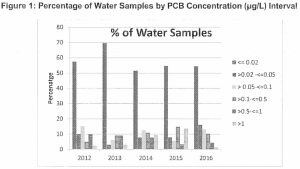
The data in Figure 1 shows that the percentage of water samples that meet or are less than the site criteria of 0.02 μg/L has not changed much over the five years of sampling. Figure 1 does show that concentrations are improving over time. The 0.02-0.05 μg/L category saw a huge increase in 2016 compared to the previous four years and the percentage of higher concentrations (0.5 μg/L) decreased substantially in 2016 compared to 2015 and other historical data.
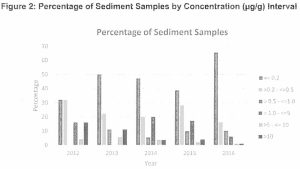
The largest percentage for sediment concentrations is less than the site criteria for each year. 2016 saw a significant increase in the number of samples that meet or are less than the site criteria of 0.2 μg/g.
The percentage of concentrations exceeding 5.0 μg/g has again significantly decreased in 2016 compared to 2012 to 2015 data.
Off-site locations include four City of Peterborough manhole jocations.
STM-MH136551 which receives runoff from Zone 1 and city storm sewers along Wolfe Street Storm water is then directed along Park Street where it mixes with runoff from CBR 22, CBR 20 and STM.MHR 41 where it ends up going to STM.MH135683 on Rink Street There was one water and sediment exceedance which coincided with the City flushing lines. There were no previous water or sediment exceedances in 2014 and 2015,
MH135686 located on Rink Street and receives storm water from Zone 3 catch basins as well as Zones 4 and 5. No sediment was found in 2016. Two water samples were taken and one exceeded site criteria.
MH135683 located on Rink Street receives storm water from all seven zones including other storm water in the catchment area. It was sampled for stormwater twice and had one exceedance. Sediment was found in 2016 on two occasions with no exceedances.
MH166xxx was sampled three times and three had storm water exceedances. Sediment was sampled in seven locations and only one at MH166xx1 had a sediment exceedance. These manholes are located on Monaghan Road and receive water from Zone 5 and other sources.
The 2016 results indicate that there has been improvement in both water and sediment concentrations resulting from the BMPs employed in 2016.
The reviewer agrees that sarnpling and cleaning should be repeated as proposed in 2017. The reviewer notes that 2016 was a very dry year and some of the improvements may be related to lack of runoff. 2017 to date has been extremely wet so if will be interesting to see if the 2017 results show continued improvement as a result of above average precipitation so far this year.
Recommendations
- Sampling of storm water and sediment should continue in 2017 as proposed.
- All historical and current monitoring data should continue to be presented in spreadsheet format (i.e. Excel™) either on CD/DVD or electronic format that can be manipulated by the reviewer.
- BMPs as proposed should continue in 2017.
lf you have any questions regarding the above comments or recommendations | would be pleased to discuss them with you.
Dana Cruikshank
cc: Kyle Stephenson; Doug Brown; Courtney Redmond
File SW-PB-PT-03-17 (GE Peterborough)
File SW-PT-07-02-1 1-02-02 (Otonabee River)
[top]
APPENDIX B: Technical Memorandum Re: Groundwater Monitoring Results in 2016 Annual Report
TO: Jamie Mugford, Issues Project Coordinator, Peterborough District Office, Eastern Region
FROM: Thomas Guo, Hydrogeologist, Technical Support Section, Eastern Region
RE: GE Power Conversion — Motors, Peterborough, 2016 PCB Monitoring Report for Storm Water and Groundwater, 107 Park Street North, Peterborough, Ontario
DATE: January 5, 2018
I have reviewed the report entitled “GE Power Conversion — Motors, Peterborough, 2016 PCB Monitoring Report for Storm Water and Groundwater” dated February 2017 and completed by AECOM consultants (AECOM).
I offer the following comments for your consideration from groundwater perspective.
Background
The GE Power Conversion — Motors industrial facility (the “site”) is located at 107 Park Street in Peterborough. GE manufactures large and small motors. PCBs were used at the site in the past to manufacture capacitors. Waste oils containing PCBs were used as a dust suppressant at the site and on an adjacent property used for employee parking (the Monaghan Road parking lot).
The Facility was originally built in the late 1880s as a manufacturing facility for GE Canada and has been operating for the manufacturing and assembly of capacitors, small and large motors.
The northern portion of former Building 4 (referred to as Building 4N) is a former PCB Waste Storage Facility (Registered PCB Waste Storage 305 90A 006) and had historically been used in the manufacturing of capacitors and other products known to contain PCBs. Building 4 was demolished in 2014 (CRA, 2015) and the area was covered with a Cover System with two main objectives:1) to be protective of human health and welfare from exposure to materials potentially containing PCBs by direct contact and 2) to eliminate the potential for transfer of contaminants from Building 4 to the storm sewers and the surrounding environment.
In 1981, environmental investigations were initiated at the Site including the installation, monitoring and sampling of groundwater monitoring wells. Monitoring of stormwater, storm sewer sediment, and groundwater quality for the presence of PCB has been conducted at the Site since 1992.
In 1995, the MOECC issued Director’s Instructions establishing the Monaghan Road Parking Lot as an Interim PCB Waste Management area. In accordance with the Director’s Instructions, areas of the Monaghan Road Property, which contain soils with PCB concentrations greater than 5 g/g were covered with an asphalt cap. The Director’s Instructions also established requirements for the inspection of the cap, ongoing storm sewer and groundwater monitoring, and annual reporting.
Geology
The stratigraphic and hydrostratigraphic conditions at, and in the vicinity of the site are detailed in the Site Specific Risk Assessment (CRA, 2002). The stratigraphic units identified in descending order are:
- Silty sand and gravel alluvium deposits; and,
- Silty clay galciolacustrine deposit
Hydrogeology
Groundwater flow occurs under unconfined conditions within the silty sand and gravel alluvium deposit. The underlying silty glacial lacustrine deposit represents the basis of the unconfined groundwater flow system, and is an aquitard that separates the unconfined groundwater system from deeper groundwater flow system.
In 2016, groundwater in the silty sand and gravel alluvium deposit flows was in a southeasterly direction under unconfined conditions. The depth of the water table quickly changed from 10.9 metres below ground surface (mbgs) at MW/76, at the top of the hill, to approximately 0.2 mbgs at the bottom of the hill at MW74, as the ground surface drops 20 m. At MW73, approximately 120 m from Monaghan Road, the water table was 2.1 mbgs. Near former Building #4, the groundwater in June 2016 was approximately 2.7 mbgs.
Along Park Street North, the sanitary sewer backfill (which is expected to be composed of coarser materials that are of higher hydraulic conductivity compared to the surrounding natural deposits) appears to act as a drain that captures and conveys groundwater southward along the eastern site boundary towards the influence of the groundwater extraction and treatment system (GETS). The GETS is located along the southwestern property boundary and serves to reduce the movement of groundwater from the site.
Site Restoration Criteria
The cleanup criteria are derived from the “Soils Ground Water and Sediment Standards for Use Under Part XV.1 of the Environmental Protection Act” (MOECC, 2011). The area is municipally serviced. The onsite land use is industrial/commercial/community. The offsite land use is residential/parkland/institutional. The soils are classified as coarse textured. AECOM has applied Table 3 cleanup criteria for soil and groundwater to most of the site and Table 7 cleanup criteria to the parking lot property where the depth to the water table can be less than two metres below ground surface. These are the appropriate cleanup criteria for soil and groundwater at the site.
Contaminants of Concern
The main source area of PCBs in groundwater is in the vicinity of the former building #4 (the location of the former capacitor manufacturing operation).
Groundwater Monitoring Results
AECOM reports the following with respect to the groundwater monitoring:
- At the facility, MW25, MW26, and MW28 are monitoring locations where PCB concentrations have historically been above the applicable Table 3 standard. These monitoring wells are located in the area of the former Building 4 Cover System which covers the former capacitor manufacturing area. The three monitoring wells were above the applicable Table 3 standard in 2016 but 2016 results are lower than historical results;
- Monitoring wells (MW25, MW26 and MW28) are located at, or near, the north end of former Building 4 Cover System. PCB concentrations are consistent with historical trends. There is no existing on-site storm sewer line in the area below the water table. Groundwater in this location is unlikely to impact stormwater quality in this area;
- Dissolved PCBs in groundwater are unlikely to impact stormwater quality;
- PCBs in groundwater at the Monaghan Road Property were either below the reporting limit or below the applicable Table 7 standard of 0.2 ug/L;
- Debris containing low levels of PCBs was removed from the roofs on Building 20, part of Building 16A and part of Building 18 to reduce the potential loading of PCBs from the building roofs to the storm sewer system; and,
- Surface soil impacted with PCB in the area around CBR85 was isolated and stabilized to eliminate the potential for contact and mobilization to catch basins (CBs) and manholes (MHs). Geotextile was placed on exposed soil and covered with approximately 150 mm of clear stone material.
Recommendations
AECOM recommends the following:
- The proposed 2017 groundwater monitoring program is presented in Appendix J. The PCB groundwater quality program should continue to focus on the area of the former Building 4 Cover System; MW25, MW26 and MW28.
- Implement measures to minimize soil disturbance and sediment transport at the Site and in particular adjacent to paved working areas at the Site (i.e. through the use of signage and barriers where appropriate); and,
- Identify further opportunities to promote infiltration of surface water into the ground and reduce flow to storm sewer CBs and MHs.
I concur with the consultant’s recommendations.
Thomas Guo, M. Eng, P. Geo.
cc: Peter Taylor, Technical Support Manager; Greg Faaren, Water Resources Supervisor; Dana Cruikshank, Surface Water Specialist
File GW PB PT 03 02 PA (GE 107 Park Street North)
TG/IDS # 1005-AK3LXU
[top]
APPENDIX C: Technical Memorandum Re: 2016 Soil Vapour Monitoring Report
TO: K. Andreoli, District Engineer, Peterborough District Office, Eastern Region
FROM: Ross Kircher, Air Quality Analyst, Technical Support Section, Eastern Region
RE: 2016 Soil Vapour Monitoring Report, GE Industrial Systems Facility, 107 Park Street North, Peterborough, Ontario
DATE: June 13, 2017
IDS Ref#: 5125-AK3LDL
I have reviewed the 2016 Soil Vapour Sampling Report and supporting information prepared by AECOM Canada Ltd. (AECOM) dated February 16, 2017 with respect to soil vapour and air quality concerns around the area of 107 Park Street North, Peterborough.
Background
- The “site” includes 107 Park Street North as well as several adjacent parking lots in Peterborough, ON. General Electric (GE) operates a manufacturing facility at the site, producing capacitors and large and small motors. Neighboring land use is primarily residential, with some commercial and recreational land use.
- Volatile organic compounds (VOC) were detected in groundwater in 2000. Contaminants of concern (CoCs) are trichloroethylene (TCE) and its breakdown products: cis-1,2-dichloroethylene (c12DCE), trans-1,2-dichloroethylene (t12DCE), 1,1dichloroethylene (11DCE)and vinyl chloride (VC). TCE was used at the site for degreasing operations.
- Conestoga-Rovers & Associates (CRA) established a Remedial Action Plan (RAP) for the site in 2001. The RAP included the installation of a groundwater extraction and treat system (GETS), source removal, as well as a site specific risk assessment (SSRA). As part of the SSRA, several soil vapour monitoring locations were installed downgradient of the facility. The SSRA also established site-specific soil vapour criteria for off-site VOC impacts.
- In 2012, the historical soil vapour monitoring locations were replaced with a network of twenty-two (22) new soil vapour monitors.
- In 2015, Standards Development Branch (SDB) of the MOECC commented on the 2014 Soil Vapour Monitoring Report for the Site. SDB requested the use of updated healthbased indoor air criteria (HBIAC) to derive soil vapour screening levels. Soil vapour monitoring frequency was reduced to semi-annually (spring and summer) after this review.
- GE Canada submitted the revised soil vapour screening levels as well as a proposal to use Waterloo Membrane Samplers (WMSs) at all soil vapour monitoring locations alongside Summa canisters at selected monitoring locations for validation.
Summary
- In accordance with the amended RAP, and recommendations from previous soil vapour monitoring reports for the Site, monitoring for CoCs was conducted according to the schedule below:
| Method | Waterloo Membrane Sampler (WMS) | Summa Canister |
| Spring | GP3-12 | |
| GP5-12 | GP5-12 | |
| GP7-12 | GP7-12 | |
| GP18-12 | ||
| GP19-12 | ||
| GP21-12 | ||
| Summer | GP3-12 | |
| GP5-12 | GP5-12 | |
| GP7-12 | GP7-12 | |
| GP18-12 | ||
| GP19-12 | ||
| GP21-12 |
- Soil vapour sampling was conducted by AECOM using WMSs for the first time in 2015, and has continued to be the primary method since that time.
- The WMS method was developed at the University of Waterloo. It uses a polydimethylsiloxane (PDMS) membrane across the opening of a vial filled with sorbent charcoal. The PDMS controls the uptake rate of VOCs into the sampler. The WMSs used at the Site incorporated a cap over the membrane with a “pinhole” opening, which facilitates a slower uptake rate of VOCs. This slower uptake rate is advantageous for the site, because it limits the potential for starvation effects. VWWMSs were installed and left in the soil vapour probes for the duration of the monitoring period.
- WMSs were installed in each soil vapour robe using a downrigger cable, which suspended each WMS with the membrane facing downward, positioned approximately in the middle of the screened interval of the probe. Where duplicate samples were taken, two WMSs were hung from the same downrigger cable in the same probe several centimeters from each other. J-plugs were installed at the top of each soil vapour probe for an effective seal. New J-plugs were installed at each soil vapour probe in 2015.
- Section 2.2.1 summarizes the sampling schedule for WMS samplers at the Site in both spring 2016 and summer 2016 events. On average, WMSs were present in soil vapour probes for approximately 10 days. Following removal, WMSs were sent to Eurofins Air Toxics Ltd. In California for analysis. QA/QC procedures were utilized to ensure sample integrity.
- Summa canister samples were collected over approximately 20 minutes in accordance with MOECC Draft Technical Guidance: Soil Vapour Intrusion Assessment (Sept, 2013), and analyzed according to US EPA method TO-15. Samples were analyzed by Maxxam Analytics Inc. QA/QC procedures were utilized to ensure sample integrity.
- Section 3.2 of the submission details the analytical results for the spring 2016 and summer 2016 sampling events. Results are compared to soil vapour screening levels calculated using the MOECC Modified Generic Risk Assessment Spreadsheet (2014). These screening levels vary with contaminant as well as groundwater depth, as detailed below (Section 3.2 in the submission):
| Parameter | Where Water Table >3 mBGS | Where Water Table <3 mBGS | ||
| Residential (μg/m3) |
Industrial/Commercial (μg/m3) |
Residential (μg/m3) |
Industrial/Commercial (μg/m3) |
|
| TCE | 95.8 | 1,580 | 13.6 | 100 |
| 11DCE | 5110 | 182,000 | 730 | 12,500 |
| c12DCE | 4460 | 441,000 | 1,570 | 26,800 |
| t12DCE | 11,100 | 181,000 | 625 | 10,700 |
| VC | 43.7 | 1,350 | 6.3 | 102 |
- AECOM references Nov 2016 updates to the MGRA model that may affect the soil vapour screening levels, but indicates that until guidance is released on the use of these updates, AECOM will continue to use the 2014 MGRA screening levels.
- AECOM notes TCE is the only soil vapour parameter that has exceeded applicable screening levels since the implementation of the RAP soil vapour monitoring program in 2012. Therefore, AECOM concludes that all other CoCs (11DCE, c12DCE, t12DCE, and VC) do not pose an unacceptable risk to human health due to vapour intrusion.
- In 2016, all soil vapour samples were below relevant soil vapour screening levels, with the exception of GP7-12. Duplicate samples were collected using both Summa canisters and WMSs at GP7-12 in both spring and summer 2016. Summa canisters and duplicates recorded TCE concentrations of approximately 300yg/m* and 620yg/m? in spring and summer respectively. WWMSs and duplicates recorded TCE concentrations of approximately 190µg/m* and 390µg/m3 in spring and summer respectively. These concentrations exceed the relevant screening level (13.6µg/m3 -residential, water table <3mBGS).
- AECOM indicates that the soil vapour results are consistent with historical results. In general, summer soil vapour concentrations are higher than those in spring, which AECOM suggests may be associated with a drier than normal summer in 2016.
- AECOM concludes that results do not indicate a potential for unacceptable risk due to vapour intrusion to the properties surrounding GP3-12, GP5-12, GP18-12, GP19-12, and GP21-12, since all CoC concentrations were below relevant screening levels. Similarly, AECOM concludes that while TCE concentrations at GP7-12 exceed the screening level, they do not pose a potential for unacceptable risk due to vapour intrusion since TCE concentrations at shallower adjacent monitoring wells (GP18-12 and GP21-12) are below the screening level.
- AECOM suggests that the presence of a clay lens in the area further ameliorates the potential for vapour intrusion, since it does not allow vapour concentrations to permeate upward.
- AECOM indicates that there is a significant difference between WMS results and Summa canister results, which may be due to natural spatial and/or temporal variability. This does not necessarily indicate that WMS results are less accurate or precise. Additional parallel sampling with WMSs and Summa canisters will continue to be undertaken in future soil vapour investigations at the Site.
- AECOM recommends no changes to the sampling program for 2017.
Comments and Recommendations
I agree with the test methods and quality of sample data obtained. I am confident the concentrations obtained from the survey accurately represent conditions at the sites assessed.
I accept the parallel use of WMSs and Summa canisters, and support the continued use of both at the site. Due to the high concentrations at GP7-12, | support the continued use of both methods when testing that particular probe.
TCE concentrations were detected in GP7-12 at approximately 50 times the screening limit. These are significant concentrations, and coupled with groundwater results suggest that potential for vapour intrusion is present at the site.
- AECOM concludes that the discontinuous clay lens will act to attenuate vapour migration into nearby residences. The MOECC Groundwater Unit has advised that this is true only if the clay liner is continuous near potential receptors. Although the presence of a clay lens may indeed prevent migration into the surface layer, concentrations detected beneath the clay lens are high enough that should a discontinuity be present at or near a receptor, potential risk of vapour intrusion is significant.
- MOECC Draft Technical Guidance suggests that at more than 5 times the screening imit, an indoor air sampling program be considered to more fully determine the extent and risk of vapour intrusion to nearby properties. Recognizing the significant concentrations at GP7-12 and its proximity to potential receptors, the implementation of an indoor air and/or a sub-slab sampling program should be considered around the site.
Summary
TCE concentrations were detected at significant concentrations in soil vapour near 107 Park St N, Peterborough. AECOM has advised that a clay lens in the area prevents migration of contaminants from soil vapour to indoor air; however, this is only true if the clay lens is continuous near potential receptors. This is an assumption that has not been confirmed at all locations; therefore, the potential for vapour intrusion exists and is significant. Because of the high concentrations detected at GP7-12, | recommend soil vapour sampling continue as planned in 2017. Further, an indoor air or sub-slab sampling program may also be considered at proximate receptors for another line of evidence.
If you have any questions concerning these comments | would be pleased to discuss them with you.
Ross Kircher
cc: Kelly Andreoli; Meghan Brien; Shawn Trimper; Greg Faaren; Peter Taylor; Kyle Stephenson
[top]
APPENDIX D: Technical Memorandum Re: the Groundwater Extraction and Treatment Annual Report, Monitoring Program Summary Document, including Groundwater Extraction and Treatment System Operation
TO: K. Andreoli, District Engineer, Peterborough District Office, Eastern Region
FROM: F. Crossley, Hydrogeologist, Technical Support Section, Eastern Region
RE: 2014 Groundwater Extraction and Treatment System, General Electric Industrial Systems Facility, 107 Park Street North, Peterborough, Ontario
DATE: April 23, 2015
I reviewed the “2014 Groundwater Extraction and Treatment System — General Electric” dated February, 2015 to determine the impacts from the GE site and determine the effectiveness of the groundwater pump and treat system.
General Electric Industrial Systems Facility (GE) is located at 107 Park Street North in Peterborough, Ontario. GE manufactures large and small motors.
In November, 2000, this Ministry issued GE an Order requiring GE to submit and implement an action plan to investigate and develop a remedial approach to abate the egress of contaminants offsite. The contaminants of concern have been determined to be trichloroethylene (TCE) and its related breakdown products dichloroethylenes (DCE’s) and vinyl chloride (VC). The contaminants of concern are referred to as the “volatile organic compound plume”.
The cleanup criteria is derived from the “Soils, Ground Water and Sediment Standards for Use Under Part XV.1 of the Environmental Protection Act” (MOE, 2011). The cleanup criteria is Table 3 from this document. CRA state that they undertook a Site Specific Risk Assessment and determined soil gas and groundwater site specific risk based cleanup criteria. CRA state that the Ministry concurred (2002) with the site specific risk based cleanup criteria.
The consultants determined the geology to be:
- Silty sand and gravel unit (Alluvium Deposit) varying in thickness from approximately 2 — 10 metres below ground surface.
- Silty clay unit (Lacustrine Deposit) reported on the order of 18 metres in thickness.
- Limestone/shale (Verulum Formation).
The consultants determined the physical hydrogeological characteristics to be:
- The groundwater is at about 2-3 metres below ground surface.
- The estimated hydraulic conductivity of the silty sand unit is 1 x 10? cm/sec.
- The estimated hydraulic conductivity of the silty clay unit is 1 x 10” cm/sec.
- The hydraulic gradient ranges from 0.001 to 0.004.
- The hydrogeological conceptual model is migration of the contaminants of concern to the south southeast in the silty sand unit (unconfined aquifer) with the underlying silty clay unit acting as an aquitard and restricting the vertical migration of the contaminants of concern. There are localized effects due to anthropogenic activities (sanitary sewer along Park Street which restricts the movement of contaminants of concern to the east).
The agreed upon work plan (2001) was:
- Installation of a perimeter groundwater extraction and treatment system to eliminate/reduce the egress of contaminants of concern from continuing to migrate off property.
- Investigation in the source area and continue product removal from MW-58.
- Undertake a Site Specific Risk Assessment to address the offsite impacts.
- Conduct a monitored natural attenuation approach to: evaluate the effectiveness of the remedial activities; evaluate the effectiveness of the monitored natural attenuation approach; determine the impacts and determine the potential impacts.
CRA state that they installed the perimeter groundwater extraction and treatment system in 2001 as a pilot study. The full scale perimeter groundwater extraction and treatment system was activated in October, 2004.
The groundwater pumping system consists of:
- Seven extraction wells (EW1-EW7) located along the southern property boundary (eastern half) to depths ranging from 8.23 to 9.3 metres below ground surface.
The groundwater treatment system consists of:
- Chemical sequestering system (to reduce scaling).
- Air stripper (main treatment).
- Two liquid phase granulated activated carbon (GAC) units in series (polishing).
- Bag filters.
- Equalization tanks.
- Discharge of “treated water” to the sanitary sewer (City of Peterborough).
CRA state that the groundwater pump and treat system collected 78,759 m* since the startup of the system to December 31, 2014 (15,334 m* during 2014). The groundwater pump and treat system has a permit, 5222-9L2QKE (formerly 04-P-4045). The calculated average daily taking is 42,011 litres/day. The total allowable taking is 273,600 litres/day. The permit is valid until April 21, 2019.
Figure 5.1 in the report shows the groundwater contours. Figure 5.2 in the report shows the groundwater contours in proximity to the groundwater extraction system (enlargement of Figure 5.1). The groundwater contours show the pumping effects are having hydraulic control along the southern property boundary.
The influent results are summarized in Table E6.1 in the report. The results are from the startup (2004) until the end of 2014. The results show the following yearly average TCE concentrations: 1,445 µg/L — 2004; 1,697 µg/L — 2005; 1,715 µug/L — 2006; 1,888 µg/L — 2007; 1,096 µg/L — 2008, 579 µg/L — 2009, 1,215 µg/L — 2010, 621 µg/L — 2011, 1276 µg/L — 2012; 1,222 µg/L -2013 and 733 µg/L -2014. The results show a fluctuating trend.
The midstream results are summarized in Table E6.2 in the report. The 2014 results show low to non detect values of the contaminants of concern during 2014 after the air stripper (midstream). The results post GAC units (Table E6.3 in the report) show non detect or low level concentrations. The results show the primary treatment system is the air stripper with the GAC units providing a “polishing” effect.
The effluent results are summarized in Table E6.4 in the report. The 2014 results show non detect values of the contaminants of concern. The effluent has to meet discharge criteria set by the municipality.
The consultants state that they undertook a Site Specific Risk Assessment and that this Ministry accepted the risk assessment (2002). The consultants state that the site specific risk based cleanup criteria for the contaminants of concern in groundwater are:
- tetrachloroethylene (PCE) — 3,198 µg/L
- TCE — 1,355 µg/L
- 1,1-DCE — 3 µg/L
- cis-1,2-DCE — 16,785 µg/L
- vinyl chloride — 1.5 µg/L
The consultants conducted a groundwater sampling program. The program consists of onsite and offsite monitoring wells.
MW-58 is located in the “source area”. CRA state that product was evident in this monitoring well during the 2014 sampling events. During November, 2014, CRA pumped approximately 250 litres of liquid from MW58. The drums were shipped to a hazardous waste site (Clean Harbours) for disposal. As requested, this monitoring well was sampled during 2014. The 2014 results showed highly elevated concentrations (82,000 µg/L) of TCE.
CRA sampled numerous onsite monitoring wells in proximity to the southern and eastern property boundaries. Exceedances of the risk based cleanup criteria occurred in the following onsite monitoring wells during 2014: MW32 and MW58. Exceedances of the Table 3 cleanup standard occurred in all of the onsite monitoring wells during 2014 except MW67. Figure 4.1 to 4.10 (inclusive) show the TCE time plots for specific onsite monitoring wells. In general, the overall plots show a decreasing trend with the exception of MW32 which is showing an increasing trend. The results show an alternate “source area’ in the vicinity of MW32.
CRA sampled numerous offsite monitoring wells to delineate the extent of the volatile organic compound plume. Exceedances of the risk based cleanup criteria occurred in the following offsite monitoring wells during 2014: MW59 (VC); MW60 (VC) and MW68 (TCE). Exceedances of the Table 3 cleanup standard occurred in all the offsite monitoring wells with the exception of: MW12 and MW66. Figures 4.11 to 4.20 (inclusive) show the TCE time plots for specific offsite monitoring wells. In general, the overall plots show a stable to decreasing trend with the exception of the VC concentration in MW60. The impacts in MW63R and MW65 are related to tetrachloroethylene (PCE). These impacts do not appear to be sourced from the GE site.
The horizontal impacts related to GE extend between Parnell Avenue (MW64 impacted) and Romaine Street (MW63R impacted but unrelated to GE). This is based on the Table 3 cleanup standard.
CRA recommend that the monitoring continue in accordance with the monitoring schedule as approved by this Ministry in May, 2014.
Conclusions and recommendations
I offer the following conclusions and recommendations:
- The site is located at 107 Park Street North in Peterborough. The GE Industrial Systems Facility operates at the site.
- The cleanup criteria is derived from the “Soils, Ground Water and Sediment Standards for Use Under Part XV.1 of the Environmental Protection Act” (MOE, 2011). The cleanup criteria is Table 3 (Groundwater in Non Potable Conditions) with an industrial/commercial/community land use onsite and primarily residential/parkland/ institutional offsite. The soils are classified as coarse textured.
- The consultants undertook a Site Specific Risk Assessment as opposed to using the generic criteria. The consultants determined risk based cleanup criteria as part of the Site Specific Risk Assessment (CRA, 2002). As part of the Risk Management Plan, a monitoring program is required (MNA).
- The contaminants of concern are TCE and its related breakdown products DCE’s and ve.
- The main “source area’ is in the vicinity of MW58. This monitoring well is checked for product (TCE). If product is present, the product is collected. If product is not present, the monitoring well is to be sampled. Approximately 250 litres of product/impacted water was pumped from MW58 and transported offsite for disposal (hazardous) in November, 2014.
- The contaminants of concern in the onsite monitoring wells exceed the Table 3 cleanup criteria and the risk based cleanup criteria at MW32 and MW58. The data indicates that there is an alternate source(s) onsite (MW32). Additional work is required at and in the vicinity of MW32.
- The contaminants of concern in the onsite monitoring wells exceed the Table 3 cleanup standard with the exception of MW67.
- The impacts in the vicinity of the eastern property boundary are believed to be intercepted by the sanitary sewer along Park Street and are infiltrating into the sewer or migrating along the bedding material (“short circuiting effect”) however there are some impacts to the east of Park Street (approximately 40 metres east).
- The consultants installed (2004) a groundwater pump and treat system along the southern property boundary. The purpose of this remediation system is to eliminate/reduce the egress of contaminants offsite (hydraulic control). It should be noted that the system is not designed to “pull back” contaminants that have already migrated beyond the property boundary. The consultants should provide the quantity of water collected/“treated” on an annual basis and also compare the takings to the permitted values in the Permit to Take Water to demonstrate compliance with the permit.
- The consultants state that they have been testing various scale control products during 2014 to attempt to improve the efficiency of the treatment train. CRA state that descaling of the air strippers were undertaken on three (3) occasions and the re-bedding of the GAC units was also undertaken on three (3) occasions during 2014. CRA state that the first GAC vessel leaked and had to be replaced.
- The contaminants of concern in the influent exceed the Table 3 cleanup criteria and the risk based cleanup criteria, thus the groundwater pump and treat system must be operated and maintained.
- The influent results for the groundwater pump and treat system generally are showing a fluctuating trend.
- The effluent results are primarily non detect. The air strippers are providing the primary treatment while the GAC units are providing a “polishing effect”. The effluent is discharged to the sanitary sewer, thus the discharge criteria is set and regulated by the municipality.
- The impacts beyond the property boundary (zone of influence of the groundwater pump and treat system) are being allowed to naturally attenuate with a monitored natural attenuation approach. The groundwater monitoring program has to be capable of evaluating the effectiveness of the groundwater remediation; evaluating the effectiveness of the natural attenuation approach; determining the impacts and determining the potential impacts.
- The hydrogeological conceptual model is migration of the contaminants in the shallow sand unit (unconfined aquifer) to the south, southeast with the underlying silty clay unit (aquitard) restricting the vertical migration. The groundwater pump and treat system targets the primary pathway as the extraction wells are completed in the shallow sand unit at the top of the silty clay unit.
- The contaminants of concern in the offsite monitoring wells exceed the risk based cleanup criteria at: MVV59; MW60 and MW68. The primary concern is vapour intrusion.
- The contaminants of concern in the offsite monitoring wells exceed the Table 3 cleanup standard. The primary concern is vapour intrusion.
- The horizontal extent of the “volatile organic compound plume” in the groundwater is reasonably determined and extends from the GE plant to between Parnell Avenue and Romaine Street.
- The vertical extent of the “volatile organic compound plume” is restricted to the shallow sand unit by the geology (low permeable silty clay unit — aquitard).
- The PCE impacts at MW65 and MW63R are not attributed to the GE site. An alternate source, potentially a former and/or current dry cleaning operation, likely exists in the area.
- The groundwater monitoring program should be continued as there are offsite impacts.
- The groundwater monitoring program is:
- monitor for the contaminants of concern (TCE and its breakdown products) at the same onsite and offsite monitoring wells as 2014 (Table 3.1 in the report) ata frequency of once per year.
- maintain the monthly (twelve times per year) sampling (contaminants of concern) at the groundwater pump and treat system (influent, post air strippers, between GAC filters, effluent).
- sampling the monitored natural attenuation parameters at a frequency of once every five years.
- The potential primary receptor is vapour intrusion. This is being monitored separately.
F. Crossley, P.Geo.
ec: J. Martherus (Acting Supervisor); G. Faaren (Acting Supervisor); D. Bradley; P. Taylor
c: File GW PB PT 03 02 PA (GE)
FC/IDS #7424-9UNJUL
[top]
APPENDIX E: Monitoring Program Summary (20181207)
TO: ?
FROM: AECOM
RE: Monitoring Program Summary (20181207)
DATE: December 7, 2018
Groundwater Monitoring and Sampling Program
Groundwater monitoring wells shall be monitored and sampled one time per year in spring subject to well accessibility and condition, Table 1.
Groundwater shall be sampled for Total PCB or Select VOCs (1,1 DCE; trans1,2 DCE; cis1,2 DCE, TCE, VC) annually and for Monitored Natural Attenuation (MNA) parameters every five years.
The groundwater monitoring program shall be reviewed annually by the QC and any recommendations for change or amendments shall be submitted to the Ministry for review. Any recommendations accepted by the Ministry shall be implemented and shall form part of Appendix E as amended.
Monitoring results and recommendations shall be reported annually under the titles PCB Monitoring Report for Storm Water and Groundwater and Groundwater Extraction and Treatment System Monitoring Report.
| Well ID | PCB | Select VOCs | MNA (5 Years) |
| EW1 | X | ||
| EW2 | X | ||
| EW3 | X | ||
| EW4 | X | ||
| EW5 | X | ||
| EW6 | X | ||
| EW7 | X | ||
| MW11R | X | X | |
| MW12R | X | X | |
| MW25 | X | ||
| MW26 | X | ||
| MW28 | X | ||
| MW5R | X | ||
| MW32 | X | ||
| MW33 | X | ||
| MW49 | X | ||
| MW50 | X | ||
| MW51 | X | ||
| MW52 | X | ||
| MW53 | X | ||
| MW58 | X | ||
| MW59 | X | X | |
| MW60 | X | X | |
| MW61 | X | X | |
| MW62 | X | ||
| MW63R | X | X | |
| MW64 | X | X | |
| MW65 | X | X | |
| MW66 | X | X | |
| MW67 | X | ||
| MW68 | X | X | |
| MW71 | X | X |
[Map of Groundwater Monitoring and Sampling Locations – Poor quality]
Soil Gas Monitoring Program
Soil Gas probes shall be sampled two times per year in the spring and summer subject to well accessibility and condition, Table 2.
Parallel sampling was conducted at two locations where Waterloo Membrane Sampler (WMS) and Summa Canister samples were collected at the same time. The need for parallel Summa samples is evaluated annually; based on 2016 and 2017 sampling results it is anticipated that only WMS samples will be collected in 2019 and going forwards.
Samples shall be analyzed for select VOCs (1,1 DCE; trans1,2 DCE; cis1,2 DCE, TCE, VC)
The soil gas monitoring program shall be reviewed annually by the QC and any recommendations for change or amendments shall be submitted to the Ministry for review. Any recommendations accepted by the Ministry shall be implemented and shall form part of Appendix E as amended.
Monitoring results and recommendations shall be reported annually under the title Soi! Vapour Monitoring Report.
| Well ID | WMS |
| GP3-12 | X |
| GP5-12 | X |
| GP7-12 | X |
| GP18-12 | X |
| GP19-12 | X |
| GP21-12 | X |
[Map of Soil Gas Sampling Locations – Poor quality]
Storm Sewer Monitoring Program
Storm Sewer Outfalls including three City of Peterborough Storm Sewer manholes shall be monitored and sampled three times per year during or immediately following a rain event (10mm) subject to outfall accessibility and condition, Table 3.
Monitoring shall include a visual inspection of the CB / MH and measurement of sediment thickness.
Where present, sediment shall be sampled for Total PCB (including Aroclors) and TOC.
Where present, stormwater shall be sampled for Total PCB (including Aroclors) and TSS.
The storm sewer monitoring program shall be reviewed annually by the QC and any recommendations for change or amendments shall be submitted to the Ministry for review. Any recommendations accepted by the Ministry shall be implemented and shall form part of Appendix E as amended..
Monitoring results and recommendations shall be reported annually under the title PCB Monitoring Report for Storm Water and Groundwater.
| MH/CB ID | Facility Outfalls |
Monaghan Rd Outfalls |
City of Peterborough | Little Lake |
| MHR1 | X | |||
| MHR35 | X | |||
| MHR41 | X | |||
| CBR11 * | X | |||
| CBR20 | X | |||
| CBR22 | X | |||
| CBR35 | X | |||
| CBR73 | X | |||
| CBR82 | X | |||
| C.STM.MH | X | |||
| CBR90 | X | |||
| CBR94 | X | |||
| CBR107 * | X | |||
| CBR111 | X | |||
| CBR112 | X | |||
| CBMRH113 | X | |||
| CBMHR130 | X | |||
| CBR137 | X | |||
| CBR140 * | X | |||
| CBR142 * | X | |||
| MH135686 | X | |||
| MH135683 | X | |||
| MH136551 | X | |||
| MH166902 | X | |||
| MH135703 | X | |||
| LL-15 | X |
* Catch basin not connected to City storm sewer system. These locations will be monitored but will not be considered representative of storm water outfall from Site.
[Map of Storm Water Monitoring and Sampling Locations – Poor quality]
Groundwater Extraction and Treatment System
The Groundwater Extraction and Treatment System (GETS) operates in the southeast corner of the Site to provide hydraulic containment along a network of seven groundwater extraction wells, EW1 through EVV7, located along the southern property boundary.
The GETS operates under the following permits:
-
- Permit to Take Water (PTTVWV) No. 5222-9L2QKE, Ministry of the Environment and Climate Change (MOECC)
- Environmental Compliance Approval (ECA) 7896-9HDRYN, MOECC: for treatment of groundwater via air stripping; and,
- Slug Discharge Permit, City of Peterborough (City): for discharge of treated groundwater to the City’s sanitary sewer.
In accordance with PTTW, daily water taking from all extraction wells are reported annually on a calendar year basis.
There is no specific monitoring required under the ECA. The ECA is part of a Site-wide ECA.
Operation of the PTTW (including any sampling) is subject to maintenance and repairs as required.
A consolidated summary of GETS operation and performance monitoring is reported annually under a report titled Groundwater Extraction and Treatment System Monitoring Report.
Annual Reporting Details
Each of the annual reports referred to in this document will be submitted to the Ministry by the end of February each year in the form of three paper copies and an electronic copy.
[top]
APPENDIX F: CERTIFICATE OF REQUIREMENT
CERTIFICATE OF REQUIREMENT
S. 197 (2)
Environmental Protection Act, R.S.O. 1990, c. E.19
This is to certify that pursuant Director’s Order GE-PTBO-DOO01FA, dated December 10, 2018, and issued pursuant to sections 18, 132, 196 and 197 of the Environmental Protection Act by David Bradley, Director, and being an Order related to property municipally Known as 107 Park Street, Peterborough Ontario with Property Identifier Number (PIN) 28081-0123 (the “Property”) with respect to PCB and TCE contamination on the Property, the following person:
GENERAL ELECTRIC CANADA PROPERTY INC.
and any other persons having an interest in the Property are required, before dealing with the Property in any way, to give a copy of the Order, including any amendments that may be made thereto, to every person who will acquire an interest in the land as a result of the dealing.
Under s. 197 (3) of the Environmental Protection Act, this requirement applies to each person who, subsequent to the registration of this certificate, acquires an interest in the Property.
[top]
APPENDIX G: CERTIFICATE OF REQUIREMENT
CERTIFICATE OF REQUIREMENT
S. 197 (2)
Environmental Protection Act, R.S.O. 1990, c. E.19
This is to certify that pursuant Director’s Order GE-PTBO-DOOO1FA, dated December 10, 2018, and issued pursuant to sections 18, 132, 196 and 197 of the Environmental Protection Act by David Bradley, Director, and being an Order related to property municipally known as 1063 Monaghan Road, Peterborough Ontario with Property Identifier Number (PIN) 28067-0046 (the “Property”) with respect to PCB and TCE contamination on the Property, the following person:
GENERAL ELECTRIC CANADA PROPERTY INC.
and any other persons having an interest in the Property are required, before dealing with the Property in any way, to give a copy of the Order, including any amendments that may be made thereto, to every person who will acquire an interest in the land as a result of the dealing.
Under s. 197 (3) of the Environmental Protection Act, this requirement applies to each person who, subsequent to the registration of this certificate, acquires an interest in the Property.
[top]
APPENDIX H: CERTIFICATE OF REQUIREMENT
CERTIFICATE OF REQUIREMENT
S. 197 (2)
Environmental Protection Act, R.S.O. 1990, c. E.19
This is to certify that pursuant Director’s Order GE-PTBO-DOOO01FA, dated December 10, 2018, and issued pursuant to sections 18, 132, 196 and 197 of the Environmental Protection Act by David Bradley, Director, and being an Order related to property municipally known as 297 Rink Street, Peterborough Ontario with Property Identifier Number (PIN) 28091-0139 (the “Property”) with respect to PCB and TCE contamination on the Property, the following person:
GENERAL ELECTRIC CANADA PROPERTY INC.
and any other persons having an interest in the Property are required, before dealing with the Property in any way, to give a copy of the Order, including any amendments that may be made thereto, to every person who will acquire an interest in the land as a result of the dealing.
Under s. 197 (3) of the Environmental Protection Act, this requirement applies to each person who, subsequent to the registration of this certificate, acquires an interest in the Property.
[top]
APPENDIX I: CERTIFICATE OF REQUIREMENT
CERTIFICATE OF REQUIREMENT
S. 197 (2)
Environmental Protection Act, R.S.O. 1990, c. E.19
This is to certify that pursuant Director’s Order GE-PTBO-DOOO01FA, dated December 10, 2018, and issued pursuant to sections 18, 132, 196 and 197 of the Environmental Protection Act by David Bradley, Director, and being an Order related to property municipally known as 107 Rubidge Street, Peterborough Ontario with Property Identifier Number (PIN) 28091-0137 (the “Property”) with respect to PCB and TCE contamination on the Property, the following person:
GENERAL ELECTRIC CANADA PROPERTY INC.
and any other persons having an interest in the Property are required, before dealing with the Property in any way, to give a copy of the Order, including any amendments that may be made thereto, to every person who will acquire an interest in the land as a result of the dealing.
Under s. 197 (3) of the Environmental Protection Act, this requirement applies to each person who, subsequent to the registration of this certificate, acquires an interest in the Property.
[top]
Licence
We are publishing this material under a Creative Commons Attribution-NonCommercial-ShareAlike 4.0 International licence.
[top]
Leave a Reply