Author: Admin01

  • Ministry Monitoring of Contaminants and Stormwater Runoff from GE into Little Lake

    We present a map titled “Ministry Monitoring of Contaminants and Stormwater Runoff from GE into Little Lake” to  help the general public appreciate the past, present, and potential future impacts of the General Electric in Peterborough, ON.

    The map depicts two major classes of objects:

    1. Devices that monitor contaminants of concern on GE’s properties and in nearby neighbourhoods.
    2. Stormwater infrastructure that carries rainwater runoff from GE’s properties into Little Lake.

    Primary sources

    Monitoring devices

    • Director’s Order No. 1-228916698 (Ministry of the Environment, Conservation and Parks, issued March 6, 2024), especially:
      • Table 1 — Groundwater Monitoring & Sampling Program.
      • Table 2 — Soil Vapour Monitoring & Sampling Program.
      • Table 3 — Storm Sewer Monitoring & Sampling Program.
    • Environmental Compliance Approval No. 8032-BEJNAK (Ministry of the Environment, Conservation and Parks, issued September 30, 2019), especially:
      • Table 1 — Effluent Objectives at Outfall manholes MH.R1 and MH.R41.
      • Table 2 — Effluent Monitoring at Outfall manholes MH.RI and MH.R41 and at the Lake Outfall manhole MH 135683.
    • Environmental Compliance Approval No. 7896-9HDRYN (Ministry of the Environment, Conservation and Parks, issued March 24, 2013; last amended September 14, 2017).
    • Permit to Take Water No. 6551-BCWQSV (Ministry of the Environment, Conservation and Parks, issued June 7, 2019).
    • Slug Discharge Permit (City of Peterborough, issued May 12, 2004).
    • 2024 Groundwater Extraction and Treatment System Monitoring Report, GEPR Peterborough (AECOM, February 2025).
    • 2024 PCB Monitoring Report for Stormwater and Groundwater, GEPR Peterborough (AECOM, February 2025).
    • 2024 Soil Vapour Monitoring Report, GEPR Peterborough (AECOM, February 2025).

    Stormwater Infrastructure


    3.2 Contaminants of concern

    • PCBs (polychlorinated biphenyls, as Aroclors) — in groundwater (Facility and Monaghan Rd well sets), in storm-sewer sediment and stormwater (Table 3), and in the stormwater effluent (ECA 8032).
    • Chlorinated VOCs — specifically 1,1-DCE; trans-1,2-DCE; cis-1,2-DCE; TCE (trichloroethylene); and VC (vinyl chloride) — in groundwater (RAP/SSRA well set), soil vapour, and the GETS.
    • PAHs (polycyclic aromatic hydrocarbons) — in the stormwater effluent (ECA 8032, Table 2).
    • Supporting analytes: TOC (sediment) and TSS (stormwater) in the storm-sewer program; MNA parameters (five-yearly) in groundwater. (“RAP/SSRA” = Remedial Action Plan / Site-Specific Risk Assessment.)

    3.3 Device classes and their regulatory association

    Device class (on map) Count Authority / program Contaminants
    Monitoring wells 31 Director’s Order, Table 1 (GMSP) PCB (Facility or Monaghan Rd), or Select VOCs; MNA on some
    Extraction wells (EW1–EW7) 7 GETS — PTTW 6551-BCWQSV + ECA 7896-9HDRYN; also DO Table 1 (Select VOCs) Chlorinated VOCs (TCE/DCE/VC)
    Soil-vapour monitors (GP-series) 6 Director’s Order, Table 2 (SVMSP) Select VOCs
    Stormwater sampling points 24 Director’s Order, Table 3 (SSMSP) Total PCB (Aroclors), TOC, TSS
    Oil/grit separators (shown) 5 ECA 8032-BEJNAK (stormwater works) (effluent: PCB, PAH)
    Effluent-monitoring manholes — MHR1, MHR41, 135683 3 ECA 8032-BEJNAK, Table 2 (effluent) and (MHR1/MHR41/135683) DO Table 3 PCB, PAH
    Receiving water — LL-15 (Little Lake) 1 Director’s Order, Table 3 (receiving water) Total PCB (Aroclors), TSS

    The stormwater sampling points break down (per DO Table 3) into Facility Outfalls (e.g., MHR1, MHR35, MHR41, the CBR-series, C.STM.MH, CBMHR113), Monaghan Rd Outfalls (CBMHR130, CBR137, and CBR140/142 — the latter two noted as not connected to the City system), five City of Peterborough storm manholes (135686, 135683, 136551, 166902, 135703 — the last sampled six times per year), and the Little Lake receiving-water point (LL-15). A sixth City manhole, 135704, appears in the ECA 8032 conveyance description (the manholes the effluent discharges downstream of to Little Lake) but is not a Director’s-Order Table 3 sampling point; it is shown for context without a sampling program.

    3.4 Geolocation and precision

    Each device’s coordinates come from one of four sources, and the pop-up states which, so a reader can weigh positional confidence:

    Precision label (pop-up) Meaning Applies to
    Precise (Peterborough GIS) surveyed municipal asset coordinates all City GIS features (pipes, manholes, inlets, discharge points, OGS, the City storm manholes)
    Survey-grade (PTTW UTM) UTM 17N coordinates from the PTTW record extraction wells EW1–EW7
    ± ~5 m (Manual placement on Google Maps) positioned by hand on aerial imagery most Ministry wells, soil-vapour probes, and GE facility/Monaghan outfalls
    ± ~15 m (Georeferenced from AECOM figures) scaled/registered from a report figure wells/points located only from AECOM figures

    The Little Lake sampling point LL-15 is a manually placed receiving-water point; on the map it is positioned on the extension of the pipe centre-line running into outfall 139977, ~15 m beyond it into the lake (its documented separation from the discharge point), rather than on the shoreline.

    3.5 Underlying datasets

    Beyond the City GIS TopoJSON layers (§1), three JSON datasets carry the Ministry and runoff data:

    • well_coordinates.json (45 Ministry devices): id, lat, lon, location, type (monitoring_well / extraction_well / soil_vapour_probe / treatment_system), categories (PCB_Facility, PCB_Monaghan, VOC_RAP_SSRA, MNA, Extraction, Soil_Vapour), source, precision_m.
    • stormwater_monitoring.json (24 points): id, lat, lon, category (Facility Outfall / Monaghan Rd Outfall / City of Peterborough / Little Lake), type, frequency, source, precision_m, notes.
    • ge_runoff_collectors.json: for each GE receptor, the source side(s) it drains (the “Receives rainwater runoff from …” detail shown in orange on receptor pop-ups).

    3.6 How the pop-ups are assembled

    Every pop-up is built from the same five modules, so each device is described consistently and only the applicable modules appear:

    1. Module 1 — identity: ID, Type, Coordinates, Precision.
    2. Module 2 — physical characteristics (type-specific): for pipes, subtype / diameter / connection (FROM→TO) / up-&-down elevations / slope; for manholes and catchbasins, rim / invert elevations; for extraction wells, the permitted pumping rate.
    3. Module 3 — ownership: Owner (Peterborough or GE) and installation year.
    4. Module 4 — monitoring programs: one tagged block per regulatory program the device belongs to, each stating Authority × Program × Contaminants (e.g., Director’s Order 1-228916698 · Storm Sewer Monitoring & Sampling (Table 3) · PCB; or ECA 8032-BEJNAK · Effluent Monitoring (Table 2) · PCB, PAH). Devices in more than one program show stacked blocks.
    5. Module 5 — runoff source (receptors only): an orange line naming the GE Site 1 / Site 2 area whose runoff the object receives.

    4. References (academic)

    Digital terrain / DEM hydrology — flow routing and catchment delineation

    • O’Callaghan, J. F., & Mark, D. M. (1984). The extraction of drainage networks from digital elevation data. Computer Vision, Graphics, and Image Processing, 28(3), 323–344. — D8 flow direction.
    • Jenson, S. K., & Domingue, J. O. (1988). Extracting topographic structure from digital elevation data for geographic information system analysis. Photogrammetric Engineering & Remote Sensing, 54(11), 1593–1600. — flow direction, accumulation, and watershed delineation from DEMs.
    • Planchon, O., & Darboux, F. (2002). A fast, simple and versatile algorithm to fill the depressions of digital elevation models. Catena, 46(2–3), 159–176. — depression filling.
    • Tarboton, D. G. (1997). A new method for the determination of flow directions and upslope areas in grid digital elevation models. Water Resources Research, 33(2), 309–319. — D-infinity (noted alternative; D8 was used here for transparency).
    • Wilson, J. P., & Gallant, J. C. (Eds.). (2000). Terrain Analysis: Principles and Applications. New York: Wiley. (ISBN 978-0-471-32188-0). — standard synthesis of terrain-analysis methods.

    Application to urban stormwater drainage

    • Gironás, J., Niemann, J. D., Roesner, L. A., Rodriguez, F., & Andrieu, H. (2010). Evaluation of methods for representing urban terrain in storm-water modeling. Journal of Hydrologic Engineering, 15(1), 1–14. — DEM/terrain-based delineation of the areas draining to urban storm inlets.

    Airborne-LiDAR bare-earth DEMs and the effect of resolution

    • Meng, X., Currit, N., & Zhao, K. (2010). Ground filtering algorithms for airborne LiDAR data: A review of critical issues. Remote Sensing, 2(3), 833–860. — generating a bare-earth DTM from LiDAR.
    • Vaze, J., Teng, J., & Spencer, G. (2010). Impact of DEM accuracy and resolution on topographic indices. Environmental Modelling & Software, 25(10), 1086–1098. — why high-resolution (LiDAR) DEMs improve terrain-derived flow/hydrologic indices.

    5. Primary data sources and companion records

    Primary data sources (to cite on the public product):

    • City of Peterborough municipal GIS — storm-sewer asset layers (pipes, manholes, inlets, discharge points, culverts, open drains, oil/grit separators).
    • Ontario provincial LiDAR-derived 0.5 m bare-earth Digital Terrain Model (Land Information Ontario / Ontario GeoHub), UTM Zone 17N (EPSG:26917).
    • MECP regulatory instruments: Director’s Order No. 1-228916698 (2024-03-06) and its Monitoring Program Summary (Tables 1–3); ECA 8032-BEJNAK (2019-09-30); ECA 7896-9HDRYN; PTTW 6551-BCWQSV.
    • AECOM 2024 PCB Monitoring Report (Appendix K) and the 2014 CRA drawing “Figure 1 — Storm Sewer Monitoring Locations,” reconciled in GE_StormSewer_Reconciled_Inventory.xlsx.

    Companion method records (in the project):

    • Runoff_Classification_Criteria_Statement_of_Record.md — the full terrain method and its revisions.
    • Runoff_Classification_Criteria_Addendum_2026-09-09.md — the adopted capture criterion and the 68-receptor result.
    • GE_Map_Simplification_Deletion_Log.md — every feature removed/restored (what, mechanism, when, why), the connectivity findings, and the Jackson Creek analysis.
    • GE_Stormwater_Map_Summary.md — capstone summary of method and final state.
    • ge_stage2_orange_ids.json (the 68 receptor IDs); ge_source_polygons.json (Site 1 / Site 2 boundaries); ge_dtm_0p5m_utm17n.tiff (the DTM).

    Objectivity note: this document states the data sources, methods, criteria, and regulatory facts on which the map rests, so that a third party can examine and reproduce them. It does not argue a position; any advocacy use is the map owner’s.

  • Spills of Contaminants into Little Lake 2018-2022

    On this page

    Introduction

    Local news media in Peterborough reported on three spills of contaminants into Little Lake in 2018 – 2022.

    The first and most extensive reporting concerned a spill into Little Lake, near the Peterborough Marina, on March 7, 2018. The spill was soon attributed to a broken fire-suppression line in one of GE’s buildings at 107 Park Street North.

    On March 8 and March 9, 2018, Gary Wheeler, spokesperson for Ontario’s Ministry of the Environment and Climate Change, described the contaminant as a “petroleum product” or “spilled hydrocarbons (i.e. petroleum product).” Barry Campbell, an environment officer with the City, said “it’s possibly fuel oil or diesel.” Jenna LaPlante, spokeswoman for General Electric Canada, described only “sheens“.1GE would attribute a “hydrocarbon sheen event” to a water main break under Building 14. See AECOM, 2024 PCB Monitoring Report for Stormwater and Groundwater, GEPR Peterborough Site, p. 16 Not until May 18, 2018, did the Ministry acknowledge that GE had contaminated Little Lake with PCBs.

    In May 2019, a report of a second spill of contaminants into Little Lake, again near the Peterborough Marina, failed to identify the contaminants or their source. The report recalled that “a broken fire-suppression line from General Electric Peterborough caused a petroleum product to leak into the lake [in March 2018].”

    In August 2022, a report of a third spill of contaminants at the south end of Jackson Creek, near Little Lake, also failed to identify the contaminants or their source. The report recalled the spills of contaminants into Little Lake in March 2018 and May 2019.

    Request for Records

    On September 17, 2026, we submitted the following FIPPA request to Ontario’s Ministry of the Environment, Conservation and Parks:

    I am requesting AECOM’s 2018 PCB Monitoring Report for Stormwater and Groundwater for General Electric, Peterborough, ON – along with any internal memos/briefs/etc and correspondence between the Ministry and GE regarding a firemain break in March 2018 that led to the water table flooding the storm sewer pipe and a reported spill at Little Lake, Peterborough, ON.

    March 2018 – Spill Attributed to GE

    On Wednesday, March 7, 2018, Global News broadcast Firefighters tackling spill on Little Lake in Peterborough.

    Peterborough firefighters are working to contain a spill in Little Lake.

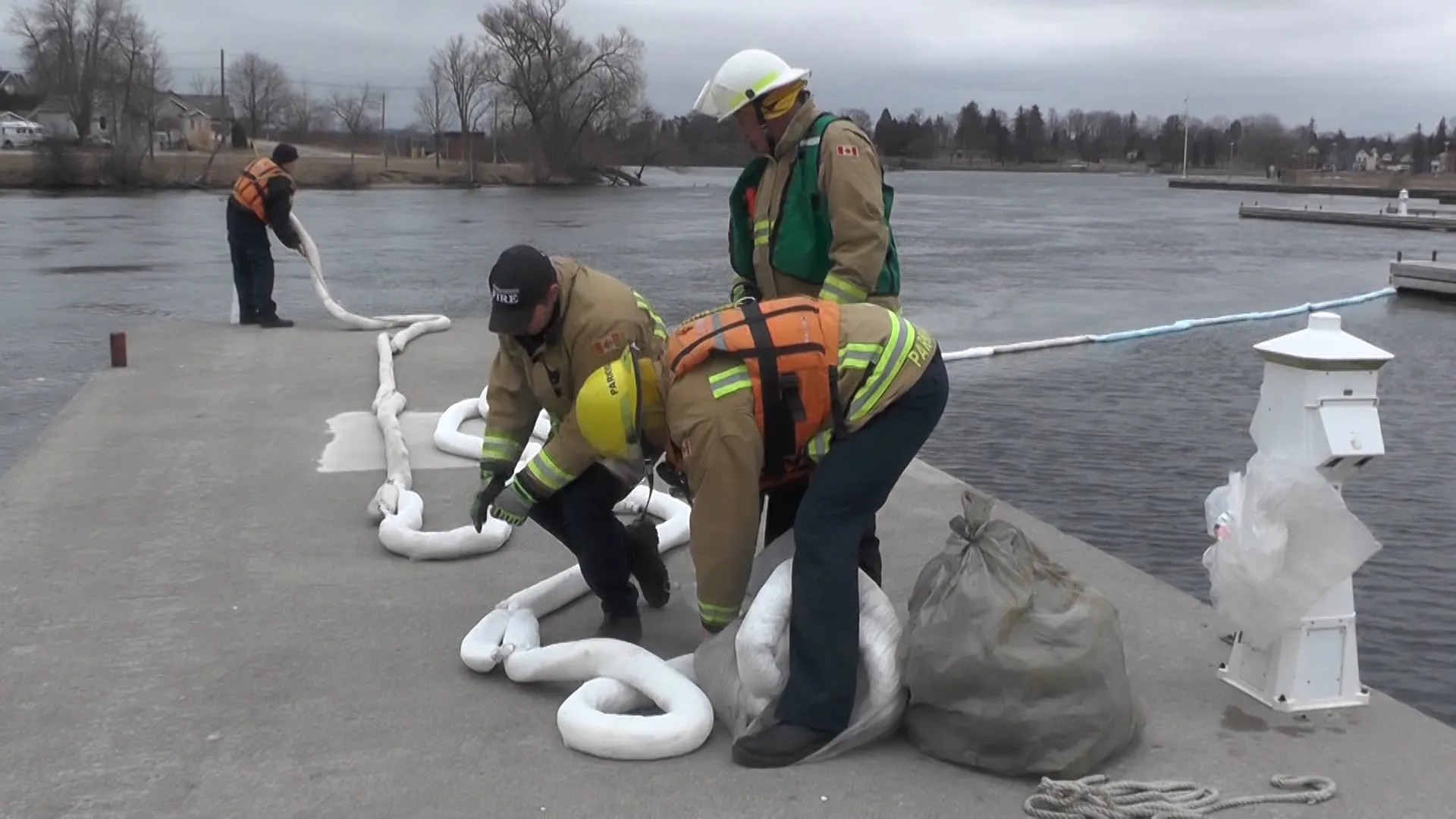
    Around mid-morning Wednesday, crews were called to the Peterborough Marina along George St. N. following reports of a substance flowing into the water.

    There aren’t any boats moored at the marina since it’s currently closed for the winter season.

    The substance has a strong odour.

    Fire officials say they working to contain the spill and have contacted the Ministry of the Environment to help determine what the substance is and to figure out a way to remove it from the water.

    Spill berms have been setup along the shoreline.

    Firefighters work to set up spill berms at the marina at Little Lake in Peterborough. Harrison Perkins/Special to CHEX News

    On Thursday, March 8, 2018, the Peterborough Examiner published Little Lake spill came from General Electric Peterborough plant:

    The contaminant that spilled into Little Lake on Wednesday was a petroleum product from a broken fire suppression line in one of the buildings at General Electric, says the Ministry of the Environment.

    The petroleum product flowed from GE’s storm sewer system into the city’s storm sewers and eventually into the lake, Ministry of the Environment and Climate Change spokesman Gary Wheeler stated in an email to The Examiner on Thursday.

    “GE retained a contractor and an environmental consultant to begin immediate cleanup and to complete a monitoring program at the site,” Wheeler wrote.

    An oily sheen on the water’s surface, as well as a gasoline smell, brought city firefighters to the marina at Little Lake on Wednesday morning

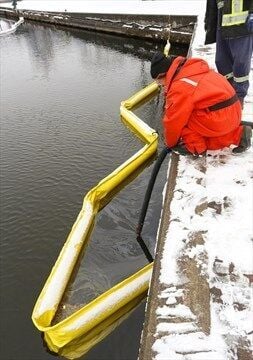
    Peterborough Fire Services set up inflatable marine booms to contain the spill on Wednesday, and ministry staff attended the scene too

    On Thursday there were contractors from Detox Environmental in Bowmanville on the scene, working to clean up the lake

    Wheeler wrote that the consultant added extra booms and also used a truck with a specialized vacuum hose to skim contaminated water from the marina

    Vacuum trucks were also made available to pump out catchbasins and storm sewer water along the municipal sewer system and on GE’s property, Wheeler wrote

    “Ministry staff continue to oversee all clean-up efforts and are working with GE and the city to ensure that the spill is contained and the natural environment is restored,” stated Wheeler.

    Jodi DeNoble, the city’s manager of emergency and risk management, said the contractor removed as much of the contaminant from the water as possible on Thursday. “The investigation is ongoing,” she said.

    General Electric Canada spokeswoman Jenna LaPlante issued the following response about Wednesday’s Little Lake spill:

    Environmental stewardship is a top priority for GE. GE is working in close partnership with the Ministry of Environment and the City of Peterborough to thoroughly investigate the situation and continue taking immediate steps to contain and mitigate a potential source area as quickly as possible.

    We are not aware of any spills from current manufacturing activities at the site. Sheens have been identified in one of the on-site sewer lines which entered the sewer as a result of water leaking from a fire suppression main located beneath the building floor.

    Immediately after we became aware of the situation, we dispatched teams to assess a potential source area and our teams have been actively engaged in implementing containment at our site, in the City sewers and at Little Lake.

    We are undertaking clean up measures to ensure this is adequately dealt with.

    These include inspecting the potential source area where the sheens are located and pumping up remaining sheen at Little Lake.

    We are working with our contractors, in consultation and cooperation with the City, the MOECC and others, as appropriate, to determine what the sheen is and determine any further work that may be required.

    Workers from Detox Environmental Marine Response Service remove contaminated sections of a boom during a cleanup of a spill on Thursday March 8, 2018 on Little Lake at Peterborough Marina in Peterborough, Ont.
    Clifford Skarstedt / Examiner Staff

    On Thursday, March 8, 2018, contractors from Detox Environmental in Bowmanville arrived with extra booms and a truck with a vacuum to skim contaminants from the water’s surface. The Ministry offered to provide Peterborough and GE with specialized trucks to pump out catchbasins and sewers in their respective stormwater systems.

    “Ministry staff continue to oversee all clean-up efforts and are working with GE and the city to ensure that the spill is contained and the natural environment is restored,” stated Wheeler.

    On March 8, 2018, Global News broadcast Broken fire suppression line at GE source of spill in Little Lake.

    An oily substance found in Little Lake on Wednesday has been coming from General Electric, Peterborough city officials have determined.

    Firefighters and the Ministry of the Environment and Climate Change (MOECC) spent the day containing a spill by setting up berms along the Peterborough Marina near George Street North. The substance had a strong odour but officials were not originally able to identify what it was.

    Barry Campbell, environment officer with the city, says officials traced the spill back to the GE site on Park Street North. “The source of the sheen discharging into Little Lake has been tracked to 107 Park St. N (GE),” he said in an email.

    “The exact location on-site has not been identified but City of Peterborough, Environmental Protection Division staff have installed primary containment on-site to reduce the amount of material making its way to Little Lake. ”

    Testing continues to determine what the substance is but it’s possibly fuel oil or diesel, said Campbell.

    Staff says the MOE has turned over the incident to GE which has hired Accurex to continue cleanup. There does not appear to be any environmental risks based on how quickly the spill was contained.

    “The elevated river level may be an issue with getting all of the residual oil out of the storm sewer between George St. and the sewer outlet,” Campbell said.

    UPDATE FRIDAY [March 9, 2018]:

    Officials say the source of the spill is a broken fire suppression line in one of GE’s on-site buildings.

    “The spilled hydrocarbons (i.e. petroleum product) flowed from GE’s storm sewer system into the city’s storm sewer system and eventually into Little Lake,” said Gary Wheeler with the MOECC.

    Wheeler says the ministry and GE have collected samples of the spilled material.

    “The environmental consultant has deployed additional marine booms in Little Lake and vacuum trucks are skimming the impacted water from the marina,” he said.

    “Vacuum trucks are also available to pump out impacted catch basins and storm water along the city’s storm sewer system and on GE’s property. Ministry staff continue to oversee all clean-up efforts and are working with GE and the city to ensure that the spill is contained and the natural environment is restored.”

    On March 23, 2018, Global News broadcast 2018-03-23 – Global News – Clean up continues on Little Lake after General Electric spill.

    Environmental crews continue to clean Little Lake after an oily substance was found in the water by the Peterborough Marina on Wednesday, March 7.

    Peterborough’s General Electric (GE) plant quickly took responsibility for the leak and hired the crews from Bowmanville to clean the mess.

    GE originally stated the substance was a petroleum product which leaked from a broken fire suppression line in the plant. The product then went through GE’s storm sewers, which connect with the City’s storm sewers and eventually lead to Little Lake.

    Experts says fire suppression lines only ever contain water, or in some cases air. It’s against the fire code for them to contain a petroleum product.

    CHEX News contacted GE through the Ministry of Environment Thursday [March 22, 2018] to clarify where the petroleum product came from.

    “The fire suppression line that discharged through to GE’s onsite storm sewer system was subsequently contaminated with hydrocarbons from GE’s property,” a spokesperson said.

    The Ministry went on to say the spilled carbons (a petroleum product) flowed through the sewers to the lake.

    GE did not say where the hydrocarbons came from on their property, or why the fire suppression line was discharged in the first place.

    GE has cleaned the oil out of the sewers that stretch from the plant to Little Lake. And the company hired to clean the lake has blocked off storm sewer lines from affected locations at the lake to ensure any left over residue does not leave the GE plant.

    The Peterborough Fire Department is not involved in the incident, but fire experts say clean ups involving oil can take a long time.

    They say one drop of oil can expand to cover 10 feet in the water. A cup of oil would cover the entire surface of Little Lake.

    The Ministry says staff collected samples and have submitted them to their laboratory for priority analysis. They say it’s not clear yet as to the specific quantity of product that was leaked.

    The Ministry says it is still reviewing the incident, and has not made any decisions on whether fines will be set.

    They’re continuing to assess whether any wildlife has been harmed by the spill.

    On May 2, 2018, Global News broadcast Chemical cleanup at Little Lake complete but contingency measures stay in place:

    The contamination and spilling of PCBs into Little Lake from the General Electric plant has been contained, said officials from the Ministry of the Environment and Climate Change.

    Environmental cleanup trucks have been on-site since March 7 after an oily sheen was visible in the water and seen flowing into the lake from a wastewater sewage outlet near the marina.

    General Electric immediately claimed responsibility for the spill, said Aaron Gordon, a senior environmental officer with the province and ensured sampling is ongoing as part of the cleanup and remediation process.

    They hired an environmental cleanup company which immediately set out marine booms in the vicinity and a vacuum truck has been skimming the impacted water from the marina.

    In a statement, GE said the hydrocarbon or petroleum product leaking into the sewage system originally came from one of its fire suppression lines inside the plant located a few blocks west of Little Lake.

    Gordon says the MOE is no longer concerned about the pollution levels in the water, as sampling results have shown a return to normal levels.

    “At this point, we are content with the cleanup efforts by GE,” said Gordon. “Hydrocarbons are relatively easily cleaned up and they appear to be all gone.”

    From a public health perspective, Dr. Rosana Salvaterra, the chief medical officer of health for the region says there are many concerns when contaminants enter the water.

    “Peterborough takes its drinking water from the Otonabee River,” she said. “The source is upstream and so there isn’t a concern with this current spill.

    “But in general, we have been aware of the monitoring by both the federal and provincial levels of government of the PCBs that are in the sediment, and we know the levels in the water itself do not pose a risk to the public health.”

    There is a legacy of toxic contamination in the Otonabee River that exists from previous industrial and manufacturing waste, and the ministry continues to monitor those levels, as well as monitoring the current spill.

    Still, PCBs are a problem because they don’t break down easily and persist in the environment, Salvaterra says, and suggests the chemicals are heavier than water and sink in the river.

    “They are in the sediment of our river and Little Lake but as long as we don’t disturb them, they are not a problem.”

    GE will continue to take samples and will be submitting them to the MOE for inspection but there is no timeline as to when the docks at the marina might open. The city is hopeful the site can open for business on May 18.

    Peterborough Public Health suggests there are no risks to the public’s health with relation to the spill and said that recreational use of the waterway is safe for all.

    May 2019 – Unattributed Spill

    On May 30, 2019, Global News broadcast Ministry of Environment probing spill in Little Lake in Peterborough:

    The Ministry of the Environment has been called in to investigate a spill in Little Lake in Peterborough.

    Around 10:30 p.m. on Wednesday, Peterborough firefighters responded to the lake near the marina following reports from anglers and boaters of an unknown substance in the water.

    The Ministry of the Environment has been called in to investigate a spill in Little Lake in Peterborough.

    Around 10:30 p.m. on Wednesday, Peterborough firefighters responded to the lake near the marina following reports from anglers and boaters of an unknown substance in the water.

    Firefighters worked to contain the substance, using booms to help stop its spread.

    A city employee took a sample of the substance to be tested.

    It’s not known yet how much of the substance was in the water.

    In March 2018, a broken suppression line from General Electric Peterborough caused a petroleum product to leak into the lake, which is located in the centre of the city.

    August 2022 – Unattributed Spill

    On August 26, 2022, Global News broadcast Cleanup continues for ‘fuel oil’ spill in Jackson Creek near Little Lake in Peterborough.

    The City of Peterborough, Ont., says cleanup continues following a “fuel oil” spill discovered at the south end of Jackson Creek near Little Lake.

    According to the city, the spill was identified Wednesday by the Ministry of the Environment, Conservation and Parks at the south end of Jackson Creek in the area of Townsend and Aylmer streets.

    The city notes the contamination is not discharging into Little Lake and water quality in the lake “has been maintained.”

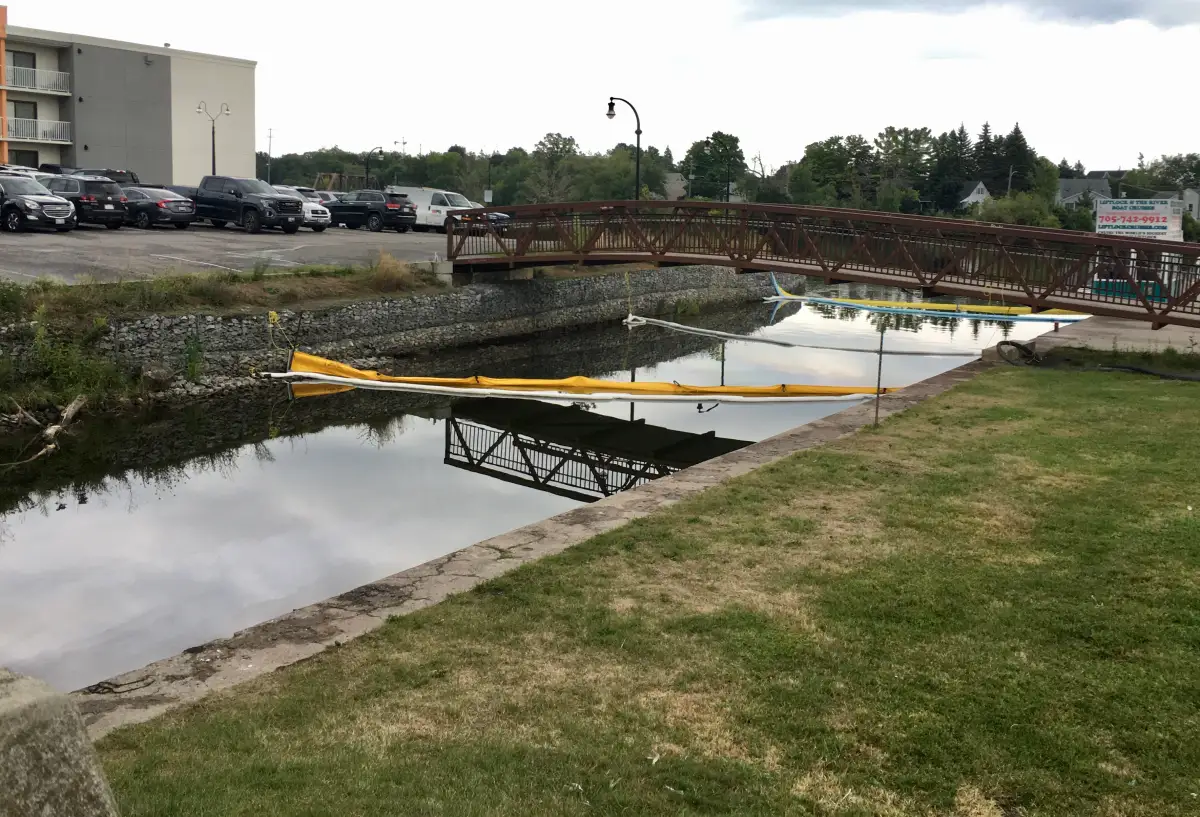
    Contamination of Jackson Creek near Little Lake in Peterborough as seen on Aug. 25, 2022. Harrision Perkins/Special to Global News Peterborough

    The city says it “immediately” established environmental protection measures to prevent the spill from discharging into Little Lake. The city has also retained an environmental consultant to investigate the source of the contamination as well as an environmental remediation specialist.

    “The area hosted many former industries, and the source has not been identified at this time,” the city stated. “Multiple property owners in the area have retained environmental consultants related to known contaminations and are working with the Ministry of the Environment.’

    The city notes contamination is being contained at the south end of Jackson Creek with environmental protection measures, and will “continue to be managed through the investigation.”

    Global News reached out to the Ministry for additional details on the incident.

    In an email, the ministry said on Aug. 24  contaminated groundwater (contaminated with oily hydrocarbons such as spilled fuel) was observed entering Jackson Creek.

    The ministry notes the city has retained the services of a clean-up company to contain and remediate impacts to Jackson Creek.

    “They have also retained the services of a qualified consultant to assess and take appropriate measures to address the groundwater contamination,” stated Aaron Gordon, senior environmental office.

    The ministry continues to monitor the situation to ensure that the City of Peterborough remediate any impacts to the environment.

    In late May 2019 the Ministry investigated an oily sheen found flowing into Little Lake from a storm sewer. In March 2018, a broken suppression line from former General Electric Peterborough facility caused a petroleum product to leak into the lake.

    [top]

    Licence

    We are publishing this material under a Creative Commons Attribution-NonCommercial-ShareAlike 4.0 International licence.
    CC BY-NC: Attribution-NonCommercial 4.0

    [top]

    • 1
      GE would attribute a “hydrocarbon sheen event” to a water main break under Building 14. See AECOM, 2024 PCB Monitoring Report for Stormwater and Groundwater, GEPR Peterborough Site, p. 16 ↩︎
  • Questions about GE’s Private Stormwater System

    On this page

    Applying Ontario’s Environmental Protection Act to GE

    In 2024, the Ministry of the Environment, Conservation and Parks (MECP) used four (partially overlapping) instruments under Ontario’s Environmental Protection Act (1990) to regulate GEPR Energy Canada’s (GE’s) properties in Peterborough, ON:

    1. Director’s Order GE-PTBO-DO001FA, dated December 10, 2018; revoked March 2024 and replaced by:
    2. Director’s Order 1-228916698, dated March 6, 2024
    3. Director’s Instructions for Interim PCB Waste Management — Monaghan Road, dated June 21, 1995; revoked May 2024 and replaced by Director’s Order 1-228916698, Appendix A: Requirements for the In-Situ Management of PCB-impacted Soils at the Monaghan Road Parking Lot on Site 2
    4. ECA 8032-BEJNAK, dated September 30, 2019.

    Director’s Order 1-228916698 applies to two Sites on GE’s properties:

    • “Site 1” means the property with two municipal addresses of 107 Park Street and 1160 Monaghan Road, Peterborough, ON with the following Property Identifier Number 28081-0123.
    • “Site 2” means the property with two municipal addresses of 1063 and 1091 Monaghan Road, Peterborough, ON with the following Property Identifier Number 28067-0046.

    Director’s Order GE-PTBO-DO001FA, dated December 10, 2018, covered two additional GE properties, until March 6, 2024:

    • “Site 3” means the property located at 297 Rink Street, Peterborough, ON with the following Property Identifier Number 28091-0139.
    • “Site 4” means the property located at 107 Rubidge Street, Peterborough, ON with the following Property Identifier Number 28091-0137.

    Director’s Instructions for Interim PCB Waste Management – Monaghan Road covered Site 2, until May 8, 2024.

    The MECP agreed to GE’s request that Site 3 and Site 4 be excluded from Director’s Order 1-228916698.1“On March 16, 2023, GEPR requested that Site 3 and Site 4 be removed from this Director’s Order. Those two properties were included in the previous order as there are monitoring wells located on them that are part of the Site monitoring program. However, the monitoring wells are being replaced with new monitoring wells to be located on adjacent off-property locations by GEPR, which is acceptable to the Ministry, and therefore it is appropriate to remove them as reflected in this Order.” Ministry of the Environment, Conservation and Parks, Director’s Order 1-228916698, March 6, 2024, p. 6. The 2024 PCB Monitoring Report for Stormwater and Groundwater prepared by GE’s consultant, AECOM Canada ULC (AECOM), included findings for Site 3 and Site 4 per Director’s Order GE-PTBO-DO001FA, and findings for Site 2 per the 1995 Director’s Instructions.
    [top]

    Monitoring PCBs in GE’s Groundwater and Stormwater

    Director’s Order 1-228916698 identifies polychlorinated biphenyls (PCBs) as one of two primary contaminants of concern associated with Site 1 and Site 2 – the other being trichloroethylene (TCE) and its degradation compounds, such as dichloroethylene and vinyl chloride:

    The main concern regarding potential off-site environmental impacts associated with the PCB contamination at the Site is for PCB molecules to be transported off-site via water discharges into the municipal storm water sewer system which flows eastward along Rink Street and discharges into Little Lake and the Otonabee River.

    Little Lake and the Otonabee River also subject to recreational water activities, and exposure to PCB contaminated waters and sediment may represent a human health risk. PCBs also transfer up the ecological food chain to other aquatic, terrestrial and avian species within which the contaminants may bioaccumulate and result in ecological impacts. As such, further inputs of PCBs to Little Lake and the Otonabee River system should be mitigated.

    Various studies have shown that deposits of PCB contaminated sediments are present in Little Lake and further downstream along the Otonabee River and in Rice Lake, which the Otonabee flows into, located approximately 20 kilometres south of the City of Peterborough.

    Studies have shown that PCBs are present within the tissues of sport fish collected from the Otonabee River and Rice Lake at concentrations that have caused fish consumption advisories to be issued and which should be followed for the protection of human health; refer to the MECP’s online ‘Guide to Eating Ontario Fish’. The Hiawatha First Nation community is located on the north shore of Rice Lake and community members, as well as other sport fishers, consume fish from the lake. …

    In regard to the PCB storm water sewers (water and sediment) and groundwater monitoring programs, MECP Eastern Region Technical Support Section reviews annual monitoring reports and provides comments that are reviewed with GEPR to guide further monitoring activities and site management actions. The reviews to date have recommended continuation of the ongoing monitoring program.

    Considering the long-term and wide-spread nature of the PCB contamination at the Site, and the ongoing instances of PCB contaminant concentrations in storm water discharges from the Site, it is expected that the PCB monitoring program will continue to be required of GEPR for many years to monitor the effectiveness of its actions to control, prevent and mitigate PCB discharges from the Site to the natural environment.2Ministry of the Environment, Conservation and Parks, Director’s Order 1-228916698, March 6, 2024, pp. 8, 11.

    Details of GE’s program for monitoring PCBs in the groundwater and stormwater include:3See Director’s Order 1-228916698, Appendix B, Table 1: Groundwater Monitoring and Sampling Program, Table 3: Storm Sewer Monitoring Program, Figure 1A: Groundwater Monitoring and Sampling Location PCB at Facility,  Figure 1B: Groundwater Monitoring and Sampling Location PCB at Monaghan Road Parking Lot, and Figure 3: Storm Water Monitoring Locations.

    • Groundwater monitoring
      • Site 1: 3 monitoring wells
      • Site 2: 7 monitorong wells
      • Monitoring wells are sampled for Total PCB one time per year in the spring.
      • Monitoring includes measuring groundwater levels.
    • Stormwater monitoring
      • Site 1: 13 outfalls
      • Site 2: 4 outfalls
      • City of Peterborough: 5 manholes
      • Little Lake: sample taken 15 m from culvert inlet
      • Most storm sewer outfalls, including 3 City of Peterborough storm sewer manholes, are sampled three times per year during or immediately following a rain event (10 mm).
      • City of Peterborough manhole (MH135703), located near the intersection of George and Rink Streets, is sampled six times per year.
      • Where present, stormwater will be sampled for Total PCB (including Aroclors) and Total Suspended Solids (TSS).
      • Where present, sediment will be sampled for Total PCB and TSS and its thickness measured.

    [top]

    Questions about GE’s Private Stormwater System

    AECOM’s documentation of its monitoring of PCB raises a critical question about whether GE’s private stormwater system somehow connects to the City’s public stormwater system.

    On the one hand, AECOM’s 2024 PCB Monitoring Report for Stormwater and Groundwater  (Appendix K: Storm Sewer Data Summary) makes no mention of any connection between the two systems. AECOM usually remarks that the run-off of rainwater from different Zones of GE’s properties “feeds” or “flows toward” the City’s stormwater system:

    • Zone 1 “feeds the municipal storm sewer [STM.MH136551] on Wolfe Street, located north of the Site [1]”
    • Zone 2 “feeds the municipal storm sewer [STM.MH135683] on Park Street, located east of the Site [1]”
    • Zone 3 “feeds the municipal storm sewer on Albert Street. located south of the Site [1] … all of which flow towards City storm sewer MH135686”
    • Zone 4 “feeds the municipal storm sewers on Monaghan Road and Frank Street, located east and south of the Monaghan Road Property [Site 2]”
    • Zone 5 “feeds the municipal storm sewer on Monaghan Road [Site 2] … Some of the surface water from this area flows overland toward city CBs located on Monaghan Road. In 2016, MH166902 was established as the outfall monitoring location for Zone 5 … [and] collects stormwater drainage from Zone 5 and parts of Monaghan Road”
    • Zone 6 “feeds the municipal storm sewer on Rubidge and Townsend Street [Site 4] … All the water flows toward the STM.MH135686”
    • Zone 7 feeds the municipal storm sewer on Rubidge Street [Site 3] … All the water flows toward the STM.MH135686″

    On the other hand, AECOM’s Storm Sewer Monitoring Program seems to indicate that 15 of the 17 outfalls from Site 1 and Site 2 actually connect to the City’s stormwater system. AECOM puts asterisks beside two outfalls (CBR140 and CBR142) in Table 3 to indicate “Catch basin not connected to City storm sewer system. These locations will be monitored but will not be considered representative of storm water outfall from Site.”4Director’s Order 1-228916698, Appendix B, Table 3: Storm Sewer Monitoring Program.

    The question of whether GE’s private stormwater system connects to Peterborough’s public stormwater system seems critical to evaluating the efficacy of GE’s program for monitoring PCB in the stormwater. Accordingly, I have sought clarification from the Director, Peterborough District Office, MECP.

    According to AECOM’s 2024 PCB Monitoring Report for Stormwater and Groundwater, GE’s private stormwater system includes at least 162 catchbasins and manholes at Site 1 and Site 2 [p. ii]. AECOM’s maps of the Zones/Catchment Areas/Sub-catchment Areas associated with Site 1 and Site 2 in Appendix K refer to multiple features of GE’s stormwater system, including:

    • Storm Sewer Catchbasin
    • Decommissioned Storm Sewer Catchbasin
    • Storm Sewer Catchbasin – Below Water Table
    • Storm Sewer Manhole
    • Storm Sewer Manhole – Below Water Table
    • Storm Sewer – Below Water Table
    • Storm Sewer System (Underground)
    • Storm Sewer System (Overhead)
    • Inspected Sewer Pipe
    • Damaged Sewer Pipe
    • Jellyfish System

    The MECP has provided low-resolution, grayscale copies of these maps to the Canadian Environmental Law Association. Unfortunately, these images obscure many of features of GE’s stormwater system. I have asked the Director, Peterborough District Office, MECP for help in obtaining the higher-resolution, colour images copies of AECOM’s original submission of Appendix K.

    Findings

    Forthcoming.

    [top]

    Licence

    We are publishing this material under a Creative Commons Attribution-NonCommercial-ShareAlike 4.0 International licence.

    CC BY-NC: Attribution-NonCommercial 4.0

    [top]

    • 1
      “On March 16, 2023, GEPR requested that Site 3 and Site 4 be removed from this Director’s Order. Those two properties were included in the previous order as there are monitoring wells located on them that are part of the Site monitoring program. However, the monitoring wells are being replaced with new monitoring wells to be located on adjacent off-property locations by GEPR, which is acceptable to the Ministry, and therefore it is appropriate to remove them as reflected in this Order.” Ministry of the Environment, Conservation and Parks, Director’s Order 1-228916698, March 6, 2024, p. 6. ↩︎
    • 2
      Ministry of the Environment, Conservation and Parks, Director’s Order 1-228916698, March 6, 2024, pp. 8, 11. ↩︎
    • 3
      See Director’s Order 1-228916698, Appendix B, Table 1: Groundwater Monitoring and Sampling Program, Table 3: Storm Sewer Monitoring Program, Figure 1A: Groundwater Monitoring and Sampling Location PCB at Facility,  Figure 1B: Groundwater Monitoring and Sampling Location PCB at Monaghan Road Parking Lot, and Figure 3: Storm Water Monitoring Locations. ↩︎
    • 4
      Director’s Order 1-228916698, Appendix B, Table 3: Storm Sewer Monitoring Program. ↩︎
  • Why has the Ministry adopted far less stringent criteria for cleaning up GE’s contamination of the groundwater

    After 20 years of what the Ministry of the Environment (Ministry) has termed General Electric’s “voluntary” monitoring and remediation of contaminants associated with its operations in Peterborough, something triggered the engagement of Conestoga-Rovers & Associates (CRA) to conduct further studies. Perhaps the trigger was the Environmental Protection Agency’s holding GE accountable for contaminating multiple sites across the United States or the Ministry’s own findings of the contamination of Little Lake, the Otonabee River, and Rice Lake.

    Whatever the trigger, between 2001 – 04, CRA issued four reports that:1(1) Remedial Action Plan for Trichloroethene Groundwater Concentrations, GE Industrial Systems Facility, Peterborough, Ontario. Conestoga-Rovers & Associates, May 22, 2001. (2) Site-Specific Risk Assessment, GE Industrial Systems Facility, Peterborough, Ontario. Conestoga-Rovers & Associates, March 1, 2002. (3) Perimeter Groundwater Extraction and Treatment System Pilot Study Interim Report, GE Industrial Systems Facility, Peterborough, Ontario. Conestoga-Rovers & Associates, August 8, 2003. (4) Perimeter Groundwater Extraction and Treatment System Pilot Study Final Report, GE Industrial Systems Facility, Peterborough, Ontario. Conestoga-Rovers & Associates, February 26, 2004.:

    1. Surveyed the geology and hydrogeology in GE’s vicinity.
    2. Delineated the migration of Volatile Organic Compounds (VOCs) like trichloroethylene (TCE), from GE’s property into Peterborough’s groundwater.
    3. Summarized the results of its Site Specific Risk Assessment (SSRA).
    4. Prepared a Remediation Action Plan (RAP), including the installation of a Groundwater Extraction and Treatment System (GETS).

    We are awaiting the Ministy’s response to our FIPPA request for the release of CRA’s initial reports.

    Meanwhile, we will rely on a Ministry hydrogeologist’s account of CRA’s key findings:2Memorandum of F. Crossley, Hydrogeologist, April 23, 2015, p. 6. Source: Director’s Order GE-PTBO-DO001FA, December 10, 2018, Appendix D.

    1. Geology and hydrogeology
      1. The geology in GE’s vicinity consists of a silty sand and gravel unit varying from 2 – 10 metres in thickness below ground surface, on top of a silty clay unit about 18 metres in thickness.
      2. The groundwater was at about 2-3 metres below ground surface.
    2. Migration of contaminants
      1. Contaminants of concern were determined to be TCE and its breakdown products, like dichloroethylenes (DCE’s) and vinyl chloride (VC).
      2. CRA determined that a plume of contaminants in the groundwater extended south from the GE plant to between Parnell Avenue and Romaine Street.
      3. CRA modelled the horizontal migration of contaminants in the shallow silty sand unit (unconfined aquifer) from GE’s property to the south, southeast. A city sanitary sewer along Park Street impeded the migration of contaminants to the east. The underlying silty clay unit (aquitard) restricted the vertical migration of contaminants.
      4. CRA identified Building 12 as the main “source area” of TCE.
    3. Site Specific Risk Assessment (SSRA)
      1. CRA began its risk assessment with reference to the clean-up criteria given in “Table 3: Full Depth Generic Site Condition Standards in a Non-Potable Ground Water Condition” of the Soils, Ground Water and Sediment Standards under Part XV.1 of the Environmental Protection Act.
      2. CRA completed a “Site Specific Risk Assessment” that proposed less stringent clean-up criteria for the groundwater that GE had contaminated.
      3. The Ministry accepted CRA’s less stringent clean-up criteria in 2002.
    4. Remediation Action Plan (RAP)
      1. A Groundwater Extraction and Treatment System (GETS), comprising seven extraction wells and an air stripper, was installed along the GE property’s southern boundary on Albert Street.
      2. The GETS was meant to provide “hydraulic control” – that is, to minimize the further migration of contaminants from GE into the groundwater. The GETS was not designed to “pull back” contaminants that had already migrated from GE’s property.
      3. The remediation of groundwater that had already been contaminated would depend solely on “Monitored Natural Attenuation” (MNA).
      4. The Ministry accepted CRA’s Remediation Action Plan in 2001.

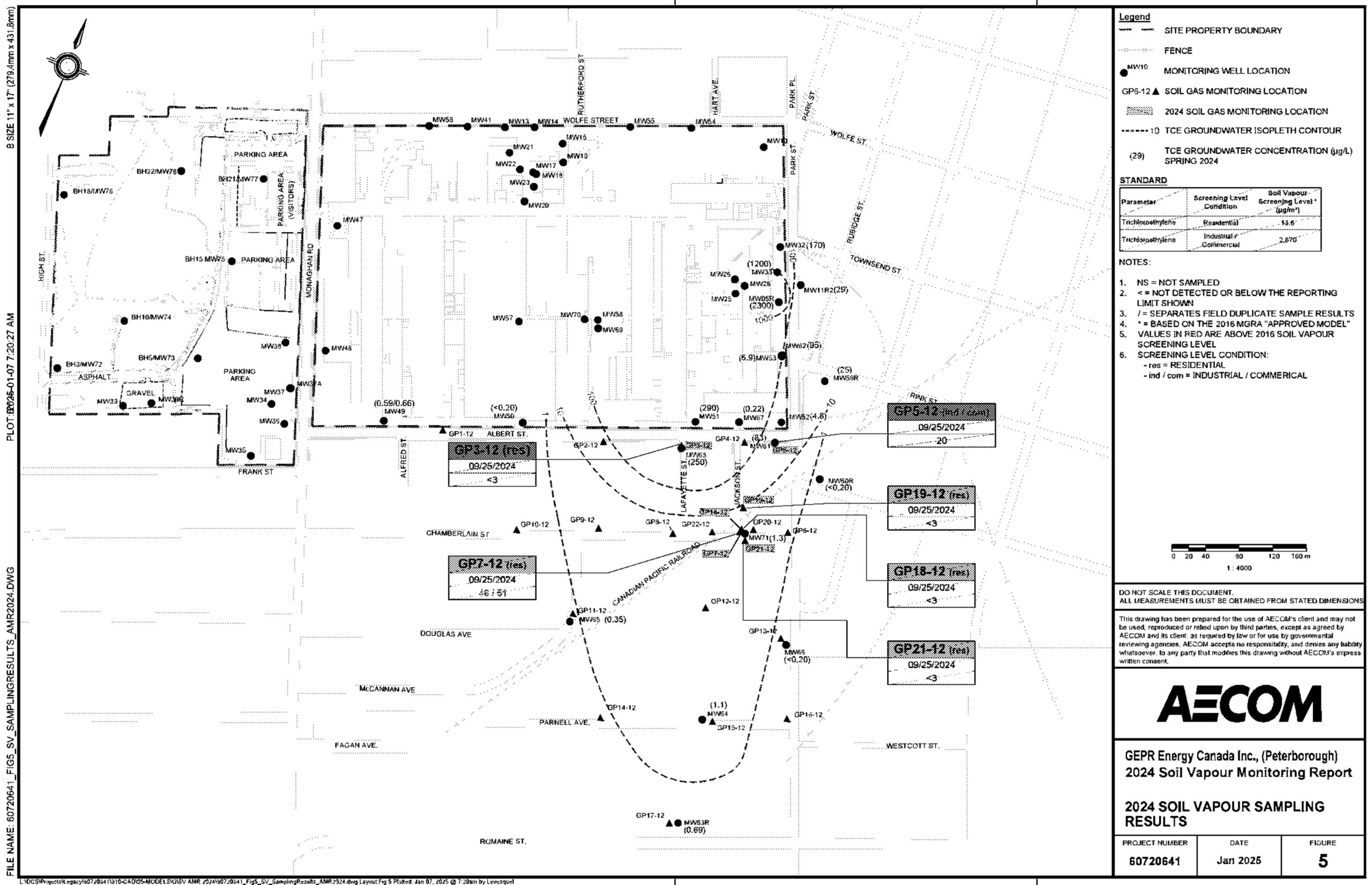
    Figure 1 presents a recent depiction of the plume of VOCs in Peterborough’s groundwater from AECOM/GE’s 2024 Soil Vapour Monitoring Report that the Canadian Environmental Law Association (CELA) obtained from the Ministry. In a later post, we will detail what we know – and don’t know – about GE’s contamination of Peterborough’s groundwater.

    Figure 1. Isopleth contour of plume of TCE in the groundwater south/southeast of GE’s property. Source: “Figure 5: 2024 Soil Vapour Sampling Results,” AECOM/GE, 2024 Soil Vapour Monitoring Report, February 2025.

    Right now, we want to examine the Ministry’s acceptance of the clean-up criteria for GE’s contamination of Peterborough’s groundwater that CRA had put forward in its Site Specific Risk Assessment (March 2002).

    Under Part XV.1 of Ontario’s Environmental Protection Act, the Ministry has established standards for prescribed contaminants of groundwater under multiple combinations of conditions, including:

    • Soil Texture (coarse vs medium/fine)
    • Overburden Thickness (full depth vs shallow)
    • Land Use (residential/parkland/institutional vs industrial/commercial/community)
    • Groundwater Potability (potable vs non-potable)

    A property is said to be meet Ministry standards provided that no prescribed contaminant is present in its groundwater at a concentration that exceeds applicable standards.

    With respect to GE’s property, a Ministry hydrogeologist has reported that CRA derived its cleanup criteria from Table 3: Full Depth Generic Site Condition Standards in a Non-Potable Ground Water Condition, though the hydrogeologist goes on to note that “CRA state that they undertook a Site Specific Risk Assessment and determined … groundwater site specific risk based cleanup criteria. CRA state that the Ministry concurred (2002) with the site specific risk based cleanup criteria.”3Memorandum of F. Crossley, Hydrogeologist, April 23, 2015, p. 4. Source: Director’s Order GE-PTBO-DO001FA, December 10, 2018, Appendix D.

    Our Table 1 presents CRA’s GE-specific cleanup criteria alongside the Ministry’s standard cleanup criteria for the contaminants of concern found in the groundwater south of the GE.

    Table 1: Standard vs GE-Specific Cleanup Criteria for Contaminated Groundwater

    Prescribed Contaminant Standard Cleanup Criteria
    for Groundwater
    (µg ⁄ L)
    GE-Specific Cleanup Criteria
    for Groundwater
    (µg ⁄ L)
    Maximum Concentration
    (GE-Specific vs Standard Criteria)
    Tetrachloroethylene (PCE) 1.6 1,060 662.5
    Trichloroethylene (TCE) 1.6 1,098 686.3
    Dichloroethylene, 1,1 (1,1-DCE) 1.6 3 1.9
    Dichloroethylene, 1,2 cis (cis-1,2-DCE) 1.6 1,617 1,010.6
    Dichloroethylene, 1,2 trans (trans-1,2-DCE) 1.6 no criterion undefined
    Vinyl Chloride 0.5 1.5 3.0

    Observe that the Ministry has adopted CRA’s criteria for cleaning up the groundwater contaminated by GE that are far more permissible than the Ministry’s standard cleanup criteria. For example, the GE-specific maximum concentration of TCE in groundwater is 683.3 (1,098/1.6) times greater than the Ministry’s standard maximum concentration of TCE in groundwater.

    1. Why did the Ministry adopt CRA’s far less stringent criteria for cleaning up the groundwater contaminated by GE?
    2. What additional risks do residential and commercial properties south of GE face from upward soil vapour migration of TCE and other VOCs, given the Ministry’s having adopted CRA’s far less stringent cleanup criteria?
    3. If the Ministry were to apply the standard cleanup criteria to the contaminated groundwater south of GE, how would GE’s Groundwater Extraction and Treatment System need to be improved?
    4. GE’s Groundwater Extraction and Treatment System aims to minimize the further migration of TCE and other VOCs into the neighbourhood – not to reduce the concentration of contaminants that have already escaped from GE’s property. What other measures would need to included in GE’s Remediation Action Plan to reduce the concentration of contaminants, beyond what “natural attenuation” is slowly accomplishing?

    Good Neighbours Deserve Answers.

    Licence

    We are publishing this material under a Creative Commons Attribution-NonCommercial-ShareAlike 4.0 International licence. If you find use for our work, please credit Paul Allen (https://paulallen.ca).

    CC BY-NC: Attribution-NonCommercial 4.0

    • 1
      (1) Remedial Action Plan for Trichloroethene Groundwater Concentrations, GE Industrial Systems Facility, Peterborough, Ontario. Conestoga-Rovers & Associates, May 22, 2001. (2) Site-Specific Risk Assessment, GE Industrial Systems Facility, Peterborough, Ontario. Conestoga-Rovers & Associates, March 1, 2002. (3) Perimeter Groundwater Extraction and Treatment System Pilot Study Interim Report, GE Industrial Systems Facility, Peterborough, Ontario. Conestoga-Rovers & Associates, August 8, 2003. (4) Perimeter Groundwater Extraction and Treatment System Pilot Study Final Report, GE Industrial Systems Facility, Peterborough, Ontario. Conestoga-Rovers & Associates, February 26, 2004. ↩︎
    • 2
      Memorandum of F. Crossley, Hydrogeologist, April 23, 2015, p. 6. Source: Director’s Order GE-PTBO-DO001FA, December 10, 2018, Appendix D. ↩︎
    • 3
      Memorandum of F. Crossley, Hydrogeologist, April 23, 2015, p. 4. Source: Director’s Order GE-PTBO-DO001FA, December 10, 2018, Appendix D. ↩︎
  • Why did the Ministry give up authority over GE’s contamination of its Monaghan Road Parkng Lot with PCBs?

    On this page

    Background

    On June 21, 1995, the Ministry of Environment and Energy (Ministry) issued Director’s Instructions to General Electric that accorded with GE’s own proposals for the interim in-situ management of PCB waste at GE’s Monaghan Road Parking Lot.

    The Director’s Instructions included these provisions:

    1. On annual basis, GE will conduct a “review of commercially available and financially feasible destruction or disposal methods for the PCB materials stored at the interim PCB waste management area.” [provision 4]
    2. In an Annual Report, GE will summarize the results of its review of these methods to the Ministry. [provision 4]
    3. In its Annual Report, GE will provide details justifying the continuation of the use of the interim PCB waste management area to the Ministry. [provision 6]
    4. Once a destruction method becomes commercially available for the destruction of all PCB material located at the interim PCB waste management area, GE will provide a timetable for this destruction to the Ministry within six months. [provision 6]

    On March 6, 2024, the Ministry issued Director’s Order 1-228916698. The Director’s Order replaced the Director’s Instructions of 1995 and eliminated – with no explanation – any provision in the Director’s Instructions for GE someday destroying or disposing of PCB waste at the Monaghan Road Parking Lot.

    Questions for the Ministry

    1. Under the terms of the Director’s Instructions of June 1995,
      1. What methods had GE reviewed annually for destroying or disposing of the PCB waste at its Monaghan Road Parking Lot?
      2. What results of these reviews had GE included in its Annual Reports on its ground and surface water monitoring program?
      3. What justifications for continuing to maintain PCB waste at its Monaghan Road Parking Lot had GE included in these Annual Reports?
    2. In the Ministry’s opinion,
      1. What methods are currently available for destroying or disposing of the PCB waste at GE’s Monaghan Road Parking Lot?
      2. Are any of these methods financially feasible for GE?
    3. Will the Ministry reinstate the provisions in the Director’s Instructions for GE someday destroying or disposing of PCB waste at its Monaghan Road Parking Lot?

    See my correspondence with David Bradley, Director, Peterborough Distict Office, MECP and Dave Smith, MPP on September 17, 2026.

    Good Neighbours Deserve Answers.

    Ministry’s Response

    On October 13, 2026, the Ministry provided this response:

    “GE Vernova is responsible for determining available remediation options, including their technical applicability, commercial availability, and associated costs, relating to their management of on-site contaminants.

    “In August 2020, both a Human Health Risk Assessment and Ecological Risk Assessment were conducted by AECOM consulting on behalf of General Electric Canada for the 1063 Monaghan Road site. These assessments were undertaken using Risk Assessment considerations made under Ontario Regulation 153/04 [Records of Site Condition] under the Environmental Protection Act.

    “Based on the Risk Assessments, the ministry considers the current management practices at the site to be acceptable. As detailed by the Director’s Order, continued monitoring will be undertaken to confirm the ongoing effectiveness of the management strategy and to ensure risks remain appropriately mitigated.

    “Considering these findings, revocation of the Director’s Instructions, with continued oversight through the requirements of the Director’s Order, was considered the most appropriate regulatory approach and tool for the site at this time.”

    See the response from David Fisher, Supervisor (Acting) with the Ministry of the Environment, Conservation and Parks (MECP).

    It’s concerning that the MECP gave the public no opportunity to comment on AECOM’s Human Health Risk Assessment and Ecological Risk Assessment in 2020 before giving up authority over GE’s PCB contamination of the Monaghan Road Parking Lot.

    On October 19, 2026, the MECP acknowledged receipt of my FIPPA request for the following records: (1) AECOM’s Human Health Risk Assessment (August 2020) for GE’s 1063 Monaghan Road site; (2) AECOM’s Ecological Risk Assessment (August 2020) for GE’s 1063 Monaghan Road site; and (3) Any additional Human Health Assessment or Ecologicial Risk Assessment that AECOM conducted for GE’s other sites on Monaghan Road or Park Street North.

    See the MECP acknowledgement of my FIPPA request.

    Meanwhile, we may infer from Ontario Regulation 153/04 that

    • A qualified person has taken a sample of sediment, soil or ground water from the land or water on, in or under a property for the purpose of analysing the sample for a contaminant as part of a risk assessment. (s. 47(1) Analytical procedures), and
    • A qualified person has submitted a sample to a laboratory for analysis for a contaminant in accordance with the Analytical Protocol, unless the laboratory has obtained the written permission of the Director to use another analytical method for that contaminant. (s. 47(2) and s. 47(4))

    Ontario Regulation 153/o4 makes no mention of either “Human Health Risk Assessment” or “Ecological Risk Assessment” that the MECP’s response references. However, the Analytical Protocol, buried inside Ontario Regulation 153/04, includes seven references to publications of the Canadian Council of Ministers of the Environment, some of which point to .

    In turn, these references include:

    • One bibliographic reference:
      • “CCME – Canadian Council of Ministers of the Environment” (Acronyms, p. 6)
    • Three irrelevant references fo Petroleum Hydrocarbons:
      • “PHCs in soil and sediment E3421 Note: The analysis of petroleum hydrocarbons (PHCs) must be in accordance with the Canadian Council of Ministers of the Environment (CCME) method2, which is composed of both ‘prescriptive’ and ‘performance based’ elements” (p. 40)
      • “Canadian Council of Ministers of the Environment (CCME) “Reference Method for the Canada wide Standard for Petroleum Hydrocarbons (CWS-PHC) in Soil – Tier 1 Method.” (fn 2, p. 40)
      • “Canadian Council of Ministers of the Environment (CCME). Reference Method for the Canada wide Standard for Petroleum Hydrocarbons (CWS-PHC) in Soil – Tier 1 Method. 2001” (References, p. 103)
    • Three potentially relevant references:
      • “This protocol sets out the sample handling and storage requirements, analytical methods and method specific quality control and assurance procedures for laboratories established by recognized organizations: … Canadian Council of Ministers of the Environment (CCME)” (p. 12)
      • “The analytical methods described in this section derive from the following sources: … “Canadian Council of Ministers of the Environment (CCME). Guidance Manual for Environmental Characterisation in Support of Environmental and Human Health Risk; Volume IV: Compendium of Analytical Methods for Contaminated Sites (2015 release date TBD)” (p. 32)
      • “Canadian Council of Ministers of the Environment (CCME). Guidance Manual for Environmental Characterisation in Support of Environmental and Human Health Risk; Volume IV: Compendium of Analytical Methods for Contaminated Sites (2015 release date TBD)” (References, p. 103)

    The Canadian Council of Ministers of the Environment (CCME) addresses “Environmental Characterization in Support of Environmental and Human Health Risk” in four volumes:

    I will wait for the MECP’s response to my FIPPA request for AECOM’s Human Health Risk Assessment and Ecological Risk Assessment for GE’s 1063 Monaghan Road site (August 2020) before assessing AECOM’s assessments against the standards and methodologies set by the Canadian Council of Ministers of the Environment..

    Licence

    We are publishing this material under a Creative Commons Attribution-NonCommercial-ShareAlike 4.0 International licence. If you find use for our work, please credit Paul Allen (https://paulallen.ca).

    CC BY-NC: Attribution-NonCommercial 4.0

  • Director’s Instructions vs Director’s Order

    Under Ontario’s Environmental Protection Act (EPA), R.R.O. 1990, Regulation 362 (Waste Management — PCBs) governs how polychlorinated biphenyls (PCBs) must be handled, stored, and disposed of. [1, 2, 3]

    This specific regulation perfectly illustrates how the MECP uses both Director’s Instructions and Director’s Orders to manage high-risk environmental hazards.

    1. Director’s Instructions under Reg 362 (Operational Approval)

    Because PCBs are highly regulated toxic substances, you cannot simply manage or decontaminate them however you see fit. Reg 362 establishes a framework where a site containing PCB waste must operate under strict technical rules. [3]

    • How it works: Under Section 1 of Reg 362, materials are no longer legally deemed “PCB waste” if they have been successfully decontaminated according to instructions issued by the Director. [1]
    • The Role: The Director issues a formal set of Director’s Instructions to a facility or mobile processing unit. These instructions lay out the approved procedural script: exactly how a company must contain, monitor, treat, or temporarily store the PCBs. [3, 4, 5]
    • The Legal Context: It is an administrative mechanism. Following these instructions keeps the facility in legal compliance with Reg 362. [3]

    2. Director’s Orders under Reg 362 (Enforcement & Remediation)

    If a company fails to follow Reg 362, or if a legacy site has unmanaged, buried, or leaking PCB-contaminated soil, the Ministry shifts from administrative guidance to mandatory enforcement. [6]

    • How it works: If a historic site has an old underground cell or container leaking PCBs, the MECP Director will issue a formal Director’s Order (e.g., under EPA Section 17, 18, or 196). [6]
    • The Role: This order legally compels the property owners, polluters, or corporate officers to take immediate corrective measures. It can mandate that they hire engineers, install security fences, perform mandatory continuous monitoring, or excavate and safely remove the PCB waste to a certified facility. [1, 6]
    • The Legal Context: This is a punitive and remedial enforcement tool. Violating a Director’s Order issued for a Reg 362 infraction crosses the line into a prosecutable provincial offense. [6]

    Summary of the Difference in a Reg 362 Context

    Feature Director’s Instruction (Reg 362) Director’s Order (Reg 362)
    Trigger A spill, contamination, or failure to comply with the rules. A spill, contamination, or failure to comply with the rules.
    Tone “Here is the approved technical protocol you must follow to handle this waste.” “You are legally commanded to clean up this site by X date or face prosecution.”
    Goal Safe, authorized operational management of PCBs. Immediate hazard mitigation and environmental remediation.
  • MECP Director’s Order Number 1-228916698

    On this page

    Part A – Work Ordered

    Director’s Order Issued To
    GEPR ENERGY CANADA INC. 1919 MINNESOTA CRT SUITE 100, MISSISSAUGA, ON, L5N 0C9

    Site
    General Electric
    107 PARK ST N, PETERBOROUGH, ON, K9J 3V6

    This work is ordered pursuant to my authority under EPA | 132 | (1), EPA | 18 | (1), EPA | 197 | (1), I order you to do the following:

    Item No. 1

    Within fifteen days of service of this Order, submit written confirmation to the Director by email to [email protected] and environment. [email protected] that the Qualified Consultant that was retained to comply with the requirements of Director’s Order GE-PTBO DO001FA continues to be retained to conduct the work required by this Order. The written confirmation shall include confirmation from the Qualified Consultant that they have, (1) received a copy of this Order; (2) been retained to carry out the work; and (3) the experience and qualifications to carry out such work.

    Item No. 2

    Within thirty days of service of this Order, arrange for the Qualified Consultant retained as a result of Item No. 1 to commence the activities and tasks associated with Contaminants of Concern at the Site as detailed in Appendices A and B, and arrange for the Qualified Consultant to continue to undertake the activities and tasks identified in Appendices A and B in accordance with the timelines set out in the appendices until the Director revokes or amends this Order.

    Item No. 3

    Within thirty days of service of this Order, submit to the Director by email to [email protected] and [email protected] for acceptance, a Financial Assurance evaluation in accordance with the Ministry’s Financial Assurance Guideline F-15, which shall specify the amount of Financial Assurance to be provided to the Ministry to provide sufficient funds to implement and complete the ongoing work required by Item No. 2 of this Order and detailed in Appendices A and B. The Financial Assurance evaluation shall include written analyses, detailed and itemized calculations, and, if necessary, accounting documents to provide a justification of the proposed amount.

    Item No. 4

    Within sixty days of receipt of the Director’s acceptance of the Financial Assurance evaluation submitted pursuant to Item No. 3 of this Order, submit to the Director in accordance with the instructions set out in the acceptance, payment of the accepted amount of Financial Assurance.

    Item No. 5

    Commencing on October 31, 2027, and every four years thereafter until the Initial Financial Assurance submitted as a result of Item No. 4 has been returned, submit to the Director a re-evaluation of the amount of Initial Financial Assurance (Re-evaluated Financial Assurance). The re-evaluation shall be done in accordance with the Ministry’s Financial Assurance Guideline F- 15, and shall include written analyses, detailed and itemized calculations, and, if necessary, accounting documents to provide a justification of the proposed amounts.

    Item No. 6

    Within twenty-one days of receipt of the Director’s acceptance of the Re- evaluated Financial Assurance evaluation submitted pursuant to Item No. 5 of this Order, submit to the Director in accordance with the instructions set out in the acceptance payment of the accepted amount of Re-evaluated Financial Assurance.

    Item No. 7

    Upon service of this Order, GEPR Energy Canada Inc. and any other person with an interest in the Site shall, before dealing with the Site in any way, give a copy of this Order, including any amendments thereto, to every person who will acquire an interest in the Site as a result of the dealing.

    Item No. 8

    Within fifteen days of receipt of an acknowledgment and direction form signed by the Director enclosing a certificate of withdrawal, register the certificate of withdrawal issued under s. 197 of the EPA on title to Site 1, Site 2, Site 3 and Site 4, in the appropriate land registry office.

    Item No. 9

    Within fifteen days of receipt of an acknowledgment and direction form signed by the Director enclosing a certificate of requirement, register the certificate of requirement issued under s. 197 of the EPA on title to Site 1 and Site 2 in the appropriate land registry office.

    Item No. 10

    Within five days of registration of each of the Certificates of Withdrawal and Requirement as required by Items No. 8 and 9, provide written verification to the Director that the Certificates of Withdrawal and Requirement have been registered on title to each of Site 1, and Site 2, and that the Certificates of Withdrawal have been registered on title for each of Site 1, Site 2, Site 3 and Site 4, respectively.

    [top]

    Part B – Background and Reasons

    This Director’s Order is being issued for the reasons set out below.

    Definitions

    For the purposes of this Director’s Order, the following capitalized terms shall have the meanings set out below: “CGECL” means Canadian General Electric Canada Limited (Ontario Corporation Number 000001701), a predecessor corporation of General Electric Canada Company (Ontario Corporation Number 001796028), a previous owner of the Site.

    “Contaminants of Concern” includes but is not necessarily limited to the following compounds and any associated degradation compounds:

    1. polychlorinated biphenyls (PCBs)
    2. trichloroethylene (TCE)
    3. dichloroethylene (DCE)
    4. vinyl chloride (VC).

    “Director” means the undersigned or any other person appointed for purposes of s. 18, 132, and 197 of the EPA.

    “Director’s Order GE-PTBO-DO001FA” means the Director’s Order that was issued on December 10, 2018, under the EPA, to General Electric Canada Company and General Electric Canada Property Inc.

    “EPA” means the Environmental Protection Act, R.S.O. 1990, c. E.19.

    “Financial Assurance” or “FA” has the same meaning as in section 131 of the EPA,

    “GECC” means General Electric Canada Company, the successor company to Canadian General Electric Corporation Limited (Ontario Corporation Number 000001701) and, General Electric Canada Inc. (Ontario Corporation Numbers 000576365 and 000875925).

    “GECPI” means General Electric Canada Property Inc., the previous owner of the Site.

    “GEPR” means GEPR Energy Canada Inc., the current owner of the Site.

    “Ministry” or “MECP” means the Ontario Ministry of the Environment, Conservation and Parks.

    “PCBs” means polychlorinated biphenyls.

    “PWQO” means Ontario’s Provincial Water Quality Objectives.

    “Qualified Consultant” means a person who has obtained the appropriate education and training and has demonstrated experience and expertise in the areas relating to the work required to be carried out by this Order. For the purposes of this Order, the person shall also meet the qualifications set out in Section 5 of O. Reg. 153/04, made under the EPA.

    “Site” means the two properties located within the city of Peterborough, Ontario consisting of Site 1 and Site 2, as defined below.

    “Site 1” means the property with two municipal addresses of 107 Park Street and 1160 Monaghan Road, Peterborough, ON with the following Property Identifier Number 28081-0123.

    “Site 2” means the property with two municipal addresses of 1063 and 1091 Monaghan Road, Peterborough, ON with the following Property Identifier Number 28067-0046.

    “Site 3” means the property located at 297 Rink Street, Peterborough, ON with the following Property Identifier Number 28091-0139, which was subject to the previous Director’s Order GE- PTBO-DO001FA but is not subject to this Order.

    “Site 4” means the property located at 107 Rubidge Street, Peterborough, ON with the following Property Identifier Number 28091-0137, which was subject to the previous Director’s Order GE- PTBO-DO001FA but is not subject to this Order.

    “TCE” means trichloroethylene.

    “VOCs” means volatile organic compounds.

    [top]

    Description of Person(s) Subject to the Director’s Order

    GEPR Energy Canada Inc. is a federally incorporated company, corporation number 1394805- 6, incorporated on April 12, 2022. GEPR is a successor to the previous owner the Site, along with Site 3 and Site 4, whereby ownership of the four properties were transferred to GEPR on January 3, 2023, from General Electric Canada Property Inc. which owned of the four properties since 2004. GEPR was created as part of the corporate restructuring process of General Electric (parent company of General Electric Canada Company (GECC)) to subdivide the company into three separate corporations which commenced at the beginning of 2023 with spinoff of GE’s Health Care business (GE Healthcare).

    The separation of the two remaining businesses (GE Aerospace and GE Vernova) is still underway and planned to be completed during 2024. GEPR is a subordinate company within GE Vernova which designs and manufactures various types of energy production and management systems. As part of the restructuring, GEPR has assumed the responsibilities for the Site, including any off-site impacts, that GECC and CECPI are or were responsible for under the EPA.

    GECC is the successor corporation to various former corporate entities which previously owned and had management and control of the four properties (Site 1, 2, 3 and 4) for decades. More specifically, GECC and its predecessor corporations owned and had management and control of all or significant portions of the four properties as follows: Site 1 since in or around 1893; Site 2 since in or around 1947; Site 3 since in or around 1910/11; and since in or around 1928 for at least a portion of Site 4 and since 1980 in terms of Site 4 in its entirety.

    Description of the Site and/or System/Facility

    The Site is located within the City of Peterborough where there are various land uses in the surrounding areas, including predominantly residential, as well as some commercial and industrial uses, and a school (Prince of Wales Public School).

    The Site that is the subject of this Order consists of two separate properties defined as Site 1 and Site 2. The previous Director’s Order GE-PTBO-DO001FA was issued with respect to four properties which included two additional properties, Site 3 and Site 4. On March 16, 2023, GEPR requested that Site 3 and Site 4 be removed from this Director’s Order. Those two properties were included in the previous order as there are monitoring wells located on them that are part of the Site monitoring program. However, the monitoring wells are being replaced with new monitoring wells to be located on adjacent off-property locations by GEPR, which is acceptable to the Ministry, and therefore it is appropriate to remove them as reflected in this Order.

    Site 1 was used for manufacturing purposes between 1891 and 2018. In or around 1891, a large manufacturing plant was constructed at Site 1 consisting of three buildings with a total manufacturing area of 74,000 square feet. Industrial manufacturing of dynamos, motors for stationary power and electrical railway purposes, mining locomotives, underground conductors, electrical instruments, appliances, electric cables and insulated wire took place in the early years of manufacturing at the Site. Over the years, manufacturing continued and changed. During the First World War, manufacturing shifted to the production of artillery, shells and guns. In or around 1946, separate buildings were developed for the fractional motors and porcelain departments. Industrial manufacturing in the form of large electrical motors and other components continued at Site 1 until the manufacturing activities were ceased by GECC in late 2018. Some buildings at Site 1 continue to be used for office space by a limited number of GEPR employees.

    Site 2 consists largely of undeveloped land, however, there are several parking lot areas on the eastern portion of the property, along Monaghan Road, that are used by employees of GEPR and a formerly associated business. Some activities related to the industrial manufacturing businesses at Site 1 may have occurred on Site 2 over time, based on the presence of contaminants there, including PCBs. Site 2 has one building that is located near its southeastern corner (at the corner of Frank Street and Monaghan Road) and one building located in the northwestern corner along High Street.

    Site 3 (297 Rink Street) and Site 4 (107 Rubidge Street) are small vacant properties located immediately east of Site 1 that are currently used as parking areas. A railway line passes along the southeastern side of Site 3 where a former rail spur, that served the GECC plant facility on Site 1, splits off and passes through the northern part of Site 4, along its route to the plant facility. Groundwater monitoring wells were located on Sites 3 and 4 that were sampled as part of GECC’s Site monitoring program in relation to the TCE contamination issue. These monitoring wells are in the process of being replaced by new wells to be established on adjacent off-property locations, which is acceptable to the Ministry.

    Through various industrial and related activities that occurred over time at the Site, contamination of soil and groundwater resulted, including PCBs and TCE. PCBs and TCE (along with associated degradation compounds, such as dichloroethylene and vinyl chloride) are the primary Contaminants of Concern at the Site.

    PCBs were once widely deployed in the industrial sector within dielectric and coolant fluids in electrical apparatus and in heat transfer fluids.

    TCE has typically been used in the industrial sector as a solvent for degreasing metal materials and parts during the manufacture of products.

    Both Sites 1 and 2 are the subject of ongoing environmental monitoring/sampling, assessment and remedial/mitigative activities undertaken by GEPR to manage these contamination issues and to mitigate contaminant discharges and potential adverse effects. These environmental monitoring/sampling, assessment and remedial/mitigative activities have been ongoing since at least the 1980’s.

    The two sites are serviced with storm water sewers (Site 1 extensively, and Site 2 to a limited extent on-site, but with surface water runoff directed to surrounding municipal storm water sewer lines) that connect to the municipal storm water sewer system in the surrounding areas which is owned by the City of Peterborough. The municipal storm water sewer system in the immediate vicinity of the Site drains eastwardly along Rink Street into Little Lake which is situated on the Otonabee River within the city.

    Little Lake and the Otonabee River system are the subject of ongoing environmental monitoring and assessments in regard to accumulated sediment that contains PCBs (and other contaminants, such as polycyclic aromatic hydrocarbons and metals) and associated environmental impacts by the Ontario Ministry of the Environment, Conservation and Parks, and by Parks Canada Agency, an agency of the federal Crown which owns the water lot section of the Otonabee River and Little Lake that is part of the Trent-Severn Waterway.

    Reasons for the Director’s Order

    This Order revokes and replaces Director’s Order GE-PTBO-DO001FA that was issued on December 10, 2018, for the purpose of updating various information and requirements, and replaces Director’s Instructions issued by the ministry on June 21, 1995. It also addresses the in-situ management of PCB impacted soils that have previously been managed in accordance with Director’s Instructions issued under Regulation 362 under the EPA. More specific details are provided below.

    [top]

    Environmental Concerns associated with the Site Contamination

    The two primary contaminants of concern for the purposes of this Order are PCBs and TCE, as described in the following sections.

    a) Polychlorinated Biphenyls (PCBs)

    The main concern regarding potential off-Site environmental impacts associated with the PCB contamination at the Site is for PCB molecules to be transported off-site via water discharges into the municipal storm water sewer system which flows eastward along Rink Street and discharges into Little Lake and the Otonabee River.

    Little Lake and the Otonabee River also subject to recreational water activities, and exposure to PCB contaminated waters and sediment may represent a human health risk. PCBs also transfer up the ecological food chain to other aquatic, terrestrial and avian species within which the contaminants may bioaccumulate and result in ecological impacts. As such, further inputs of PCBs to Little Lake and the Otonabee River system should be mitigated.

    Various studies have shown that deposits of PCB contaminated sediments are present in Little Lake and further downstream along the Otonabee River and in Rice Lake, which the Otonabee flows into, located approximately 20 kilometres south of the City of Peterborough. Studies have shown that PCBs are present within the tissues of sport fish collected from the Otonabee River and Rice Lake at concentrations that have caused fish consumption advisories to be issued and which should be followed for the protection of human health; refer to the MECP’s online ‘Guide to Eating Ontario Fish‘. The Hiawatha First Nation community is located on the north shore of Rice Lake and community members, as well as other sport fishers, consume fish from the lake.

    Since the City of Peterborough, including the Site and its vicinity, is serviced with municipal water supply obtained from the Otonabee River some distance upstream of the Site and Little Lake, potential human health impacts associated with PCB groundwater contamination at the Site are unlikely.

    GEPR undertakes an annual PCB monitoring and mitigation program for surface water and sediments in storm water sewers, and for groundwater, as part of its management of the PCB contamination issues at the Site. The PCB monitoring program and findings are described in more detail in sections below.

    [top]

    b) Trichloroethylene (TCE)

    TCE is a chlorinated volatile organic compound. As a subsurface soil and groundwater contaminant (as is the case for the Site), the chemical may volatilize (become gaseous) into the subsurface soil vapour zone with the potential to infiltrate into the airspaces of buildings, including houses. TCE can then cause human health impacts to residents who may inhale the vapours, given sufficient concentration and time exposure. TCE may also degrade within the subsurface environment to form other volatile organic compounds, such as dichloroethylene and vinyl chloride, which have similar properties and environmental concerns.

    Since the City of Peterborough and local area is serviced with municipal water supply, consumption of impacted groundwater is not likely to occur, and since the contamination is within the subsurface environment, it should not represent a public health risk via direct contact with, or ingestion of, impacted soil or groundwater; however, the volatilization of these VOCs in the soil may pose a risk to indoor air of buildings located in the area of the off-site TCE plume.

    [top]

    History and Background

    a) PCB Monitoring Program History

    GECC submitted a report entitled “Storm Sewer Monitoring Program, 2012 Annual Report (Conestoga-Rovers & Associates, April 2013)” which provides the following background description regarding the operational history and PCB occurrence for Site 1 and Site 2 (the two properties subject to this Order):

    “The Site was originally developed for manufacturing operations in the late 1880s. Historical and/or current operations conducted at the Site include capacitor manufacturing, large motor manufacturing, small AC motor manufacturing, and AC traction motor manufacturing. PCBs were historically used in the manufacturing of capacitors. Wastes oils, some containing PCBs, were also used as a dust suppressant at the Site and Monaghan Road Parking Lot. Monitoring of the PCB impacts on storm water, sediment, and groundwater has been conducted since 1992. …”

    Note: the reference to ‘Site’ in the above excerpt is regarding Site 1, and the reference to the Monaghan Road Parking Lot is regarding part of Site 2.

    These historical activities at Site 1 and Site 2 resulted in PCB contamination of soils and other surfaces. PCB soil contamination was identified in the southern parking lot area of Site 2, which has been managed ‘in-place’ by GECC/GEPR since the mid-1990s through Director’s Instructions issued by the ministry on June 21, 1995 (which revised previous Director’s Instructions, dated November 2, 1993).

    The Director’s Instructions provided for the establishment and operation of an interim PCB Waste Management site by ensuring a protective cap layer is maintained over the impacted soils, along with a requirement to implement a groundwater and surface water monitoring program.

    In 2011, an expanded annual PCB Site monitoring program (in addition to that required by the Director’s Instructions, noted above) was implemented which, included the collection of water and sediment samples (in the spring, summer and fall seasons) from storm sewers outfalls from Site 1. The outline of the program, including the Site evaluation criteria for surface water and sediment discharges, was set out in a document prepared by the Ministry, entitled ‘Storm Sewer Monitoring Program for PCBs, General Electric Canada – Peterborough, February 2, 2011‘.

    A work plan was submitted to the Ministry in May 2012, which consolidated the annual PCB monitoring and reporting activities for the Site. Since 2012, GECC/GEPR has undertaken an annual maintenance and monitoring program, including the clean-out of PCB-impacted sediments from their storm sewers in response to instances of elevated PCB sampling results, as well as various activities to investigate and mitigate sources of PCBs, including soil sampling and the implementation of Best Management Practices (e.g., the cleaning of exterior surfaces such as paved areas). These annual site monitoring and management activities are detailed in an annual report submitted to the Ministry each year.

    [top]

    b) In-Situ Management of PCB-Impacted Soils at the Monaghan Road Parking Lot

    As noted above, the regulatory authority and requirements that provide for the PCB- contaminated soils at the Monaghan Road Parking Lot soils, located on Site 2, to be managed ‘in-situ’ through the implementation of appropriate risk management measures, is being transferred from the previous Director’s Instructions (1995) to this Order.

    The PCB-contaminated soils are being managed through the use of an asphalt cap (barrier) to prevent the erosion and migration of PCB contaminants in surface water runoff. PCB molecules are considered to have a relatively low mobility within the subsurface groundwater system due to their nature to bind to soil particles.

    The inspection and maintenance details of the risk management measures required of GEPR for the management of the PCB-impacted soils at the Monaghan Road Parking Lot are set out in Appendix A.

    GEPR undertakes a surface water, sediment and groundwater monitoring program with respect to the management of the PCB-impacted soils at the Monaghan Road Parking Lot to ensure the risk management measures are effective in preventing the mobilization of PCBs and their exposure to the natural environment and human receptors. The details of the monitoring and management program component for this area are contained in Appendix B.

    [top]

    c) TCE Monitoring Program and Groundwater Extraction and Treatment System

    Environmental investigations of the Site by GECC began in 1981, with the installation of groundwater wells and implementation of a monitoring and sampling program. Subsequent investigations resulted in the characterization of the subsurface hydrology and delineation of an area impacted by VOCs, where TCE and its degradation products were the primary concern.

    In 2001, a remedial action plan was approved by the Ministry, which included:

    1. the implementation of a groundwater extraction and treatment system to hydraulically contain and mitigate the off-site migration of the VOC plume;
    2. the investigation and assessment of the TCE source, including removal of free product; and
    3. the completion of a site-specific risk assessment and the ongoing assessment of monitored natural attenuation of off-site TCE groundwater impacts.

    The site-specific risk assessment was accepted by the Ministry in September 2002, which provided site-specific groundwater criteria for existing on-site and off-site VOC impacts.

    The groundwater extraction and treatment system (GETS) was activated in October 2004. Since then, annual summary reports detailing the geologic and hydrogeologic conditions, and the performance of the GETS and monitoring activities, have been completed and submitted to the Ministry by GECC.

    In addition to groundwater monitoring and sampling, GECC/GEPR has undertaken soil vapour sampling in the area of the off-site TCE plume beginning in 2000 and submits annual Soil Vapour Monitoring reports to the ministry.

    GEPR is currently in the process of replacing and updating the GETS during 2023.

    [top]

    d) Current Status of Site Operations and Monitoring Requirements

    In late August 2017, GECC announced that it would be ceasing its industrial manufacturing activities at its Peterborough plant located at the Site in the fall of 2018.

    Ongoing monitoring and remediation programs of the Contaminants of Concern have been undertaken on a voluntary basis by GECC. Financial Assurance was previously required by Director’s Order GE-PTBO-DO001FA that was issued on December 10, 2018, for any of the ongoing environmental programs or activities that were the subject of that Order, and the corresponding Financial Assurance continues to be in place, subject to the issuance of this Order.

    In regard to the PCB storm water sewers (water and sediment) and groundwater monitoring programs, MECP Eastern Region Technical Support Section reviews annual monitoring reports and provides comments that are reviewed with GEPR to guide further monitoring activities and site management actions. The reviews to date have recommended continuation of the ongoing monitoring program.

    Considering the long-term and wide-spread nature of the PCB contamination at the Site, and the ongoing instances of PCB contaminant concentrations in storm water discharges from the Site, it is expected that the PCB monitoring program will continue to be required of GEPR for many years to monitor the effectiveness of its actions to control, prevent and mitigate PCB discharges from the Site to the natural environment.

    Similarly, the ministry’s Eastern Region Technical Support Section reviews the annual GETS monitoring reports and recommends the continued operation of the GETS and continuation of the ongoing groundwater and soil vapour TCE monitoring programs.

    The specifications of the PCB and TCE monitoring and remedial programs described above are summarized in the GEPET_60698930T_4011_03_002_02 – Monitoring Program Summary (20230726) – [10 pages, dated 2023/07/26] that is attached as Appendix B and forms part of this Order.

    [top]

    Authority to Issue the Director’s Order

    I am issuing this Director’s Order under my authority as a Director under the following legislation, which also includes the authority to take intermediate action and/or procedural steps:

    I am issuing this Director’s Order under my authority as a Director under the following legislation, which also includes the authority to take intermediate action and/or procedural steps:

    Sections 18, 132 and 197 of the EPA.

    Based on the foregoing, I am of the opinion that GEPR is the current owner of the Site and is the successor to the prior corporate owners of the Site who were previously in management or control of the Site and/or of activities undertaken on the Site that is contaminated with Contaminants of Concern.

    Based on the foregoing, I am of the opinion that it is reasonable to believe that the Site is currently contaminated and has been contaminated for some time.

    The Site is a source of the Contaminants of Concern which have migrated off the Site and onto adjacent properties.

    If the TCE groundwater remediation and containment program and other monitoring and mitigation programs described in Appendices A and B and as they may be amended or revised from time to time do not continue, groundwater and/or surface water contaminated with the Contaminants of Concern may continue to migrate off the Site and onto adjacent properties where adverse effects may occur or have already occurred.

    I reasonably believe that the requirements of this Order are necessary and advisable to prevent or reduce the risk of a discharge of groundwater and/or surface water impacted with the Contaminants of Concern into the natural environment from the Site and to prevent, decrease or eliminate any adverse effects that may result from such a discharge or from the presence or discharge of the Contaminants of Concern in, on or under the Site related to soil vapour, groundwater and surface water impacts.

    I am of the opinion that it is reasonable and appropriate, and consistent with my authority under section 132 of the EPA and the Ministry’s Financial Assurance Guideline F-15, specifically sections 4.4 and 4.4.5 of that Guideline, that Financial Assurance be provided by the GEPR so that funds are available for the MECP, in the event that the GEPR is unable or becomes unable or unwilling to provide ongoing care, monitoring and control of contamination issues related to the Site.

    Director’s Order GE-PTBO-DO001FA that was issued on December 10, 2018 is hereby revoked.

    [top]

    Attachments

    The attachments listed below, if any, form part of this Director’s Order:

    Issuing Director

    Name: David Bradley
    Job Title: District Manager
    Address: 300 WATER ST 2ND FLR, PETERBOROUGH, ON, K9J 3C7
    Director Email: [email protected]
    Office Email: [email protected]
    Date: Mar 6, 2024

    Appeal to the Ontario Land Tribunal Information

    You may require a hearing before the Ontario Land Tribunal if, within 15 days of service of this Director’s Order, you serve written notice of your appeal on the Ontario Land Tribunal and the Director as indicated in the Contact Information below. Your notice of appeal must state the portions of this Director’s Order for which a hearing is required and the grounds on which you intend to rely at the hearing. Unless you receive leave (permission) from the Ontario Land Tribunal, you are not entitled to appeal a portion of this Director’s Order or to rely on grounds of appeal that are not stated in the notice of appeal. …
    [top]

    Additional Information

    Unless stayed by the Director or the Ontario Land Tribunal, this Director’s Order is effective from the date of service.

    Failure to comply with a requirement of this Director’s Order constitutes an offence. Unless otherwise indicated, the obligation to comply with a requirement of this Director’s Order continues on each day after the specified compliance date until the obligation has been satisfied.

    The requirements of this Director’s Order are minimum requirements only and do not mean that you are not required to comply with any other applicable legal requirements, including any:

    • statute, regulation, or by-law;
    • federal, provincial, or municipal law; or
    • applicable requirements that are not addressed in this Director’s Order.

    The requirements of this Director’s Order are severable. If any requirement of this Director’s Order, or the application of any requirement to any circumstance, is held invalid, such finding does not invalidate or render unenforceable the requirement in other circumstances. It also does not invalidate or render unenforceable the other requirements of this Director’s Order.

    Further orders may be issued in accordance with the legislation as circumstances require.

    This Director’s Order is binding upon any successors or assignees of the persons to whom this Director’s Order is issued.

    The procedures to request a hearing and an appeal of this Director’s Order and other information provided above are intended as a guide. The legislation should be consulted for additional details and accurate reference. Further information can be obtained from e-Laws at www.ontario.ca/laws.

    [top]

    Appendix A – Requirements for the In-situ Management of PCB-impacted Soils at the Monaghan Road Parking Lot on Site 2

    In conjunction with the Site monitoring program as outlined in Appendix B to this Order, GEPR shall implement the following inspection and maintenance actions for the management of the PCB-impacted soils at Site 2:

    i. All locations within the defined area of PCB-impacted soils at Site 2, which were previously determined as containing soils with PCB concentrations greater than 5 micrograms per gram (ug/g), shall remain covered with a minimum of 5 centimetres of asphalt and the cover shall be maintained at all times. The currently defined area of the in-situ PCB-impacted soils at Site 2 that is subject to these requirements is outlined in Figure 1B of Appendix B.

    ii. The defined area shall be inspected by authorized personnel on a monthly basis and written records will be maintained of these inspections, including inspection date and condition of the asphalt cover. The records shall be signed digitally by an authorized inspector and a copy maintained at the Site. Any problem identified that may impact the environmental integrity of the in-situ management of the PCB-impacted soils at Site 2 shall be reported to the Peterborough District Manager or designate forthwith.

    iii. A summary of the inspections conducted, problems cited, and corrective actions taken shall be included in the annual report specified in Appendix B.

    Appendix B

    Groundwater Monitoring and Sampling Program

    Groundwater monitoring wells shall be monitored and sampled one time per year in spring subject to well accessibility and condition, Table 1.

    Monitoring includes groundwater level measurements. Groundwater shall be sampled for Total PCB or Select VOCs (1,1 DCE; trans- 1,2 DCE; cis- 1,2 DCE, TCE, VC) annually and for Monitored Natural Attenuation (MNA) parameters every five years. The groundwater monitoring program shall be reviewed annually by the Qualified Person (QP) and any recommendations for change or amendments shall be submitted to the Ministry for review. Any recommendations accepted by the Ministry shall be implemented and shall form part of Appendix E as amended. Monitoring results and recommendations shall be reported annually under the titles PCB Monitoring Report for Storm Water and Groundwater and Groundwater Extraction and Treatment System Monitoring Report.

    Table 1 – Groundwater Monitoring and Sampling Program
    Well ID PCB
    Facility
    PCB
    Monaghan
    Select VOCs
    RAP / SSRA
    MNA
    RAP / SSRA
    EW1 X
    EW2 X
    EW3 X
    EW4 X
    EW5 X
    EW6 X
    EW7 X
    MW05R X
    MW11R2 X X
    MW25 X
    MW26 X
    MW28 X
    MW32 X
    MW33 X
    MW35 X
    MW37A X
    MW38 X
    MW49 X
    MW50 X
    MW51 X
    MW52 X
    MW53 X
    MW58 X
    MW59R X X
    MW60R X X
    MW61 X X
    MW62 X
    MW63R X X
    MW64 X X
    MW65 X X
    MW66 X X
    MW67 X
    MW68 X X
    MW71 X X
    MW73 X
    MW102 X
    MW103 X
    MW104 X

    [top]

    Soil Vapour Monitoring Program

    Soil vapour probes shall be sampled once per year in the summer subject to well accessibility and condition, Table 2. Waterloo Membrane Samplers (WMS) shall be used to collect soil gas samples.

    Samples shall be analyzed for select VOCs (1,1 DCE; trans- 1,2 DCE; cis- 1,2 DCE, TCE, VC)

    The soil vapour monitoring program shall be reviewed annually by the QP and any recommendations for change or amendments shall be submitted to the Ministry for review. Any recommendations accepted by the Ministry shall be implemented and shall form part of Appendix E as amended.

    Monitoring results and recommendations shall be reported annually under the title Soil Vapour Monitoring Report.

    Table 2 – Soil Vapour Monitoring and Sampling Program
    Well ID WMS
    GP3-12 X
    GP5-12 X
    GP7-12 X
    GP18-12 X
    GP19-12 X
    GP21-12 X

    [top]

    Storm Sewer Monitoring Program

    Storm Sewer Outfalls including three City of Peterborough Storm Sewer manholes shall be monitored and sampled three times per year (except as noted below) during or immediately following a rain event (10mm) subject to outfall accessibility and condition, Table 3.

    Monitoring shall include a visual inspection of the CB/MH and measurement of sediment thickness. Where present, sediment shall be sampled for Total PCB (including Aroclors) and TOC. Where present, stormwater shall be sampled for Total PCB (including Aroclors) and TSS. The Monaghan Road Parking Lot shall be inspected by an authorized person on a monthly basis and written records will be maintained of these inspections, including inspection date and condition of the asphalt cover. The storm sewer monitoring program shall be reviewed annually by the QP and any recommendations for change or amendments shall be submitted to the Ministry for review. Any recommendations accepted by the Ministry shall be implemented and shall form part of Appendix E as amended.

    Monitoring results and recommendations shall be reported annually under the title PCB Monitoring Report for Storm Water and Groundwater.

    Table 3 – Storm Sewer Monitoring and Sampling Program
    MH/CB ID Facility
    Outfalls
    Monaghan Rd
    Outfalls
    City of Peterborough Little Lake
    MHR1 X
    MHR35 X
    MHR41 X
    CBR35 X
    CBR73 X
    CBR82 X
    C.STM.MH X
    CBR90 X
    CBR94 X
    CBR107 X
    CBR111 X
    CBR112 X
    CBMRH113 X
    CBMHR130 X
    CBR137 X
    CBR140 * X
    CBR142 * X
    MH135686 X
    MH135683 X
    MH136551 X
    MH166902 X
    MH135703 ** X
    LL-15 X

    *   Catch basin not connected to City storm sewer system. These locations will be monitored but will not be considered representative of storm water outfall from Site.
    **  Location shall be monitored and sampled six times per year during or immediately following a rain event (10mm) subject to outfall accessibility and condition

    [top]

    Groundwater Extraction and Treatment System (GETS)

    The Groundwater Extraction and Treatment System (GETS) operates in the southeast corner of the Site to provide hydraulic containment along a network of seven groundwater extraction wells, EW1 through EW7, located along the southern property boundary.
    The GETS operates under the following permits:

    1. Permit to Take Water (PTTW) No. 6551-BCWQSV, Ministry of the Environment, Conservation and Parks (MECP);
    2. Environmental Compliance Approval (ECA) 7896-9HDRYN, MOECC: for treatment of groundwater via air stripping; and,
    3. Slug Discharge Permit, City of Peterborough (City): for discharge of treated groundwater to the City’s sanitary sewer.

    In accordance with PTTW, daily water taking from all extraction wells are reported annually on a calendar year basis.

    There is no specific monitoring required under the ECA. The ECA is part of a Site-wide ECA. [ECA 8032-BEJNAK?]

    Operation of the PTTW (including any sampling) is subject to maintenance and repairs as required.

    A consolidated summary of GETS operation and performance monitoring is reported annually under a report titled Groundwater Extraction and Treatment System Monitoring Report.

    Annual Reporting Details

    Each of the annual reports referred to in this document will be submitted to the Ministry by the end of February each year in the form of three paper copies and an electronic copy.

    [top]

    References

    • 1995-06-21 – MECP, Director’s Instructions, Interim PCB Waste Management – Monaghan Road (Source: AECOM_2024-PCB-Monitoring-Report-for-Stormwater-and-Groundwater_20250228, pp. 74-76).
    • 2011-02-02 – MECP, Storm Sewer Monitoring Program for PCBs, General Electric Canada – Peterborough
    • 2013-04-00 – GECC/GEPR – Storm Sewer Monitoring Program, 2012 Annual Report (Conestoga-Rovers & Associates)
    • 2018-12-10 – MECP, Director’s Order GE-PTBO-DO001FA (Source: AECOM_2024-PCB-Monitoring-Report-for-Stormwater-and-Groundwater_20250228, pp. 78-138)
      • Appendix A – 2017-07-06 – MOECP – Technical Memorandum Re: Surface Water/Sediment Results in GE’s 2016 PCB Monitoring Report for Stormwater and Groundwater (February 2017) (pp. 101-108)
      • Appendix B – 2018-01-05 – MECP – Technical Memorandum re: Groundwater Monitoring Results in GE’s 2016 PCB Monitoring Report for Stormwater and Groundwater (February 2017) (pp. 110-113)
      • Appendix C – 2017-06-13 – MECP – Technical Memorandum re: GE’s 2016 Soil Vapour Monitoring Report (February 16, 2017) (pp. 115-119)
      • Appendix D – 2015-04-23 – MECP – Technical Memorandum re: GE’s 2014 Groundwater Extraction and Treatment Report, Monitoring Program Summary Document, including Groundwater Extraction and Treatment System Operation (pp. 121-126)
      • Appendix E – 2018-12-07 – AECOM – Monitoring Program Summary (pp. 128-134)
      • Appendix F – I – MECP – Certificates of Requirement
    • 2019-09-30_MECP_ECA-8032-BEJNAK (Source: AECOM 2024 PCB Monitoring Report for Stormwater and Groundwater pp. 140-151)
    • 2024-05-08_MECP_Revocation of Director’s Instructions (1995-06-21) (pp. 183-184)
    • 2025-01-31_MECP_Comments re groundwater component of GE’s 2023 PCB Monitoring Report for Stormwater and Groundwater (pp. 247-248)
    • 2024-09-17_MECP_Comments re surface water component of GE’s 2023 PCB Monitoring Report for Stormwater and Groundwater (pp. 250-259)
    • ???_AECOM_Background_Site Geologic and Hydrogeological Summary (pp. 262-265, 268-283)
    • ???_AECOM_Historical Results (pp.286-366) (not extracted)
    • ???_AECOM_Certificates of Analysis (pp. 369-645) (not extracted)
    • ???_AECOM_Monitoring Program Methodology_GE Peterborough Soil Management Plan (pp. 648-651, 653-658)
    • ???_AECOM_Hydrologic Calculations (pp. 678-679)
    • ???_AECOM_Groundwater Quality Sampling Plan v.11 (pp. 689-695)
    • ???_AECOM_Stormwater Monitoring Programs v.11 (pp. 697-698)
    • ???_AECOM_Storm Sewer Data Summary by Zones (pp. 700-795)
    • ?? – MECP, Guide to Eating Fish
    • ?? GECC/GEPR – Annual Soil Vapour Monitoring Report
    • ?? GECC/GEPR – Annual PCB Monitoring Report for Storm Water and Groundwater Report
    • ?? GECC/GEPR – Annual Groundwater Extraction and Treatment System (GETS) Monitoring Report
    • ?? Waterloo Membrane Samplers (WMS)
    • ?? – MECP, Financial Assurance Guideline F-15
    • ?? – MECP, Environmental Protection Act
    • GECC/GEPR, Initial Financial Assurance
    • MECP, Re-evaluated Financial Assurance
    • Certificate of Withdrawal
    • Certificate of Requirement
    • MECP, Permit to Take Water (PTTW) No. 6551-BCWQSV
    • MECP, Environmental Compliance Approval (ECA) 7896-9HDRYN
    • City of Peterborough, Slug Discharge Permit
    • MECP, Site-wide ECA

    Documents

    Author Title Date Mentioned by Attached to Local Download
    GE Letter of Proposal April 30, 1993 Director’s Instructions 1995 N/A NEEDED
    GE Letter of Proposal September 27, 29913 Director’s Instructions 1995 N/A NEEDED
    MEE Director’s Instructions 1993 November 2, 1993 Director’s Instructions 1995 N/A NEEDED
    GE Letter of Proposal April 10, 1995 Director’s Instructions 1995 N/A NEEDED
    MEE Director’s Instructions 1995 June 21, 1995 AECOM_2024-PCB-Monitoring-Report-for-Stormwater-and-Groundwater_20250228 AECOM_2024-PCB-Monitoring-Report-for-Stormwater-and-Groundwater_20250228, pp. 74-76 Director’s Instructions 1995
    MECP Director’s Order GE-PTBO-DO001FA December 10, 2018 Director’s Order Number 1-228916698 N/A Director’s Order GE-PTBO-DO001FA
    MECP Director’s Order 1-228916698 – Draft December 14, 2023 N/A N/A Director’s Order 1-228916698 – Draft
    MECP Director’s Order 1-228916698 March 6, 2024 N/A N/A Director’s Order 1-228916698

    Licence

    We are publishing this material under a Creative Commons Attribution-NonCommercial-ShareAlike 4.0 International licence.

    CC BY-NC: Attribution-NonCommercial 4.0

    [top]

  • Director’s Instructions 1995

    On this page

    Background

    On June 21, 1995, the Ministry of Environment and Energy (Ministry) issued Director’s Instructions under Ontario Regulation 362 to General Electric authorizing the interim in-situ management of PCB waste at GE’s Monaghan Road Parking Lot in accordance with the proposals outlined in General Electric Canada Inc.’s letters of April 30, 1993, September 27, 1993 and April 10, 1995. These Director’s Instructions replaced the Ministry’s Director’s Instructions issued to GE on November 2, 1993.

    See Director’s Instructions vs Director’s Order under O. Reg. 362.

    [top]

    Transcription

    Ministry of Environment and Energy
    June 21, 1995

    Mr. T.L. Sayer, Ph.D.
    Co-ordinator
    Environment, Health & Safety
    Motors and Industrial Systems
    General Electric Canada Inc.
    107 Park Street North
    Peterborough, ON
    K9J 7B5

    Dear Sir:

    Re: Interim PCB Waste Management – Monaghan Road
    Director’s Instructions

    This letter constitutes Director’s Instructions under Ontario Regulation 362. The interim in-situ management of PCB waste is hereby authorized at the following location:

    OWNER: General Electric Canada Inc.

    LOCATION: Monaghan Road Parking Lot, Peterborough, Ontario.

    This authorization is subject to the following conditions:

    In the event of a conflict between a provision in the submission and one of the following provisions, the following provision shall govern.

    1. The Monaghan Road Parking Lot shall be established as an Interim PCB Waste Management area in accordance with the proposals outlined in General Electric Canada Inc.’s letters of April 30, 1993, September 27, 1993 and April 10, 1995.
    2. All locations in the Interim PCB Waste Management Area which contain soils with PCB concentrations greater than 5 μg/g will be covered with a minimum of 5 centimetres of asphalt.
    3. A detailed ground and surface water monitoring program shall be submitted to the Director for review by July 7, 1995. This monitoring program shall include, but not be limited to the following:
      1. Location and rationale for all monitoring stations and monitoring wells;
      2. Method and frequency of sampling;
      3. Analytical laboratory and QA/QC to be used;
      4. Reporting of results;
      5. Threshold levels for implementation abatement action; and
      6. Catch basin sediment sampling (where applicable).
    4. A yearly report prepared shall be compiled and forwarded to the Peterborough District Office of the Ontario Ministry of Environment and Energy by February 28th of each year. The yearly report shall summarize the ground and surface water monitoring results and highlight any indications of PCB movements vertically or horizontally in the soil or groundwater as well as the significance of any observed surface water discharge concentrations. This yearly report will also summarize the results of General Electric Canada Inc.’s review of commercially available and financially feasible destruction or disposal methods for the PCB materials stored at the interim PCB waste management area.
    5. The Interim PCB Waste Management Area shall be inspected by authorized personnel on monthly basis and written records will be maintained of these inspections, including inspection date and condition of the asphalt cover. The records shall be signed by an authorized inspector and a copy maintained at the plant. A summary of the inspection, problems cited and corrective action taken shall be included in the yearly report specified in Condition 4. Any problem identified that may impact the environmental integrity of the Interim PCB Waste Management Area shall be reported to the Peterborough District Manager or designate forthwith.
    6. Once a destruction method becomes commercially available for the destruction of all PCB material located at this location, a timetable for this destruction shall be provided within six months or details justifying the continuation of the use of the Interim PCB Waste Management Area shall be provided in the yearly report specified in Condition 4.
    7. Conditions specified in these Director’s Instructions are minimum requirements and do not abrogate the need to take all reasonable steps to avoid violating the provisions of any applicable legislation.
    8. The Interim PCB Waste Management Area shall be available for inspection by Provincial Officers at all reasonable times and records kept off-site shall be made available to Provincial Officers at all reasonable times.
    9. Every person engaged in the operation of this Interim PCB Waste Management Area or in charge of, or supervising such waste management, shall be responsible for complying with each of these instructions.

    The issuance of these Director’s Instructions do not prevent or preclude the Ministry of Environment and Energy from requesting or ordering General Electric Canada Inc. at some later time to remove, store or destroy any PCB material from the Interim PCB Waste Management Area.

    Failure to comply with these conditions is an offence under the Environmental Protection Act.

    Yours sincerely,

    Richard Raeburn-Gibson
    Director, Ontario Regulation 362
    Peterborough District Office
    Eastern Region

    cc:
    Medical Officer of Health
    Ministry of Labour
    City of Peterborough
    Fire Department
    Police Department
    Environment Canada
    Approvals Branch

    RRG:ilm

    [top]

    Documents

    The Director’s Instructions references several documents, copies of which we have asked the Ministry to provide under FIPPA. The Ministry replaced the Director’s Instructions with Director’s Order 1-228916698 on March 6, 2024. In replacing the Director’s Instructions, the Director’s Order eliminated – with no explanation – all provisions for GE’s someday destroying or disposing of PCB waste at the Monaghan Road Parking Lot. See Why did the Ministry reduce its authority over GE’s PCBs?

    Author Title Date Referenced by Local Download
    GE Letter of Proposal April 30, 1993 Director’s Instructions 1995 FIPPA
    GE Letter of Proposal September 27, 1993 Director’s Instructions 1995 FIPPA
    Ministry Director’s Instructions 1993 November 2, 1993 Director’s Instructions 1995 FIPPA
    GE Letter of Proposal April 10, 1995 Director’s Instructions 1995 FIPPA
    Ministry Director’s Instructions 1995 June 21, 1995 Director’s Instructions 1995
    GE Ground and surface water monitoring program July 7, 1995
    [date due]
    Director’s Instructions 1995 FIPPA
    GE 1995/1996 Annual Report February 28, 1996
    [date due]
    Director’s Instructions 1995 FIPPA
    Ministry Director’s Order 1-228916698 March 6, 2024 Director’s Order 1-228916698

    [top]

    Licence

    We are publishing this material under a Creative Commons Attribution-NonCommercial-ShareAlike 4.0 International licence. If you find use for our work, please credit Paul Allen (https://paulallen.ca).

    CC BY-NC: Attribution-NonCommercial 4.0

    [top]

  • Good Neighbours Deserve Answers

    Reporter Joelle Kovach has just updated readers of The Peterborough Examiner on GE Vernova’s intention to demolish most of its remaining buildings at 107 Park Street North:

    “The site is known to be contaminated. In the 1990s, a rash of cancer diagnoses emerged among former GE workers who said they became sick from exposure to toxic chemicals in the factory. A study from 2014 found 3,000 toxic substances were used at GE over the years – 25 of which are cancer-causing. Neighbours have expressed concern to The Examiner about the potential for asbestos-laden dust to arise from demolition of the GE buildings. But GE Vernova has not released details on how they plan to conduct a safe demolition.” [see The Peterborough Examiner online, August 17, 2026].

    Peterborough Council held two pairs of contentious discussions of GE’s intentions in October 2025 and February 2026 (see Council Proceedings). If GE had hoped that Council would consider only the heritage impact of the demolition, the company must have been sorely disappointed. Members of the public who addressed Council unanimously condemned GE’s past disregard for worker and community health and safety and wanted the City to ensure GE’s transparency and accountability for any future demolition. All Councillors were sympathetic to the public’s concerns; a handful urged colleagues to take meaningful action to safeguard the community.

    Councillor Riel intimated that GE’s lawyers may have tried to quiet public criticism of its history and legacy and open skepticism about its commitment finally to do right by the residents of Peterborough:

    “I had a email exchange with [Ilmar Simanovskis, Commissioner, Municipal Operations] today, and we’ve received a preliminary report from city staff about the cleanup of the GE site of 107 Park Street. It seems to be lacking any clear detail about the cleanup, how the neighborhood will be protected during demolition, and what measure are being taken with cleanup of contaminant soil because of the thousands of chemicals used on this site. … We’ve already had an indication what this company is capable of. … We had neighborhood people come here and talk about their concerns [at the General Committee Meeting of October 6, 2025]. We had workers that came here, who told you about the exposure levels, and what their life has been, and the loved ones that they’ve lost. And what was the reaction from the Company? Where I spent 38 and a half years? You got a letter from their lawyer. That is just how this company reacts to bad publicity. They will protect their name to the nth degree. It doesn’t matter. I think we, as a Council, have a duty – a duty – to make sure that this company cleans up this site.” [see videorecording of the Council Meeting, October 14, 2025, starting around 1:43:10]

    Ms. Kovach’s reporting in The Peterborough Examiner suggests that GE is still trying to control the narrative.

    She quotes a spokesperson for the Ontario Ministry of the Environment, Conservation and Parks as saying, “The ministry has not yet received a demolition plan or supporting documentation from GE Vernova Inc. or the City of Peterborough regarding the proposed demolition of the former GE facility in Peterborough.”

    Peterborough’s Mayor Leal told Ms. Kovach that he last heard from GE on June 30, 2026, at “a courtesy meeting to introduce to me their new government relations officer out of Washington, D.C. No substantive information was shared from either side. I asked when they planned to apply for a demolition permit. They said the work was underway to prepare a plan, but they could not give me any estimate. We’re all waiting in anticipation …”

    GE’s communication with local residents raised concerns from the beginning. A few days after sharing its intentions with Mayor Leal, GE distributed a letter that advised its nearest neighbours of the pending demolition. Apparently, GE had not shared the letter beforehand (or even afterwards) with the City and Mayor Leal had to ask one of these neighbours about what GE had told her about its intentions:

    Mayor Leal: Ms. McGahern, I have a question for you. Since GE never – and I repeat never – shared the contents of the letter that they sent to the neighbours, 4,500 – from the best of your recollection, could you tell me what they put in the letter? 

    Ms. McGahern: Yes, I could have brought it with me.

    Mayor Leal: I wish you had have.

    Ms. McGahern: It was very vague. It said, “Dear Neighbour: In late 2024, we hired an engineering firm to assess the condition of our buildings and they determined that they are in poor condition and with the health and safety in mind we have applied to the City of Peterborough to demolish certain buildings at 107 Park Street.” They framed it in a health and safety point of view even though there’s nobody working in those buildings. From there they  the talked about the beautification that would happen, that they had retained an architectural firm to design a beautification along the fenceline. They said for further information go to the website. First of all, there’s no return address on this letter. It is an envelop with no return address, no contact information on the letter. Go to the website, no more information, no information about when the demolition is occurring, very vague, and then just sort of nice stories about share your stories about working at GE. GE is a nameless, faceless corporation to me. I have no connection to them whatsoever. 

    Mayor Leal: Do you still have the letter? Do you still have the letter?

    Ms. McGahern: Yes.

    Mayor Leal: I wonder if you’d be so kind, because I’d like my office to have a copy of it, because I never saw the contents of the letter, and we’ll make sure it gets returned to you.”

    [see videorecording of the Council Meeting, October 14, 2025, starting around 53:03]

    In follow-up, Councillor Riel asked Ms. McGahern about another letter that GE had distributed to neighbours years ago:

    Councillor Riel: Ms. McGahern, did you receive a letter, this would be, you’ve been there since 2011, I wish when I was president of the union I had kept this letter. The letter was given to all of the neighbours, Patterson Street, Wolsely, Albert, Chamberlain, probably Douglas Avenue, not to grow any root vegetables in their garden. 

    Ms. McGahern: Absolutely not. 

    Councillor Riel: I wish that I would have kept that letter as the president of the union because it would be worth its weight in gold. That letter went out to all the neighbourhood, just like the letter that you got a couple of weeks ago, to not to grow root vegetables in any of their gardens. I’m just wondering if you can remember that? I certainly do and I wish I had it.

    Mayor Leal: Ms. McGahern, your memory of that?

    Ms. McGahern: No, I absolutely did not receive that letter. I would not forget something like that and I will be asking my neighbours for that letter.

    [see videorecording of the Council Meeting, October 14, 2025, starting around 55:13]

    GE’s “Peterborough Site Updates”

    GE shares whatever it chooses about its intentions with the general public through occasional posts to Peterborough Site Updates. Ms. Kovach’s reporting and Ms. McGahern’s remarks to Peterborough Council both referred to the website.

    GE’s messaging around its transparency is conveyed in an FAQ. For instance:

    When will demolition begin? How will impacts to the surrounding neighbourhood be mitigated?
    … Deconstructing older buildings is complex, and the work will be planned in a way that balances this with protecting the environment, workers, and surrounding community. This planning will take time. … GE Vernova remains committed to communicating with the community as the process unfolds.

    How has the community been able to participate in the process to date?
    The community provided input on several occasions through the City’s heritage designation process, including through deputations at City Council. … GE Vernova continues to encourage members of the community to share their favourite memories, photographs or stories, about the site.

    GE also uses the FAQ to message its accountability to the community:

    How does GE Vernova currently manage the site? What steps will be taken to minimize disruptions during demolition?
    GE Vernova is committed to taking a careful, responsible approach to this process. Deconstructing older buildings is complex, and the work will be planned in a way that balances this with protecting the environment, workers, and surrounding community. …

    Are any designated substances or hazardous materials involved in the roof repair work [on Building 30]?
    GE Vernova is committed to carrying out all work safely, responsibly, and in full compliance with all applicable requirements. The appropriate remediation plans are in place to ensure any hazardous materials are safely removed and disposed of, and a third-party consultant will oversee the work to ensure safe work practices are being followed.

    Notice that GE ducks the question about “designated substances or hazardous materials” altogether.

    Which brings us to the theme of our public forum on October 18:

    GOOD NEIGHBOURS DESERVE ANWERS!


  • GEs prior building demolitions

    On this page

    Background

    In September 2025, GE Vernova (formerly General Electric) submitted a Notice of Intent to the City of Peterborough to demolish 26 of 34 (or over three-quarters) of the buildings remaining at 107 Park Street North.

    In its discussions of GE’s Notice in October 2025 and February 2026, Council heard that CGE had previously demolished several buildings and had been approved to demolish its Smokestack, but had not carried through with the demolition. Members of Council and public delegators offered some details about these events, but their accounts raised many questions.

    On May 14, 2026, I submitted the following request for information to the City of Peterborough under the Municipal Freedom of Information and Protection of Privacy Act (MFIPPA):

    “I am requesting all records pertaining to General Electric’s demolition and/or intention to demolish any of its buildings in Peterborough between January 1, 2010 and the present, including but not restricted to completed all relevant memos, briefs, minutes of meetings, analyses, and correspondence among representatives of the corporation, the municipal government, and the provincial government.”

    When the City refused to respond to my request for these records within the statutory timeline, I appealed to the Office of the Information and Privacy Commissioner of Ontario, on July 13, 2026. On August 12, 2026, the IPC issued a Notice of Appeal to the City indicating that the IPC has decided to move my appeal through an expedited process.
    Facing CGE’s intended massive demolition, the public has a right to know how the City has managed the company’s previous demolitions. So far, the City has refused to share this information.

    [top]

    GE’s Own Account of Prior Demolitions

    The Heritage Impact Assessment Report, prepared by ERA Architects on CGE’s behalf in September 2025, outlines the company’s prior demolitions at this site:

    “Following the 1970s, operations at the Site began to slow incrementally. During the 1980s and 1990s, CGE underwent several rounds of downsizing, reflecting broader shifts in Canadian manufacturing processes. … This period was characterized by a reduction in operations and manufacturing output, and by the deconstruction of buildings rather than the construction of new facilities.

    “In the early 2000s, [CGE] initiated further downsizing and consolidation of operations. Redundant buildings were removed, including Buildings 9, 11 and 19. In the 2010s, the complex underwent a significant retrofitting effort aimed at enhancing its competitiveness in international manufacturing markets. This initiative led to the demolitions of Buildings 3, 4, 5, 7, 15, 17 and 24.

    “Some efforts were made to commemorate buildings that were demolished during this period. Notably, photographer Wayne Eardley conducted a photo-documentation project of the deconstruction, and the footprint of Building 4 was marked within the landscape to acknowledge its historical presence.”1ERA September 4, 2025, pp. 39-40.

    ERA’s Heritage Impact Assessment Report includes a map that dates more precisely the individual building demolitions (Figure 1a).2ERA, Heritage Impact Assessment Report, 2015, p. 40. Comparing ERA’s map with a CGE Tour Map from September 1979 (Figure 1b), we are able to date and identify CGE’s prior building demolitions (Table 1).

    Figure 1a. CGE’s demolished building with demolition dates (Source: ERA, Heritage Impact Assessment Report, 2025, p. 60).


    Figure 1b. GE Tour Map, September 13, 1979 (courtesy of Sue James, 2026).


    Table 1. GE’s Prior Building Demolitions (1988 – 2015).
    Early Demolitions (1988 – 2014)
    Date Building Function
    1988 – 1996 7A Salvage Yard Depot*
    9 General Purpose Motors (Fractional)
    9A Ditto
    11 Plant Medical Services
    1996 – 2002 2C Walkway. May have housed electrical grid to computer systems on the second floor of Building 2*
    2D Stairwell providing access to the second floor of Building 2 and to the basement and third floor of Building 30*
    19 Small Motors Office & Cafeteria
    2002 – 2005 17A Steel (or Copper) Storage*
    23 Plating
    2013 – 2015 24 South Part Formex (part)
    “Project Caribou” – 2014 – 2015
    Date Building Function
    2014 3 Human Resources*
    4 Capacitors
    5 Coil Impregnation
    7 Armature
    2015 15 Paint & Chemicals Storage*
    17 Non-metallic Machine Shop

    NOTE: The identification of most buildings’ functions is based on the GE Tour Map (September 13, 1979). An asterisk is used to denote identifications that are based on personal commmunications with Sue James (2026).
    [top]

    Building 5 was part of 7 where they had the Asphalt impregnation processes (See Pg. 25 -28 of the Advisory Report)
    Building 24S was the Formex department which was part of the Wire & Cable operations where they applied enamel coating to copper wire (See pg. 141 -142 of the Advisory Report)

    Early Demolitions (1988 – 2014)

    Besides ERA’s Heritage Impact Assessment Report, we have found little information about CGE’s demolition of buildings at 107 Park Street North, prior to 2014.

    On July 27, 2026, I submitted a second MFIPPA request to the City of Peterborough for all records pertaining to Canadian General Electric’s demolition of buildings between January 1988 and December 2014, including but not restricted to all relevant memos, briefs, minutes of meetings, analyses, and correspondence among representatives of the corporation, the municipal government, and the provincial government. I am awaiting the City’s response.

    [top]

    “Project Caribou” (2014 – 2015)

    “About 10 buildings, mostly standalones along the periphery of the one, massive industrial space, are being razed over the summer and replaced with green space and additional parking.” – Transformation of GE Canada plat, Peterborough Examiner, September 4, 2014.

    “In 2014 and 2015, the company demolished five of its older surplus buildings as part of Project Caribou, a demolition project intended to reduce energy costs and streamline workflow at the factory.” – Peterborough county council requests information about proposed demolition of contaminated GE buildings, Kawartha Now, October 17, 2025.

    ERA’s Heritage Impact Assessment Report is also a primary source of information about CGE’s next series of demolitions – demolitions that CGE branded “Project Caribou” and had memorialized by local photographer Wayne Eardley.

    As noted above, the City of Peterborough has refused a request for information about its approval and oversight of CGE’s demolitions during “Project Caribou” and beyond. A complaint about the City’s refusal is before the Office of the Information and Privacy Commissioner of Ontario.

    [top]

    GE’s Abandoned Plan to Demolish Its Smokestack (2020)

    GE Vernova’s plan to demolish 26 of 34 buildings that remain at 107 Park Street North was brought before Council in 2025 strictly as a concern about potential loss of heritage, not a concern about potential risk to public health. In similar fashion, Council’s deliberations over CGE’s plan to demolish its Smokestack in 2020 seemed to be warranted strictly by Council’s responsibility and authority to safeguard the property’s heritage value.

    On August 27, 2018, the General Committee approved the Peterborough Architectural Conservation Advisory Committee (PACAC)’s recommendation that 107 Park Street North (former Canadian General Electric plant) be added to list of properties on the City’s Heritage Register. On September 10, 2018, City Council approved General Committee Report No. 20, General Committee meeting of August 27, 2018.

    In September 2018, Council approved the recommendation of the Peterborough Architectural Conservation Advisory Committee (PACAC) that the CGE property at 107 Park Street North be added to the City’s Heritage Register (Table 2).3The property’s listing read “General Electric 107 Park Street N. The General Electric factory complex dates back to 1891 and is an integral part of Peterborough’s industrial heritage. Architecturally, the GE complex typifies late nineteenth and early-twentieth century factory design through its integration of late Victorian design features onto the exterior of its industrial spaces. The complex features work from a number of Ontario architects, including Walter Strickland, George Martel Miller, George Gouinlock, and John McIntosh Lyle.”

    Table 2. Peterborough Council’s Engagement with CGE’s Plan to Demolish Its Smokestack (2020).
    City’s Addition of CGE to the Its Heritage Register
    Body Date Documents Remarks
    Council September 10, 2018 Minutes Council approves the General Committee’s recommendation that the property of the former CGE plant be listed on the City’s Heritage Register.
    General Commitee August 27, 2018 Minutes

    CSACH18-004 Addition of Properties to the Heritage RegisterCSACH18-004 Appendix A List of Properties

    General Committee approves the PACAC’s recommendation that the property of the former CGE plant be listed on the City’s Heritage Register.
    Peterborough Architectural Conservation Advisory Committee (PACAC) February 1, 2018 Minutes

    CSACH18-001 Addition of Properties to the Heritage Register

    CSACH18-001 Appendix A List of Properties

    PACAC recommends that the property of the former Canadian General Electric plant at 107 Park Street North be listed on the City’s Heritage Register.
    Council’s Approval of CGE’s Demolition of Its Smokestack
    Council February 18, 2020 Minutes

    Report 3 of the General Committee, February 3, 2020

    Council approved the General Committee’s recommendation that the smokestack on the former CGE property may be demolished.
    General Committee February 3, 2020 Minutes

    CSACH-20-001 Review of Demolition Proposal at 107 Park Street North

    General Committee approved the PACAC’s recommendation that the smokestack on the former CGE property may be demolished.
    Peterborough Architectural Conservation Advisory Committee (PACAC) January 7, 2020 Minutes

    PACAC20-006 Addition of Properties to the Heritage Register for 2020

    PACAC-20-009 Application for Demolition – Portion of a Listed Property

    PACAC supported the staff recommendation from Heritage Resources that the smokestack on the former CGE property at 107 Park Street North may be demolished and that the rest of the CGE site remain a listed property on the City’s Heritage Registry.

    Pending the City’s release of information pertaining to GE’s plan to demolish its smokestack, we must rely on local newspaper reports and the proceedings of Council.

    We located three stories publiished by the Peterborough Examiner:

    In fact, Council held only one substantial public discussion of GE’s plan to demolish its smokestack – and showed little interest in safeguarding the health and welfare of nearby residents.

    Here is our transcript of the videorecording of the discussion at the Meeting of the General Committee on February 3, 2020:

    Chair – Councillor Beamer [1:48:57]: 8A Review of demolition proposal 107 Park Street North. Ms. Mayor.

    Mayor Therrien [1:49:02]: Just a quick question. Since it’s been topical lately, this site, and to allay any concerns in the community, once the demolition permit is issued, can you just speak to the process in which the demolition occurs, and how we ensure that any of the contaminants in the smokestack are dealt with? Can you just outline that, Mr. Hanson? I know it’s provincial, but if you could just elaborate a little bit on that, please.

    Erik Hanson, Heritage Resources Coordinator [1:49:31]: Actually, I’m not qualified to answer that. Those are questions that would be put to the Ministry of the Environment and the Ministry of Labour. It’s not necessarily a Heritage issue.

    Mayor Therrien [1:49:47]: Ok, but just to be clear though, the Ministry of the Environment and the Ministry of Labour come in and deal with these types of sites, when there is a demolition occurring.

    Mr. Hanson [1:49:56]: Again, I think that might be a question for the Commissioner of Infrastructure.

    Chair Beamer [1:50:06]: Mrs. Fletcher?

    Cynthia Fletcher, Commissioner of Infrastructure and Planning Services [1:50:08]: When somebody comes in for a demolition permit, they have to demonstrate, the owner has to demonstrate, or the owner’s agent demonstrates, who’s going to be responsible for the actual work. They have to sign off and take responsibility for that work. It is our expectation, in issuing a demolition permit, that they would abide by all of the Ministry of Environment and all of the Ministry of Labour regulations and protocols. If there are issues, then we need to let our provincial regulatory bodies know. …

    Chair Beamer [1:50:53]: Councillor Akapo.

    Councillor Akapo [1:50:55]: Mr. Hanson, I read the report, and there’s nothing really in the report that speaks to why PACAC didn’t deem the stack to be heritage-worthy. So, I’m just wondering, if you could speak to how the conversation went, and how the decision came to us.

    Mr. Hanson [1:51:22]: I think the discussion revolved around the fact that the smokestack is a later addition to the complex. It’s not one of the earlier buildings that relates more to the first generation of activities at CGE that surrounds the buildings closer to Park Street. It’s an ancillary building. It’s an ancillary structure to the powerhouse. It isn’t fundamental to understanding the overall history of the site. I think, in that way, the Heritage Committee felt that its loss didn’t compromise our understanding of the overall history of CGE and its role in the development of the city.

    Councillor Akapo [1:51:13]: This is going a little bit off shoot here. Do you know how many smokestacks are left in the city approximately?

    Mr. Hanson [1:52:23]: No, I don’t, although I think this may be one of the last large ones that are part of an industrial complex.

    MOTION:
    That Council approve the recommendation outlined in Report CSACH20-001, dated February 3, 2020, of the Commissioner of Community Services, as follows:

    That, pursuant to the requirements of the Ontario Heritage Act as it pertains to properties listed on the City’s Heritage Register, the recommendation of the Peterborough Architectural Conservation Advisory Committee (PACAC) that the smokestack located at 107 Park Street N (former CGE plant) be approved for demolition.

    CARRIED.

    It’s stunning that Council so casually approved CGE’s plan to demolish its Smokestack in 2020 – with no serious consideration or debate about the demolition’s potential risk to public health and safety. Fortunately, CGE did not proceed with the demolition. I have heard a rumour that the Smokestack turned out to be too contaminated. I hope that the City’s response to requests for information, including for information about CGE’s plan to demolish its Smokestack, will shed light on the matter.

    Finally, Council has already approved GE Vernova’s application to have 26 buildings at 107 Park Street North removed from the City’s Heritage Register. When GE eventually applies to the City for a permit to demolish these 26 buildings, on what authority will the City take up the matter?

    [top]

    Licence

    We are publishing this material under a Creative Commons Attribution-NonCommercial-ShareAlike 4.0 International licence. If you find use for our work, please credit Paul Allen (https://paulallen.ca).

    CC BY-NC: Attribution-NonCommercial 4.0

    [top]

    • 1
      ERA September 4, 2025, pp. 39-40. ↩︎
    • 2
      ERA, Heritage Impact Assessment Report, 2015, p. 40. ↩︎
    • 3
      The property’s listing read “General Electric 107 Park Street N. The General Electric factory complex dates back to 1891 and is an integral part of Peterborough’s industrial heritage. Architecturally, the GE complex typifies late nineteenth and early-twentieth century factory design through its integration of late Victorian design features onto the exterior of its industrial spaces. The complex features work from a number of Ontario architects, including Walter Strickland, George Martel Miller, George Gouinlock, and John McIntosh Lyle.” ↩︎