After 20 years of what the Ministry of the Environment (Ministry) has termed General Electric’s “voluntary” monitoring and remediation of contaminants associated with its operations in Peterborough, something triggered the engagement of Conestoga-Rovers & Associates (CRA) to conduct further studies. Perhaps the trigger was the Environmental Protection Agency’s holding GE accountable for contaminating multiple sites across the United States or the Ministry’s own findings of the contamination of Little Lake, the Otonabee River, and Rice Lake.
Whatever the trigger, between 2001 – 04, CRA issued four reports that:1(1) Remedial Action Plan for Trichloroethene Groundwater Concentrations, GE Industrial Systems Facility, Peterborough, Ontario. Conestoga-Rovers & Associates, May 22, 2001. (2) Site-Specific Risk Assessment, GE Industrial Systems Facility, Peterborough, Ontario. Conestoga-Rovers & Associates, March 1, 2002. (3) Perimeter Groundwater Extraction and Treatment System Pilot Study Interim Report, GE Industrial Systems Facility, Peterborough, Ontario. Conestoga-Rovers & Associates, August 8, 2003. (4) Perimeter Groundwater Extraction and Treatment System Pilot Study Final Report, GE Industrial Systems Facility, Peterborough, Ontario. Conestoga-Rovers & Associates, February 26, 2004.:
- Surveyed the geology and hydrogeology in GE’s vicinity.
- Delineated the migration of Volatile Organic Compounds (VOCs) like trichloroethylene (TCE), from GE’s property into Peterborough’s groundwater.
- Summarized the results of its Site Specific Risk Assessment (SSRA).
- Prepared a Remediation Action Plan (RAP), including the installation of a Groundwater Extraction and Treatment System (GETS).
We are awaiting the Ministy’s response to our FIPPA request for the release of CRA’s initial reports.
Meanwhile, we will rely on a Ministry hydrogeologist’s account of CRA’s key findings:2Memorandum of F. Crossley, Hydrogeologist, April 23, 2015, p. 6. Source: Director’s Order GE-PTBO-DO001FA, December 10, 2018, Appendix D.
- Geology and hydrogeology
- The geology in GE’s vicinity consists of a silty sand and gravel unit varying from 2 – 10 metres in thickness below ground surface, on top of a silty clay unit about 18 metres in thickness.
- The groundwater was at about 2-3 metres below ground surface.
- Migration of contaminants
- Contaminants of concern were determined to be TCE and its breakdown products, like dichloroethylenes (DCE’s) and vinyl chloride (VC).
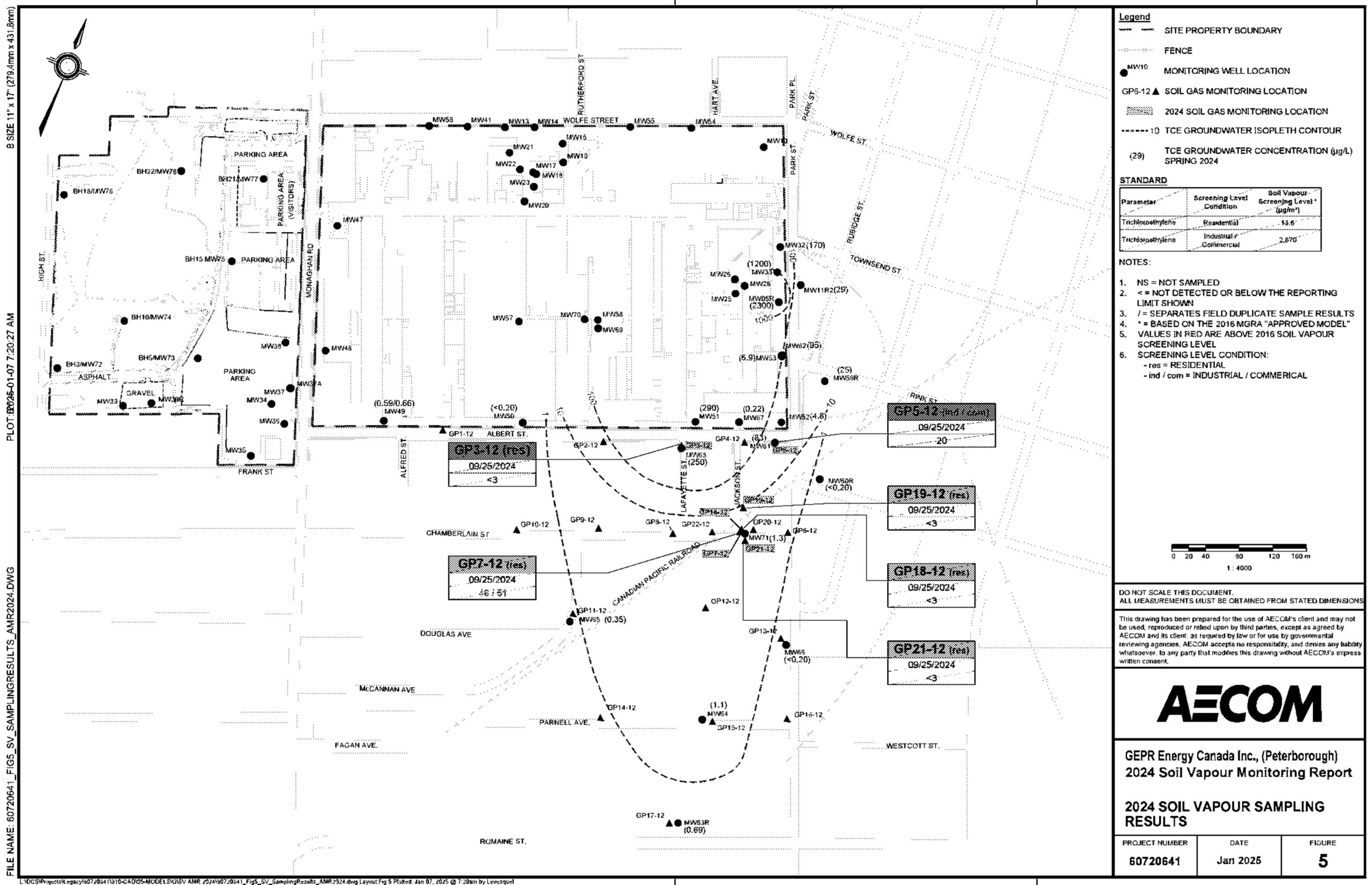
- CRA determined that a plume of contaminants in the groundwater extended south from the GE plant to between Parnell Avenue and Romaine Street.
- CRA modelled the horizontal migration of contaminants in the shallow silty sand unit (unconfined aquifer) from GE’s property to the south, southeast. A city sanitary sewer along Park Street impeded the migration of contaminants to the east. The underlying silty clay unit (aquitard) restricted the vertical migration of contaminants.
- CRA identified Building 12 as the main “source area” of TCE.
- Site Specific Risk Assessment (SSRA)
- CRA began its risk assessment with reference to the clean-up criteria given in “Table 3: Full Depth Generic Site Condition Standards in a Non-Potable Ground Water Condition” of the Soils, Ground Water and Sediment Standards under Part XV.1 of the Environmental Protection Act.
- CRA completed a “Site Specific Risk Assessment” that proposed less stringent clean-up criteria for the groundwater that GE had contaminated.
- The Ministry accepted CRA’s less stringent clean-up criteria in 2002.
- Remediation Action Plan (RAP)
- A Groundwater Extraction and Treatment System (GETS), comprising seven extraction wells and an air stripper, was installed along the GE property’s southern boundary on Albert Street.
- The GETS was meant to provide “hydraulic control” – that is, to minimize the further migration of contaminants from GE into the groundwater. The GETS was not designed to “pull back” contaminants that had already migrated from GE’s property.
- The remediation of groundwater that had already been contaminated would depend solely on “Monitored Natural Attenuation” (MNA).
- The Ministry accepted CRA’s Remediation Action Plan in 2001.
Figure 1 presents a recent depiction of the plume of VOCs in Peterborough’s groundwater from AECOM/GE’s 2024 Soil Vapour Monitoring Report that the Canadian Environmental Law Association (CELA) obtained from the Ministry. In a later post, we will detail what we know – and don’t know – about GE’s contamination of Peterborough’s groundwater.
Right now, we want to examine the Ministry’s acceptance of the clean-up criteria for GE’s contamination of Peterborough’s groundwater that CRA had put forward in its Site Specific Risk Assessment (March 2002).
Under Part XV.1 of Ontario’s Environmental Protection Act, the Ministry has established standards for prescribed contaminants of groundwater under multiple combinations of conditions, including:
- Soil Texture (coarse vs medium/fine)
- Overburden Thickness (full depth vs shallow)
- Land Use (residential/parkland/institutional vs industrial/commercial/community)
- Groundwater Potability (potable vs non-potable)
A property is said to be meet Ministry standards provided that no prescribed contaminant is present in its groundwater at a concentration that exceeds applicable standards.
With respect to GE’s property, a Ministry hydrogeologist has reported that CRA derived its cleanup criteria from Table 3: Full Depth Generic Site Condition Standards in a Non-Potable Ground Water Condition, though the hydrogeologist goes on to note that “CRA state that they undertook a Site Specific Risk Assessment and determined … groundwater site specific risk based cleanup criteria. CRA state that the Ministry concurred (2002) with the site specific risk based cleanup criteria.”3Memorandum of F. Crossley, Hydrogeologist, April 23, 2015, p. 4. Source: Director’s Order GE-PTBO-DO001FA, December 10, 2018, Appendix D.
Our Table 1 presents CRA’s GE-specific cleanup criteria alongside the Ministry’s standard cleanup criteria for the contaminants of concern found in the groundwater south of the GE.
Table 1: Standard vs GE-Specific Cleanup Criteria for Contaminated Groundwater
| Prescribed Contaminant | Standard Cleanup Criteria for Groundwater (µg ⁄ L) |
GE-Specific Cleanup Criteria for Groundwater (µg ⁄ L) |
Maximum Concentration (GE-Specific vs Standard Criteria) |
| Tetrachloroethylene (PCE) | 1.6 | 1,060 | 662.5 |
| Trichloroethylene (TCE) | 1.6 | 1,098 | 686.3 |
| Dichloroethylene, 1,1 (1,1-DCE) | 1.6 | 3 | 1.9 |
| Dichloroethylene, 1,2 cis (cis-1,2-DCE) | 1.6 | 1,617 | 1,010.6 |
| Dichloroethylene, 1,2 trans (trans-1,2-DCE) | 1.6 | no criterion | undefined |
| Vinyl Chloride | 0.5 | 1.5 | 3.0 |
Observe that the Ministry has adopted CRA’s criteria for cleaning up the groundwater contaminated by GE that are far more permissible than the Ministry’s standard cleanup criteria. For example, the GE-specific maximum concentration of TCE in groundwater is 683.3 (1,098/1.6) times greater than the Ministry’s standard maximum concentration of TCE in groundwater.
- Why did the Ministry adopt CRA’s far less stringent criteria for cleaning up the groundwater contaminated by GE?
- What additional risks do residential and commercial properties south of GE face from upward soil vapour migration of TCE and other VOCs, given the Ministry’s having adopted CRA’s far less stringent cleanup criteria?
- If the Ministry were to apply the standard cleanup criteria to the contaminated groundwater south of GE, how would GE’s Groundwater Extraction and Treatment System need to be improved?
- GE’s Groundwater Extraction and Treatment System aims to minimize the further migration of TCE and other VOCs into the neighbourhood – not to reduce the concentration of contaminants that have already escaped from GE’s property. What other measures would need to included in GE’s Remediation Action Plan to reduce the concentration of contaminants, beyond what “natural attenuation” is slowly accomplishing?
Good Neighbours Deserve Answers.
Licence
We are publishing this material under a Creative Commons Attribution-NonCommercial-ShareAlike 4.0 International licence. If you find use for our work, please credit Paul Allen (https://paulallen.ca).
- 1(1) Remedial Action Plan for Trichloroethene Groundwater Concentrations, GE Industrial Systems Facility, Peterborough, Ontario. Conestoga-Rovers & Associates, May 22, 2001. (2) Site-Specific Risk Assessment, GE Industrial Systems Facility, Peterborough, Ontario. Conestoga-Rovers & Associates, March 1, 2002. (3) Perimeter Groundwater Extraction and Treatment System Pilot Study Interim Report, GE Industrial Systems Facility, Peterborough, Ontario. Conestoga-Rovers & Associates, August 8, 2003. (4) Perimeter Groundwater Extraction and Treatment System Pilot Study Final Report, GE Industrial Systems Facility, Peterborough, Ontario. Conestoga-Rovers & Associates, February 26, 2004. ↩︎
- 2Memorandum of F. Crossley, Hydrogeologist, April 23, 2015, p. 6. Source: Director’s Order GE-PTBO-DO001FA, December 10, 2018, Appendix D. ↩︎
- 3Memorandum of F. Crossley, Hydrogeologist, April 23, 2015, p. 4. Source: Director’s Order GE-PTBO-DO001FA, December 10, 2018, Appendix D. ↩︎
Leave a Reply