Category: Environmental Protection Act

  • Questions about GE’s Private Stormwater System

    On this page

    Applying Ontario’s Environmental Protection Act to GE

    In 2024, the Ministry of the Environment, Conservation and Parks (MECP) used four (partially overlapping) instruments under Ontario’s Environmental Protection Act (1990) to regulate GEPR Energy Canada’s (GE’s) properties in Peterborough, ON:

    1. Director’s Order GE-PTBO-DO001FA, dated December 10, 2018; revoked March 2024 and replaced by:
    2. Director’s Order 1-228916698, dated March 6, 2024
    3. Director’s Instructions for Interim PCB Waste Management — Monaghan Road, dated June 21, 1995; revoked May 2024 and replaced by Director’s Order 1-228916698, Appendix A: Requirements for the In-Situ Management of PCB-impacted Soils at the Monaghan Road Parking Lot on Site 2
    4. ECA 8032-BEJNAK, dated September 30, 2019.

    Director’s Order 1-228916698 applies to two Sites on GE’s properties:

    • “Site 1” means the property with two municipal addresses of 107 Park Street and 1160 Monaghan Road, Peterborough, ON with the following Property Identifier Number 28081-0123.
    • “Site 2” means the property with two municipal addresses of 1063 and 1091 Monaghan Road, Peterborough, ON with the following Property Identifier Number 28067-0046.

    Director’s Order GE-PTBO-DO001FA, dated December 10, 2018, covered two additional GE properties, until March 6, 2024:

    • “Site 3” means the property located at 297 Rink Street, Peterborough, ON with the following Property Identifier Number 28091-0139.
    • “Site 4” means the property located at 107 Rubidge Street, Peterborough, ON with the following Property Identifier Number 28091-0137.

    Director’s Instructions for Interim PCB Waste Management – Monaghan Road covered Site 2, until May 8, 2024.

    The MECP agreed to GE’s request that Site 3 and Site 4 be excluded from Director’s Order 1-228916698.1“On March 16, 2023, GEPR requested that Site 3 and Site 4 be removed from this Director’s Order. Those two properties were included in the previous order as there are monitoring wells located on them that are part of the Site monitoring program. However, the monitoring wells are being replaced with new monitoring wells to be located on adjacent off-property locations by GEPR, which is acceptable to the Ministry, and therefore it is appropriate to remove them as reflected in this Order.” Ministry of the Environment, Conservation and Parks, Director’s Order 1-228916698, March 6, 2024, p. 6. The 2024 PCB Monitoring Report for Stormwater and Groundwater prepared by GE’s consultant, AECOM Canada ULC (AECOM), included findings for Site 3 and Site 4 per Director’s Order GE-PTBO-DO001FA, and findings for Site 2 per the 1995 Director’s Instructions.
    [top]

    Monitoring PCBs in GE’s Groundwater and Stormwater

    Director’s Order 1-228916698 identifies polychlorinated biphenyls (PCBs) as one of two primary contaminants of concern associated with Site 1 and Site 2 – the other being trichloroethylene (TCE) and its degradation compounds, such as dichloroethylene and vinyl chloride:

    The main concern regarding potential off-site environmental impacts associated with the PCB contamination at the Site is for PCB molecules to be transported off-site via water discharges into the municipal storm water sewer system which flows eastward along Rink Street and discharges into Little Lake and the Otonabee River.

    Little Lake and the Otonabee River also subject to recreational water activities, and exposure to PCB contaminated waters and sediment may represent a human health risk. PCBs also transfer up the ecological food chain to other aquatic, terrestrial and avian species within which the contaminants may bioaccumulate and result in ecological impacts. As such, further inputs of PCBs to Little Lake and the Otonabee River system should be mitigated.

    Various studies have shown that deposits of PCB contaminated sediments are present in Little Lake and further downstream along the Otonabee River and in Rice Lake, which the Otonabee flows into, located approximately 20 kilometres south of the City of Peterborough.

    Studies have shown that PCBs are present within the tissues of sport fish collected from the Otonabee River and Rice Lake at concentrations that have caused fish consumption advisories to be issued and which should be followed for the protection of human health; refer to the MECP’s online ‘Guide to Eating Ontario Fish’. The Hiawatha First Nation community is located on the north shore of Rice Lake and community members, as well as other sport fishers, consume fish from the lake. …

    In regard to the PCB storm water sewers (water and sediment) and groundwater monitoring programs, MECP Eastern Region Technical Support Section reviews annual monitoring reports and provides comments that are reviewed with GEPR to guide further monitoring activities and site management actions. The reviews to date have recommended continuation of the ongoing monitoring program.

    Considering the long-term and wide-spread nature of the PCB contamination at the Site, and the ongoing instances of PCB contaminant concentrations in storm water discharges from the Site, it is expected that the PCB monitoring program will continue to be required of GEPR for many years to monitor the effectiveness of its actions to control, prevent and mitigate PCB discharges from the Site to the natural environment.2Ministry of the Environment, Conservation and Parks, Director’s Order 1-228916698, March 6, 2024, pp. 8, 11.

    Details of GE’s program for monitoring PCBs in the groundwater and stormwater include:3See Director’s Order 1-228916698, Appendix B, Table 1: Groundwater Monitoring and Sampling Program, Table 3: Storm Sewer Monitoring Program, Figure 1A: Groundwater Monitoring and Sampling Location PCB at Facility,  Figure 1B: Groundwater Monitoring and Sampling Location PCB at Monaghan Road Parking Lot, and Figure 3: Storm Water Monitoring Locations.

    • Groundwater monitoring
      • Site 1: 3 monitoring wells
      • Site 2: 7 monitorong wells
      • Monitoring wells are sampled for Total PCB one time per year in the spring.
      • Monitoring includes measuring groundwater levels.
    • Stormwater monitoring
      • Site 1: 13 outfalls
      • Site 2: 4 outfalls
      • City of Peterborough: 5 manholes
      • Little Lake: sample taken 15 m from culvert inlet
      • Most storm sewer outfalls, including 3 City of Peterborough storm sewer manholes, are sampled three times per year during or immediately following a rain event (10 mm).
      • City of Peterborough manhole (MH135703), located near the intersection of George and Rink Streets, is sampled six times per year.
      • Where present, stormwater will be sampled for Total PCB (including Aroclors) and Total Suspended Solids (TSS).
      • Where present, sediment will be sampled for Total PCB and TSS and its thickness measured.

    [top]

    Questions about GE’s Private Stormwater System

    AECOM’s documentation of its monitoring of PCB raises a critical question about whether GE’s private stormwater system somehow connects to the City’s public stormwater system.

    On the one hand, AECOM’s 2024 PCB Monitoring Report for Stormwater and Groundwater  (Appendix K: Storm Sewer Data Summary) makes no mention of any connection between the two systems. AECOM usually remarks that the run-off of rainwater from different Zones of GE’s properties “feeds” or “flows toward” the City’s stormwater system:

    • Zone 1 “feeds the municipal storm sewer [STM.MH136551] on Wolfe Street, located north of the Site [1]”
    • Zone 2 “feeds the municipal storm sewer [STM.MH135683] on Park Street, located east of the Site [1]”
    • Zone 3 “feeds the municipal storm sewer on Albert Street. located south of the Site [1] … all of which flow towards City storm sewer MH135686”
    • Zone 4 “feeds the municipal storm sewers on Monaghan Road and Frank Street, located east and south of the Monaghan Road Property [Site 2]”
    • Zone 5 “feeds the municipal storm sewer on Monaghan Road [Site 2] … Some of the surface water from this area flows overland toward city CBs located on Monaghan Road. In 2016, MH166902 was established as the outfall monitoring location for Zone 5 … [and] collects stormwater drainage from Zone 5 and parts of Monaghan Road”
    • Zone 6 “feeds the municipal storm sewer on Rubidge and Townsend Street [Site 4] … All the water flows toward the STM.MH135686”
    • Zone 7 feeds the municipal storm sewer on Rubidge Street [Site 3] … All the water flows toward the STM.MH135686″

    On the other hand, AECOM’s Storm Sewer Monitoring Program seems to indicate that 15 of the 17 outfalls from Site 1 and Site 2 actually connect to the City’s stormwater system. AECOM puts asterisks beside two outfalls (CBR140 and CBR142) in Table 3 to indicate “Catch basin not connected to City storm sewer system. These locations will be monitored but will not be considered representative of storm water outfall from Site.”4Director’s Order 1-228916698, Appendix B, Table 3: Storm Sewer Monitoring Program.

    The question of whether GE’s private stormwater system connects to Peterborough’s public stormwater system seems critical to evaluating the efficacy of GE’s program for monitoring PCB in the stormwater. Accordingly, I have sought clarification from the Director, Peterborough District Office, MECP.

    According to AECOM’s 2024 PCB Monitoring Report for Stormwater and Groundwater, GE’s private stormwater system includes at least 162 catchbasins and manholes at Site 1 and Site 2 [p. ii]. AECOM’s maps of the Zones/Catchment Areas/Sub-catchment Areas associated with Site 1 and Site 2 in Appendix K refer to multiple features of GE’s stormwater system, including:

    • Storm Sewer Catchbasin
    • Decommissioned Storm Sewer Catchbasin
    • Storm Sewer Catchbasin – Below Water Table
    • Storm Sewer Manhole
    • Storm Sewer Manhole – Below Water Table
    • Storm Sewer – Below Water Table
    • Storm Sewer System (Underground)
    • Storm Sewer System (Overhead)
    • Inspected Sewer Pipe
    • Damaged Sewer Pipe
    • Jellyfish System

    The MECP has provided low-resolution, grayscale copies of these maps to the Canadian Environmental Law Association. Unfortunately, these images obscure many of features of GE’s stormwater system. I have asked the Director, Peterborough District Office, MECP for help in obtaining the higher-resolution, colour images copies of AECOM’s original submission of Appendix K.

    Findings

    Forthcoming.

    [top]

    Licence

    We are publishing this material under a Creative Commons Attribution-NonCommercial-ShareAlike 4.0 International licence.
    CC BY-NC: Attribution-NonCommercial 4.0

    [top]

    • 1
      “On March 16, 2023, GEPR requested that Site 3 and Site 4 be removed from this Director’s Order. Those two properties were included in the previous order as there are monitoring wells located on them that are part of the Site monitoring program. However, the monitoring wells are being replaced with new monitoring wells to be located on adjacent off-property locations by GEPR, which is acceptable to the Ministry, and therefore it is appropriate to remove them as reflected in this Order.” Ministry of the Environment, Conservation and Parks, Director’s Order 1-228916698, March 6, 2024, p. 6. ↩︎
    • 2
      Ministry of the Environment, Conservation and Parks, Director’s Order 1-228916698, March 6, 2024, pp. 8, 11. ↩︎
    • 3
      See Director’s Order 1-228916698, Appendix B, Table 1: Groundwater Monitoring and Sampling Program, Table 3: Storm Sewer Monitoring Program, Figure 1A: Groundwater Monitoring and Sampling Location PCB at Facility,  Figure 1B: Groundwater Monitoring and Sampling Location PCB at Monaghan Road Parking Lot, and Figure 3: Storm Water Monitoring Locations. ↩︎
    • 4
      Director’s Order 1-228916698, Appendix B, Table 3: Storm Sewer Monitoring Program. ↩︎
  • Why has the Ministry adopted far less stringent criteria for cleaning up GE’s contamination of the groundwater

    After 20 years of what the Ministry of the Environment (Ministry) has termed General Electric’s “voluntary” monitoring and remediation of contaminants associated with its operations in Peterborough, something triggered the engagement of Conestoga-Rovers & Associates (CRA) to conduct further studies. Perhaps the trigger was the Environmental Protection Agency’s holding GE accountable for contaminating multiple sites across the United States or the Ministry’s own findings of the contamination of Little Lake, the Otonabee River, and Rice Lake.

    Whatever the trigger, between 2001 – 04, CRA issued four reports that:1(1) Remedial Action Plan for Trichloroethene Groundwater Concentrations, GE Industrial Systems Facility, Peterborough, Ontario. Conestoga-Rovers & Associates, May 22, 2001. (2) Site-Specific Risk Assessment, GE Industrial Systems Facility, Peterborough, Ontario. Conestoga-Rovers & Associates, March 1, 2002. (3) Perimeter Groundwater Extraction and Treatment System Pilot Study Interim Report, GE Industrial Systems Facility, Peterborough, Ontario. Conestoga-Rovers & Associates, August 8, 2003. (4) Perimeter Groundwater Extraction and Treatment System Pilot Study Final Report, GE Industrial Systems Facility, Peterborough, Ontario. Conestoga-Rovers & Associates, February 26, 2004.:

    1. Surveyed the geology and hydrogeology in GE’s vicinity.
    2. Delineated the migration of Volatile Organic Compounds (VOCs) like trichloroethylene (TCE), from GE’s property into Peterborough’s groundwater.
    3. Summarized the results of its Site Specific Risk Assessment (SSRA).
    4. Prepared a Remediation Action Plan (RAP), including the installation of a Groundwater Extraction and Treatment System (GETS).

    We are awaiting the Ministy’s response to our FIPPA request for the release of CRA’s initial reports.

    Meanwhile, we will rely on a Ministry hydrogeologist’s account of CRA’s key findings:2Memorandum of F. Crossley, Hydrogeologist, April 23, 2015, p. 6. Source: Director’s Order GE-PTBO-DO001FA, December 10, 2018, Appendix D.

    1. Geology and hydrogeology
      1. The geology in GE’s vicinity consists of a silty sand and gravel unit varying from 2 – 10 metres in thickness below ground surface, on top of a silty clay unit about 18 metres in thickness.
      2. The groundwater was at about 2-3 metres below ground surface.
    2. Migration of contaminants
      1. Contaminants of concern were determined to be TCE and its breakdown products, like dichloroethylenes (DCE’s) and vinyl chloride (VC).
      2. CRA determined that a plume of contaminants in the groundwater extended south from the GE plant to between Parnell Avenue and Romaine Street.
      3. CRA modelled the horizontal migration of contaminants in the shallow silty sand unit (unconfined aquifer) from GE’s property to the south, southeast. A city sanitary sewer along Park Street impeded the migration of contaminants to the east. The underlying silty clay unit (aquitard) restricted the vertical migration of contaminants.
      4. CRA identified Building 12 as the main “source area” of TCE.
    3. Site Specific Risk Assessment (SSRA)
      1. CRA began its risk assessment with reference to the clean-up criteria given in “Table 3: Full Depth Generic Site Condition Standards in a Non-Potable Ground Water Condition” of the Soils, Ground Water and Sediment Standards under Part XV.1 of the Environmental Protection Act.
      2. CRA completed a “Site Specific Risk Assessment” that proposed less stringent clean-up criteria for the groundwater that GE had contaminated.
      3. The Ministry accepted CRA’s less stringent clean-up criteria in 2002.
    4. Remediation Action Plan (RAP)
      1. A Groundwater Extraction and Treatment System (GETS), comprising seven extraction wells and an air stripper, was installed along the GE property’s southern boundary on Albert Street.
      2. The GETS was meant to provide “hydraulic control” – that is, to minimize the further migration of contaminants from GE into the groundwater. The GETS was not designed to “pull back” contaminants that had already migrated from GE’s property.
      3. The remediation of groundwater that had already been contaminated would depend solely on “Monitored Natural Attenuation” (MNA).
      4. The Ministry accepted CRA’s Remediation Action Plan in 2001.

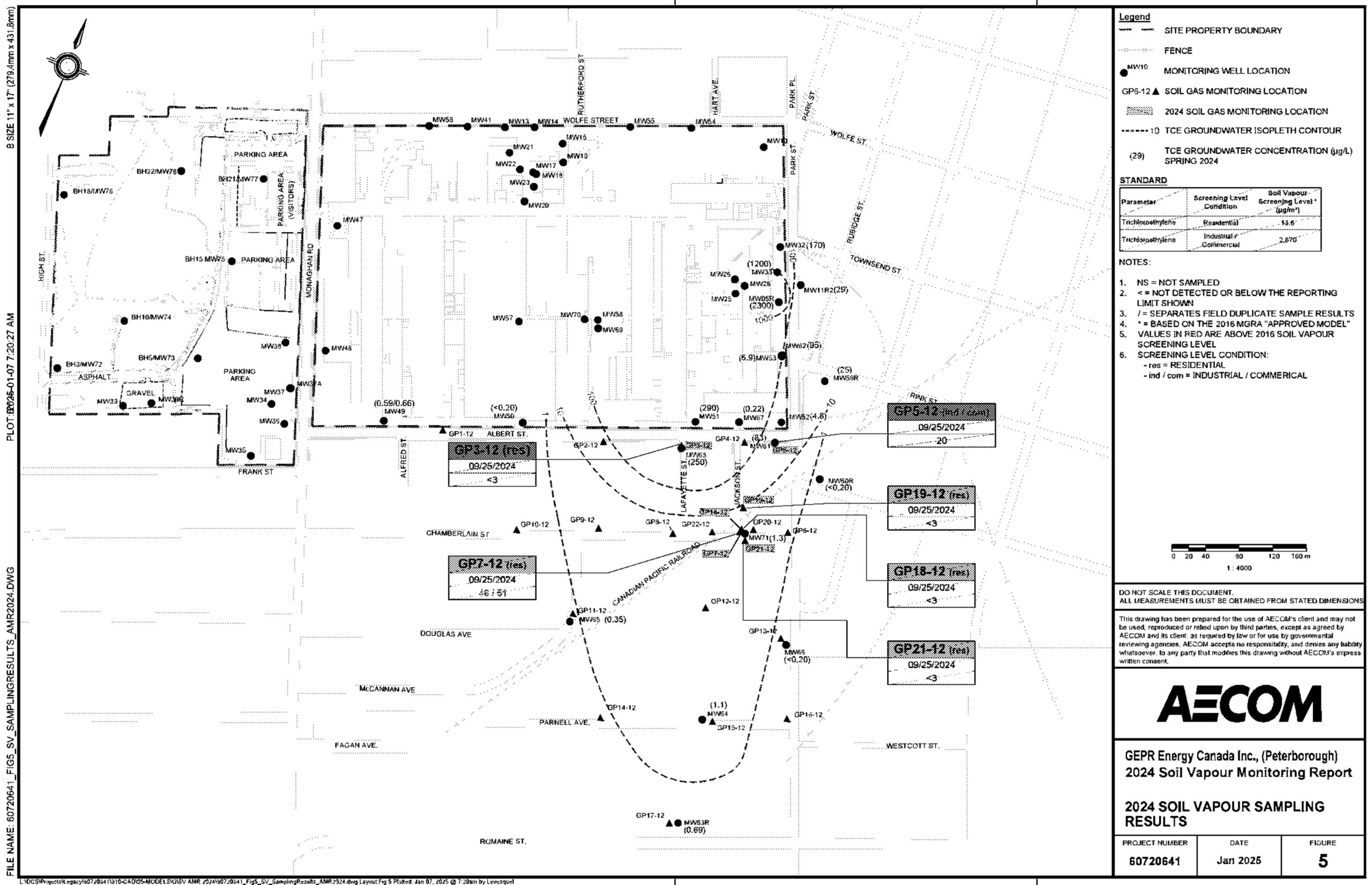
    Figure 1 presents a recent depiction of the plume of VOCs in Peterborough’s groundwater from AECOM/GE’s 2024 Soil Vapour Monitoring Report that the Canadian Environmental Law Association (CELA) obtained from the Ministry. In a later post, we will detail what we know – and don’t know – about GE’s contamination of Peterborough’s groundwater.

    Figure 1. Isopleth contour of plume of TCE in the groundwater south/southeast of GE’s property. Source: “Figure 5: 2024 Soil Vapour Sampling Results,” AECOM/GE, 2024 Soil Vapour Monitoring Report, February 2025.

    Right now, we want to examine the Ministry’s acceptance of the clean-up criteria for GE’s contamination of Peterborough’s groundwater that CRA had put forward in its Site Specific Risk Assessment (March 2002).

    Under Part XV.1 of Ontario’s Environmental Protection Act, the Ministry has established standards for prescribed contaminants of groundwater under multiple combinations of conditions, including:

    • Soil Texture (coarse vs medium/fine)
    • Overburden Thickness (full depth vs shallow)
    • Land Use (residential/parkland/institutional vs industrial/commercial/community)
    • Groundwater Potability (potable vs non-potable)

    A property is said to be meet Ministry standards provided that no prescribed contaminant is present in its groundwater at a concentration that exceeds applicable standards.

    With respect to GE’s property, a Ministry hydrogeologist has reported that CRA derived its cleanup criteria from Table 3: Full Depth Generic Site Condition Standards in a Non-Potable Ground Water Condition, though the hydrogeologist goes on to note that “CRA state that they undertook a Site Specific Risk Assessment and determined … groundwater site specific risk based cleanup criteria. CRA state that the Ministry concurred (2002) with the site specific risk based cleanup criteria.”3Memorandum of F. Crossley, Hydrogeologist, April 23, 2015, p. 4. Source: Director’s Order GE-PTBO-DO001FA, December 10, 2018, Appendix D.

    Our Table 1 presents CRA’s GE-specific cleanup criteria alongside the Ministry’s standard cleanup criteria for the contaminants of concern found in the groundwater south of the GE.

    Table 1: Standard vs GE-Specific Cleanup Criteria for Contaminated Groundwater

    Prescribed Contaminant Standard Cleanup Criteria
    for Groundwater
    (µg ⁄ L)
    GE-Specific Cleanup Criteria
    for Groundwater
    (µg ⁄ L)
    Maximum Concentration
    (GE-Specific vs Standard Criteria)
    Tetrachloroethylene (PCE) 1.6 1,060 662.5
    Trichloroethylene (TCE) 1.6 1,098 686.3
    Dichloroethylene, 1,1 (1,1-DCE) 1.6 3 1.9
    Dichloroethylene, 1,2 cis (cis-1,2-DCE) 1.6 1,617 1,010.6
    Dichloroethylene, 1,2 trans (trans-1,2-DCE) 1.6 no criterion undefined
    Vinyl Chloride 0.5 1.5 3.0

    Observe that the Ministry has adopted CRA’s criteria for cleaning up the groundwater contaminated by GE that are far more permissible than the Ministry’s standard cleanup criteria. For example, the GE-specific maximum concentration of TCE in groundwater is 683.3 (1,098/1.6) times greater than the Ministry’s standard maximum concentration of TCE in groundwater.

    1. Why did the Ministry adopt CRA’s far less stringent criteria for cleaning up the groundwater contaminated by GE?
    2. What additional risks do residential and commercial properties south of GE face from upward soil vapour migration of TCE and other VOCs, given the Ministry’s having adopted CRA’s far less stringent cleanup criteria?
    3. If the Ministry were to apply the standard cleanup criteria to the contaminated groundwater south of GE, how would GE’s Groundwater Extraction and Treatment System need to be improved?
    4. GE’s Groundwater Extraction and Treatment System aims to minimize the further migration of TCE and other VOCs into the neighbourhood – not to reduce the concentration of contaminants that have already escaped from GE’s property. What other measures would need to included in GE’s Remediation Action Plan to reduce the concentration of contaminants, beyond what “natural attenuation” is slowly accomplishing?

    Good Neighbours Deserve Answers.

    Licence

    We are publishing this material under a Creative Commons Attribution-NonCommercial-ShareAlike 4.0 International licence. If you find use for our work, please credit Paul Allen (https://paulallen.ca).

    CC BY-NC: Attribution-NonCommercial 4.0

    • 1
      (1) Remedial Action Plan for Trichloroethene Groundwater Concentrations, GE Industrial Systems Facility, Peterborough, Ontario. Conestoga-Rovers & Associates, May 22, 2001. (2) Site-Specific Risk Assessment, GE Industrial Systems Facility, Peterborough, Ontario. Conestoga-Rovers & Associates, March 1, 2002. (3) Perimeter Groundwater Extraction and Treatment System Pilot Study Interim Report, GE Industrial Systems Facility, Peterborough, Ontario. Conestoga-Rovers & Associates, August 8, 2003. (4) Perimeter Groundwater Extraction and Treatment System Pilot Study Final Report, GE Industrial Systems Facility, Peterborough, Ontario. Conestoga-Rovers & Associates, February 26, 2004. ↩︎
    • 2
      Memorandum of F. Crossley, Hydrogeologist, April 23, 2015, p. 6. Source: Director’s Order GE-PTBO-DO001FA, December 10, 2018, Appendix D. ↩︎
    • 3
      Memorandum of F. Crossley, Hydrogeologist, April 23, 2015, p. 4. Source: Director’s Order GE-PTBO-DO001FA, December 10, 2018, Appendix D. ↩︎
  • Why did the Ministry give up authority over GE’s contamination of its Monaghan Road Parkng Lot with PCBs?

    On this page

    Background

    On June 21, 1995, the Ministry of Environment and Energy (Ministry) issued Director’s Instructions to General Electric that accorded with GE’s own proposals for the interim in-situ management of PCB waste at GE’s Monaghan Road Parking Lot.

    The Director’s Instructions included these provisions:

    1. On annual basis, GE will conduct a “review of commercially available and financially feasible destruction or disposal methods for the PCB materials stored at the interim PCB waste management area.” [provision 4]
    2. In an Annual Report, GE will summarize the results of its review of these methods to the Ministry. [provision 4]
    3. In its Annual Report, GE will provide details justifying the continuation of the use of the interim PCB waste management area to the Ministry. [provision 6]
    4. Once a destruction method becomes commercially available for the destruction of all PCB material located at the interim PCB waste management area, GE will provide a timetable for this destruction to the Ministry within six months. [provision 6]

    On March 6, 2024, the Ministry issued Director’s Order 1-228916698. The Director’s Order replaced the Director’s Instructions of 1995 and eliminated – with no explanation – any provision in the Director’s Instructions for GE someday destroying or disposing of PCB waste at the Monaghan Road Parking Lot.

    Questions for the Ministry

    1. Under the terms of the Director’s Instructions of June 1995,
      1. What methods had GE reviewed annually for destroying or disposing of the PCB waste at its Monaghan Road Parking Lot?
      2. What results of these reviews had GE included in its Annual Reports on its ground and surface water monitoring program?
      3. What justifications for continuing to maintain PCB waste at its Monaghan Road Parking Lot had GE included in these Annual Reports?
    2. In the Ministry’s opinion,
      1. What methods are currently available for destroying or disposing of the PCB waste at GE’s Monaghan Road Parking Lot?
      2. Are any of these methods financially feasible for GE?
    3. Will the Ministry reinstate the provisions in the Director’s Instructions for GE someday destroying or disposing of PCB waste at its Monaghan Road Parking Lot?

    See my correspondence with David Bradley, Director, Peterborough Distict Office, MECP and Dave Smith, MPP on September 17, 2026.

    Good Neighbours Deserve Answers.

    Ministry’s Response

    On October 13, 2026, the Ministry provided this response:

    “GE Vernova is responsible for determining available remediation options, including their technical applicability, commercial availability, and associated costs, relating to their management of on-site contaminants.

    “In August 2020, both a Human Health Risk Assessment and Ecological Risk Assessment were conducted by AECOM consulting on behalf of General Electric Canada for the 1063 Monaghan Road site. These assessments were undertaken using Risk Assessment considerations made under Ontario Regulation 153/04 [Records of Site Condition] under the Environmental Protection Act.

    “Based on the Risk Assessments, the ministry considers the current management practices at the site to be acceptable. As detailed by the Director’s Order, continued monitoring will be undertaken to confirm the ongoing effectiveness of the management strategy and to ensure risks remain appropriately mitigated.

    “Considering these findings, revocation of the Director’s Instructions, with continued oversight through the requirements of the Director’s Order, was considered the most appropriate regulatory approach and tool for the site at this time.”

    See the response from David Fisher, Supervisor (Acting) with the Ministry of the Environment, Conservation and Parks (MECP).

    It’s concerning that the MECP gave the public no opportunity to comment on AECOM’s Human Health Risk Assessment and Ecological Risk Assessment in 2020 before giving up authority over GE’s PCB contamination of the Monaghan Road Parking Lot.

    On October 19, 2026, the MECP acknowledged receipt of my FIPPA request for the following records: (1) AECOM’s Human Health Risk Assessment (August 2020) for GE’s 1063 Monaghan Road site; (2) AECOM’s Ecological Risk Assessment (August 2020) for GE’s 1063 Monaghan Road site; and (3) Any additional Human Health Assessment or Ecologicial Risk Assessment that AECOM conducted for GE’s other sites on Monaghan Road or Park Street North.

    See the MECP acknowledgement of my FIPPA request.

    Meanwhile, we may infer from Ontario Regulation 153/04 that

    • A qualified person has taken a sample of sediment, soil or ground water from the land or water on, in or under a property for the purpose of analysing the sample for a contaminant as part of a risk assessment. (s. 47(1) Analytical procedures), and
    • A qualified person has submitted a sample to a laboratory for analysis for a contaminant in accordance with the Analytical Protocol, unless the laboratory has obtained the written permission of the Director to use another analytical method for that contaminant. (s. 47(2) and s. 47(4))

    Ontario Regulation 153/o4 makes no mention of either “Human Health Risk Assessment” or “Ecological Risk Assessment” that the MECP’s response references. However, the Analytical Protocol, buried inside Ontario Regulation 153/04, includes seven references to publications of the Canadian Council of Ministers of the Environment, some of which point to .

    In turn, these references include:

    • One bibliographic reference:
      • “CCME – Canadian Council of Ministers of the Environment” (Acronyms, p. 6)
    • Three irrelevant references fo Petroleum Hydrocarbons:
      • “PHCs in soil and sediment E3421 Note: The analysis of petroleum hydrocarbons (PHCs) must be in accordance with the Canadian Council of Ministers of the Environment (CCME) method2, which is composed of both ‘prescriptive’ and ‘performance based’ elements” (p. 40)
      • “Canadian Council of Ministers of the Environment (CCME) “Reference Method for the Canada wide Standard for Petroleum Hydrocarbons (CWS-PHC) in Soil – Tier 1 Method.” (fn 2, p. 40)
      • “Canadian Council of Ministers of the Environment (CCME). Reference Method for the Canada wide Standard for Petroleum Hydrocarbons (CWS-PHC) in Soil – Tier 1 Method. 2001” (References, p. 103)
    • Three potentially relevant references:
      • “This protocol sets out the sample handling and storage requirements, analytical methods and method specific quality control and assurance procedures for laboratories established by recognized organizations: … Canadian Council of Ministers of the Environment (CCME)” (p. 12)
      • “The analytical methods described in this section derive from the following sources: … “Canadian Council of Ministers of the Environment (CCME). Guidance Manual for Environmental Characterisation in Support of Environmental and Human Health Risk; Volume IV: Compendium of Analytical Methods for Contaminated Sites (2015 release date TBD)” (p. 32)
      • “Canadian Council of Ministers of the Environment (CCME). Guidance Manual for Environmental Characterisation in Support of Environmental and Human Health Risk; Volume IV: Compendium of Analytical Methods for Contaminated Sites (2015 release date TBD)” (References, p. 103)

    The Canadian Council of Ministers of the Environment (CCME) addresses “Environmental Characterization in Support of Environmental and Human Health Risk” in four volumes:

    I will wait for the MECP’s response to my FIPPA request for AECOM’s Human Health Risk Assessment and Ecological Risk Assessment for GE’s 1063 Monaghan Road site (August 2020) before assessing AECOM’s assessments against the standards and methodologies set by the Canadian Council of Ministers of the Environment..

    Licence

    We are publishing this material under a Creative Commons Attribution-NonCommercial-ShareAlike 4.0 International licence. If you find use for our work, please credit Paul Allen (https://paulallen.ca).

    CC BY-NC: Attribution-NonCommercial 4.0