On this page
- Background
- GE’s Own Account of Prior Demolitions
- Early Demolitions (1988 – 2014)
- “Project Caribou” (2014 – 2015)
- GE’s Abandoned Plan to Demolish Its Smokestack (2020)
- Licence
Background
In September 2025, GE Vernova (formerly General Electric) submitted a Notice of Intent to the City of Peterborough to demolish 26 of 34 (or over three-quarters) of the buildings remaining at 107 Park Street North.
In its discussions of GE’s Notice in October 2025 and February 2026, Council heard that CGE had previously demolished several buildings and had been approved to demolish its Smokestack, but had not carried through with the demolition. Members of Council and public delegators offered some details about these events, but their accounts raised many questions.
On May 14, 2026, I submitted the following request for information to the City of Peterborough under the Municipal Freedom of Information and Protection of Privacy Act (MFIPPA):
“I am requesting all records pertaining to General Electric’s demolition and/or intention to demolish any of its buildings in Peterborough between January 1, 2010 and the present, including but not restricted to completed all relevant memos, briefs, minutes of meetings, analyses, and correspondence among representatives of the corporation, the municipal government, and the provincial government.”
[top]
GE’s Own Account of Prior Demolitions
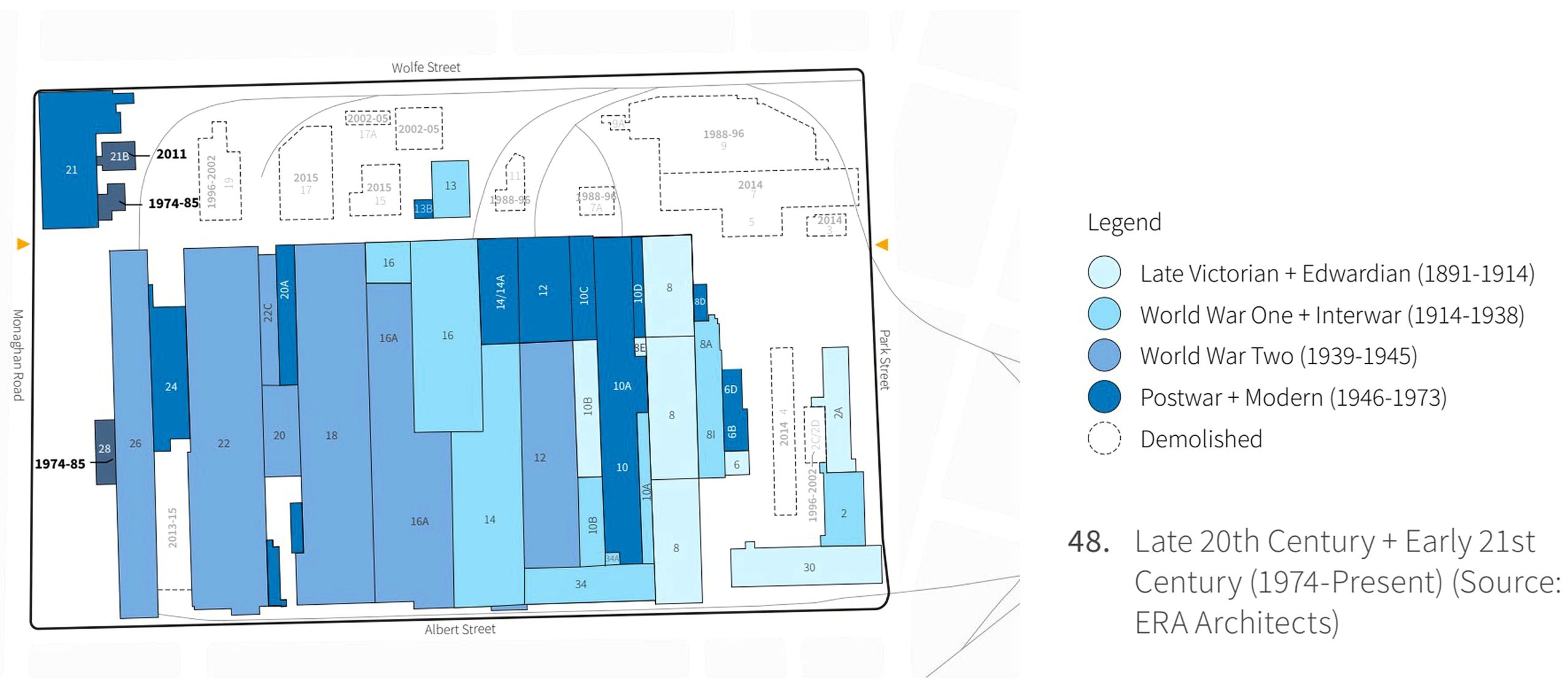
The Heritage Impact Assessment Report, prepared by ERA Architects on CGE’s behalf in September 2025, outlines the company’s prior demolitions at this site:
“Following the 1970s, operations at the Site began to slow incrementally. During the 1980s and 1990s, CGE underwent several rounds of downsizing, reflecting broader shifts in Canadian manufacturing processes. … This period was characterized by a reduction in operations and manufacturing output, and by the deconstruction of buildings rather than the construction of new facilities.
“In the early 2000s, [CGE] initiated further downsizing and consolidation of operations. Redundant buildings were removed, including Buildings 9, 11 and 19. In the 2010s, the complex underwent a significant retrofitting effort aimed at enhancing its competitiveness in international manufacturing markets. This initiative led to the demolitions of Buildings 3, 4, 5, 7, 15, 17 and 24.
“Some efforts were made to commemorate buildings that were demolished during this period. Notably, photographer Wayne Eardley conducted a photo-documentation project of the deconstruction, and the footprint of Building 4 was marked within the landscape to acknowledge its historical presence.”1ERA September 4, 2025, pp. 39-40.
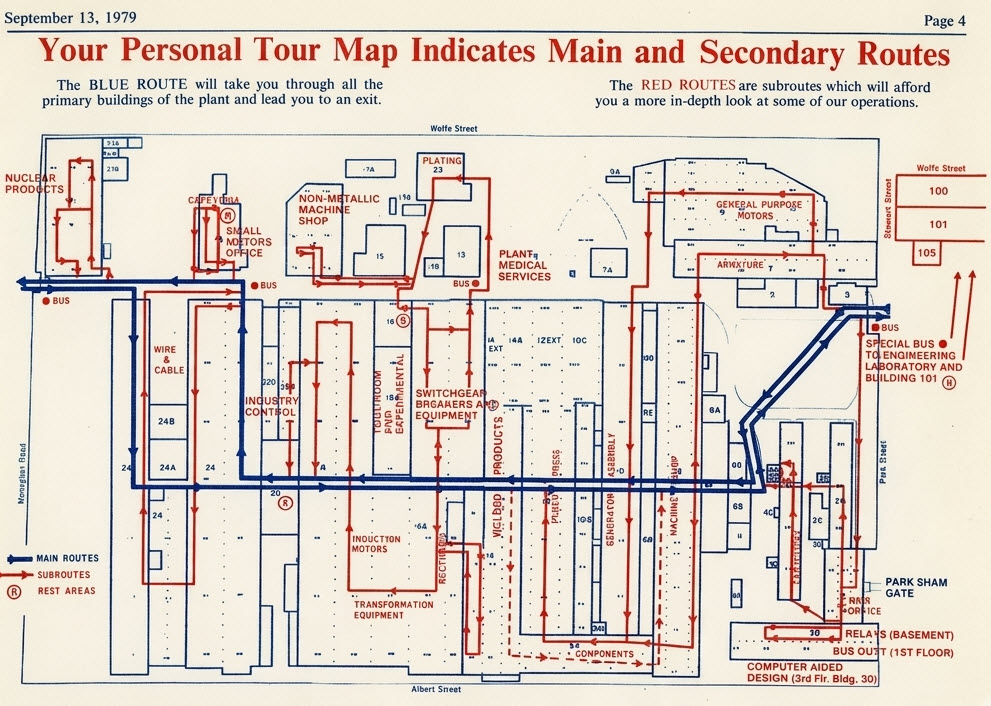
ERA’s Heritage Impact Assessment Report includes a map that dates more precisely the individual building demolitions (Figure 1a).2ERA, Heritage Impact Assessment Report, 2015, p. 40. Comparing ERA’s map with a CGE Tour Map from September 1979 (Figure 1b), we are able to date and identify CGE’s prior building demolitions (Table 1).
| Early Demolitions (1988 – 2014) |
||
| Date | Building | Function |
| 1988 – 1996 | 7A | Salvage Yard Depot* |
| 9 | General Purpose Motors (Fractional) | |
| 9A | Ditto | |
| 11 | Plant Medical Services | |
| 1996 – 2002 | 2C | Walkway. May have housed electrical grid to computer systems on the second floor of Building 2* |
| 2D | Stairwell providing access to the second floor of Building 2 and to the basement and third floor of Building 30* | |
| 19 | Small Motors Office & Cafeteria | |
| 2002 – 2005 | 17A | Steel (or Copper) Storage* |
| 23 | Plating | |
| 2013 – 2015 | 24 South Part | Formex (part) |
| “Project Caribou” – 2014 – 2015 |
||
| Date | Building | Function |
| 2014 | 3 | Human Resources* |
| 4 | Capacitors | |
| 5 | Coil Impregnation | |
| 7 | Armature | |
| 2015 | 15 | Paint & Chemicals Storage* |
| 17 | Non-metallic Machine Shop | |
NOTE: The identification of most buildings’ functions is based on the GE Tour Map (September 13, 1979). An asterisk is used to denote identifications that are based on personal commmunications with Sue James (2026).
[top]
Building 5 was part of 7 where they had the Asphalt impregnation processes (See Pg. 25 -28 of the Advisory Report)
Building 24S was the Formex department which was part of the Wire & Cable operations where they applied enamel coating to copper wire (See pg. 141 -142 of the Advisory Report)
Early Demolitions (1988 – 2014)
Besides ERA’s Heritage Impact Assessment Report, we have found little information about CGE’s demolition of buildings at 107 Park Street North, prior to 2014.
On July 27, 2026, I submitted a second MFIPPA request to the City of Peterborough for all records pertaining to Canadian General Electric’s demolition of buildings between January 1988 and December 2014, including but not restricted to all relevant memos, briefs, minutes of meetings, analyses, and correspondence among representatives of the corporation, the municipal government, and the provincial government. I am awaiting the City’s response.
[top]
“Project Caribou” (2014 – 2015)
“About 10 buildings, mostly standalones along the periphery of the one, massive industrial space, are being razed over the summer and replaced with green space and additional parking.” – Transformation of GE Canada plat, Peterborough Examiner, September 4, 2014.
“In 2014 and 2015, the company demolished five of its older surplus buildings as part of Project Caribou, a demolition project intended to reduce energy costs and streamline workflow at the factory.” – Peterborough county council requests information about proposed demolition of contaminated GE buildings, Kawartha Now, October 17, 2025.
ERA’s Heritage Impact Assessment Report is also a primary source of information about CGE’s next series of demolitions – demolitions that CGE branded “Project Caribou” and had memorialized by local photographer Wayne Eardley.
- 2016-05-07 – Peterborough Examiner – This is a greener General Electric Peterborough
- 2016-04-29 – Daily Commercial News – GE plant demo sparks Peterborough photography exhibit
- 2016-02-05 – Kawartha Now – Art on the Street – February 2016
- 2016-07-24 – Kawartha Now – Project Caribou: historic buildings of General Electric
- 2016-xx-xx – Art Gallery of Peterborough – Caribou II June 4, 2016 – September 4, 2016
- 2016-xx-xx – Art Gallery of Peterborough – Caribou I February 20, 2016 – May 22, 2016
- 2014-09-04 – Peterborough Examiner – News – Transformation at GE Canada plant
- 2014-06-14 – Peterborough Examiner – News – Underused GE buildings coming down
As noted above, the City of Peterborough has refused a request for information about its approval and oversight of CGE’s demolitions during “Project Caribou” and beyond. A complaint about the City’s refusal is before the Office of the Information and Privacy Commissioner of Ontario.
[top]
GE’s Abandoned Plan to Demolish Its Smokestack (2020)
GE Vernova’s plan to demolish 26 of 34 buildings that remain at 107 Park Street North was brought before Council in 2025 strictly as a concern about potential loss of heritage, not a concern about potential risk to public health. In similar fashion, Council’s deliberations over CGE’s plan to demolish its Smokestack in 2020 seemed to be warranted strictly by Council’s responsibility and authority to safeguard the property’s heritage value.
On August 27, 2018, the General Committee approved the Peterborough Architectural Conservation Advisory Committee (PACAC)’s recommendation that 107 Park Street North (former Canadian General Electric plant) be added to list of properties on the City’s Heritage Register. On September 10, 2018, City Council approved General Committee Report No. 20, General Committee meeting of August 27, 2018.
In September 2018, Council approved the recommendation of the Peterborough Architectural Conservation Advisory Committee (PACAC) that the CGE property at 107 Park Street North be added to the City’s Heritage Register (Table 2).3The property’s listing read “General Electric 107 Park Street N. The General Electric factory complex dates back to 1891 and is an integral part of Peterborough’s industrial heritage. Architecturally, the GE complex typifies late nineteenth and early-twentieth century factory design through its integration of late Victorian design features onto the exterior of its industrial spaces. The complex features work from a number of Ontario architects, including Walter Strickland, George Martel Miller, George Gouinlock, and John McIntosh Lyle.”
| City’s Addition of CGE to the Its Heritage Register | |||
| Body | Date | Documents | Remarks |
| Council | September 10, 2018 | Minutes | Council approves the General Committee’s recommendation that the property of the former CGE plant be listed on the City’s Heritage Register. |
| General Commitee | August 27, 2018 | Minutes
CSACH18-004 Addition of Properties to the Heritage RegisterCSACH18-004 Appendix A List of Properties |
General Committee approves the PACAC’s recommendation that the property of the former CGE plant be listed on the City’s Heritage Register. |
| Peterborough Architectural Conservation Advisory Committee (PACAC) | February 1, 2018 | Minutes
CSACH18-001 Addition of Properties to the Heritage Register CSACH18-001 Appendix A List of Properties |
PACAC recommends that the property of the former Canadian General Electric plant at 107 Park Street North be listed on the City’s Heritage Register. |
| Council’s Approval of CGE’s Demolition of Its Smokestack | |||
| Council | February 18, 2020 | Minutes
Report 3 of the General Committee, February 3, 2020 |
Council approved the General Committee’s recommendation that the smokestack on the former CGE property may be demolished. |
| General Committee | February 3, 2020 | Minutes
CSACH-20-001 Review of Demolition Proposal at 107 Park Street North |
General Committee approved the PACAC’s recommendation that the smokestack on the former CGE property may be demolished. |
| Peterborough Architectural Conservation Advisory Committee (PACAC) | January 7, 2020 | Minutes
PACAC20-006 Addition of Properties to the Heritage Register for 2020 PACAC-20-009 Application for Demolition – Portion of a Listed Property |
PACAC supported the staff recommendation from Heritage Resources that the smokestack on the former CGE property at 107 Park Street North may be demolished and that the rest of the CGE site remain a listed property on the City’s Heritage Registry. |
Pending the City’s release of information pertaining to GE’s plan to demolish its smokestack, we must rely on local newspaper reports and the proceedings of Council.
We located three stories publiished by the Peterborough Examiner:
- 2020-02-03 – Peterborough Examiner – News – General Electric smokestack demolition approved by city council
- 2020-01-30 – Peterborough Examiner – News – Demolition of landmark GE smokestack up for final approval Monday
- 2020-01-07 – Peterborough Examiner – News – Heritage committee backs removal of General Electric Peterborough smokestack
In fact, Council held only one substantial public discussion of GE’s plan to demolish its smokestack – and showed little interest in safeguarding the health and welfare of nearby residents.
Here is our transcript of the videorecording of the discussion at the Meeting of the General Committee on February 3, 2020:
Chair – Councillor Beamer [1:48:57]: 8A Review of demolition proposal 107 Park Street North. Ms. Mayor.
Mayor Therrien [1:49:02]: Just a quick question. Since it’s been topical lately, this site, and to allay any concerns in the community, once the demolition permit is issued, can you just speak to the process in which the demolition occurs, and how we ensure that any of the contaminants in the smokestack are dealt with? Can you just outline that, Mr. Hanson? I know it’s provincial, but if you could just elaborate a little bit on that, please.
Erik Hanson, Heritage Resources Coordinator [1:49:31]: Actually, I’m not qualified to answer that. Those are questions that would be put to the Ministry of the Environment and the Ministry of Labour. It’s not necessarily a Heritage issue.
Mayor Therrien [1:49:47]: Ok, but just to be clear though, the Ministry of the Environment and the Ministry of Labour come in and deal with these types of sites, when there is a demolition occurring.
Mr. Hanson [1:49:56]: Again, I think that might be a question for the Commissioner of Infrastructure.
Chair Beamer [1:50:06]: Mrs. Fletcher?
Cynthia Fletcher, Commissioner of Infrastructure and Planning Services [1:50:08]: When somebody comes in for a demolition permit, they have to demonstrate, the owner has to demonstrate, or the owner’s agent demonstrates, who’s going to be responsible for the actual work. They have to sign off and take responsibility for that work. It is our expectation, in issuing a demolition permit, that they would abide by all of the Ministry of Environment and all of the Ministry of Labour regulations and protocols. If there are issues, then we need to let our provincial regulatory bodies know. …
Chair Beamer [1:50:53]: Councillor Akapo.
Councillor Akapo [1:50:55]: Mr. Hanson, I read the report, and there’s nothing really in the report that speaks to why PACAC didn’t deem the stack to be heritage-worthy. So, I’m just wondering, if you could speak to how the conversation went, and how the decision came to us.
Mr. Hanson [1:51:22]: I think the discussion revolved around the fact that the smokestack is a later addition to the complex. It’s not one of the earlier buildings that relates more to the first generation of activities at CGE that surrounds the buildings closer to Park Street. It’s an ancillary building. It’s an ancillary structure to the powerhouse. It isn’t fundamental to understanding the overall history of the site. I think, in that way, the Heritage Committee felt that its loss didn’t compromise our understanding of the overall history of CGE and its role in the development of the city.
Councillor Akapo [1:51:13]: This is going a little bit off shoot here. Do you know how many smokestacks are left in the city approximately?
Mr. Hanson [1:52:23]: No, I don’t, although I think this may be one of the last large ones that are part of an industrial complex.
MOTION:
That Council approve the recommendation outlined in Report CSACH20-001, dated February 3, 2020, of the Commissioner of Community Services, as follows:
That, pursuant to the requirements of the Ontario Heritage Act as it pertains to properties listed on the City’s Heritage Register, the recommendation of the Peterborough Architectural Conservation Advisory Committee (PACAC) that the smokestack located at 107 Park Street N (former CGE plant) be approved for demolition.
CARRIED.
It’s stunning that Council so casually approved CGE’s plan to demolish its Smokestack in 2020 – with no serious consideration or debate about the demolition’s potential risk to public health and safety. Fortunately, CGE did not proceed with the demolition. I have heard a rumour that the Smokestack turned out to be too contaminated. I hope that the City’s response to requests for information, including for information about CGE’s plan to demolish its Smokestack, will shed light on the matter.
Finally, Council has already approved GE Vernova’s application to have 26 buildings at 107 Park Street North removed from the City’s Heritage Register. When GE eventually applies to the City for a permit to demolish these 26 buildings, on what authority will the City take up the matter?
[top]
Licence
We are publishing this material under a Creative Commons Attribution-NonCommercial-ShareAlike 4.0 International licence. If you find use for our work, please credit Paul Allen (https://paulallen.ca).
[top]
- 1ERA September 4, 2025, pp. 39-40. ↩︎
- 2ERA, Heritage Impact Assessment Report, 2015, p. 40. ↩︎
- 3The property’s listing read “General Electric 107 Park Street N. The General Electric factory complex dates back to 1891 and is an integral part of Peterborough’s industrial heritage. Architecturally, the GE complex typifies late nineteenth and early-twentieth century factory design through its integration of late Victorian design features onto the exterior of its industrial spaces. The complex features work from a number of Ontario architects, including Walter Strickland, George Martel Miller, George Gouinlock, and John McIntosh Lyle.” ↩︎